
TL;DR:
- Competitor analysis helps med spas price services competitively and identify unmet local demand.
- Regularly tracking metrics like reviews, search ranking, and social engagement informs strategic decisions.
- Ongoing competitor insights enable med spas to optimize marketing, service offerings, and reputation management.
Most med spa owners assume competitor analysis is something reserved for big corporate chains with dedicated research teams and six-figure budgets. That assumption is costing you clients. Whether you run a single-location boutique med spa or are scaling to a second site, understanding what your local competitors are doing well (and where they’re falling short) is one of the most direct paths to sharper pricing, stronger marketing, and a fuller appointment book. This article breaks down exactly what competitor analysis is, how to do it step by step, and how to turn what you learn into real business growth.
Table of Contents
- What is competitor analysis and why it matters for med spas
- The main steps in med spa competitor analysis
- Key metrics to track when analyzing med spa competitors
- Common mistakes to avoid in med spa competitor analysis
- How to turn competitor insights into real med spa growth
- What most med spas get wrong about competitor analysis
- Ready to outshine your competitors?
- Frequently asked questions
Key Takeaways
| Point | Details |
|---|---|
| Understand the value | Competitor analysis helps med spas discover new opportunities and avoid costly mistakes. |
| Follow a repeatable process | Structured steps make competitor research actionable for all med spa teams. |
| Track useful metrics | Focus on service menus, reviews, promotions, and local market presence for real impact. |
| Turn insights into actions | Apply competitor findings to improve your service, marketing, and client experience. |
What is competitor analysis and why it matters for med spas
Competitor analysis is the systematic process of identifying other med spas in your market and evaluating what they offer, how they present themselves, and how clients respond to them. It is not about copying what others do. It is about gathering enough intelligence to make smarter decisions for your own business.
For med spas specifically, this process touches nearly every part of your operation. It shapes how you price your injectables menu, how you position a new laser treatment, and how you decide to run a seasonal promotion. When you know that three competitors in your zip code offer Botox starting at $12 per unit and one is consistently pulling five-star reviews, you have real data to work with instead of gut instinct.
Ignoring your competitive landscape does not make your med spa unique. It just makes you less informed than the practice down the street.
Staying on top of marketing trends for med spas is much easier when you understand how your competitors are adapting. You start to see patterns: who is leaning into social media, who is investing in loyalty programs, and who is still relying on outdated email blasts.
Here are the top ways competitor analysis improves your decision-making:
- Pinpoints pricing gaps so you can position your services competitively without racing to the bottom
- Reveals service opportunities that local demand supports but no one near you is offering yet
- Highlights marketing tactics that are working for similar businesses in your area
- Exposes reputation weaknesses in your competitors that you can capitalize on
- Informs your branding by showing you how others are positioning themselves and where you can stand out
The main steps in med spa competitor analysis
Knowing you should analyze competitors and knowing how to do it are two very different things. Here is a clear, repeatable process you can follow even without a dedicated marketing team.
1. Identify your competitors. Start local. Search Google for “med spa near me” or “Botox [your city]” and note which businesses appear in the top results. Your direct competitors offer the same core services (injectables, laser treatments, body contouring) in your same geographic area. Indirect competitors might include dermatology offices offering light aesthetic services or high-end day spas adding wellness treatments.
2. Gather information systematically. Visit their websites, scroll through their Instagram and Facebook pages, read their Google reviews, and check their Google Business Profile for hours, photos, and Q&A sections. Look at their pricing pages if available. Sign up for their email list to see what promotions they send.
3. Analyze what you find. Compare your findings against your own practice. Where are they stronger? Where do you see weaknesses? Are clients leaving reviews complaining about wait times or pushy upselling? Those are opportunities for you to differentiate.
4. Take action based on your findings. Analysis without action is just trivia. Every insight should lead to a question: what will we do differently because of this? You might adjust your pricing, launch a new service, or rethink your review strategy. Strong reputation management for med spas often starts with seeing how poorly competitors handle negative feedback, then committing to do it better.
Pro Tip: Do not limit your analysis to med spas within a mile or two. Top-performing spas in neighboring towns influence client expectations across your whole market. If a competitor 15 minutes away is offering a membership program with outstanding results, clients in your area will eventually ask why you don’t offer something similar.
Key metrics to track when analyzing med spa competitors
Once you have a process in place, you need to know exactly what to measure. Tracking the wrong metrics wastes time. Tracking the right ones gives you a competitive edge you can act on.
The most critical competitor KPIs for med spas include website search ranking (where they appear on Google for your target keywords), social media following, average review rating and review volume, their full service menu, and their current promotional offers. Each of these tells you something distinct about their market position.
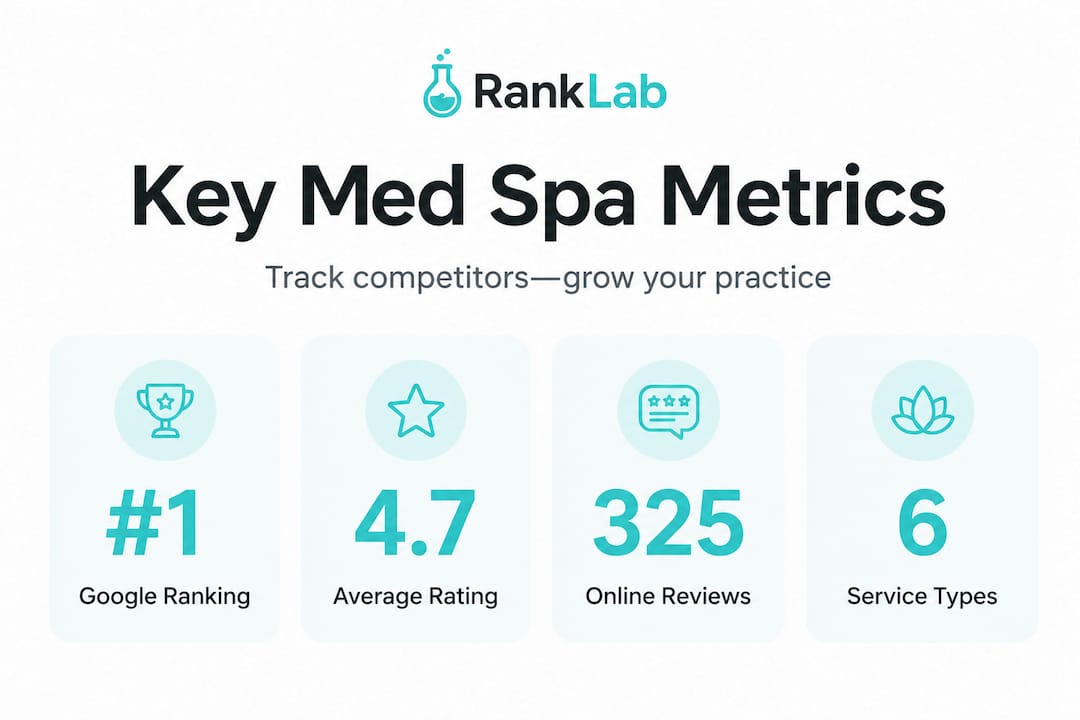
Here is a simple comparison format you can use in your own tracker:
| Metric | Your med spa | Competitor A | Competitor B | Competitor C |
|---|---|---|---|---|
| Google ranking (Botox + city) | Position 4 | Position 1 | Position 3 | Position 7 |
| Average review rating | 4.6 | 4.9 | 4.4 | 4.1 |
| Total Google reviews | 87 | 210 | 143 | 55 |
| Instagram followers | 1,200 | 4,800 | 2,100 | 600 |
| Loyalty or membership program | No | Yes | No | No |
Investing in local SEO for med spas becomes much more strategic when you can see exactly which competitors are outranking you and by how much. You stop guessing and start targeting specific gaps.
Beyond the obvious metrics, pay attention to these less-tracked but highly revealing data points:
- Social engagement rate (likes and comments relative to follower count, not just raw follower numbers)
- Referral programs (do they actively incentivize word-of-mouth?)
- Event hosting (are they running open houses, educational evenings, or community partnerships?)
- Before-and-after content quality (polished, consistent photography signals a professional brand)
- Response time to reviews (how quickly and professionally do they address feedback?)
These softer signals often reveal more about a competitor’s actual client experience than any single metric on a spreadsheet.

Common mistakes to avoid in med spa competitor analysis
Even med spas that commit to regular competitor analysis often undermine their own efforts with a handful of avoidable mistakes. Recognizing these pitfalls ahead of time saves you weeks of wasted effort.
Focusing only on big regional chains. Your most direct competitors are typically other independent or small-group med spas in your market, not national brands. Obsessing over what a major chain is doing nationally tells you very little about local client preferences.
Copying competitor pricing without local context. If you see a competitor charging $15 per unit for Botox, dropping your price to match them without understanding your own costs and client demographics is a fast path to margin problems. Pricing strategy requires more than imitation.
Ignoring negative reviews as a data source. Competitor one-star and two-star reviews are a goldmine. They tell you exactly what frustrates clients in your market. If multiple competitors have complaints about poor aftercare communication, that is your opportunity to build a standout follow-up process.
Treating it as a one-time project. Markets shift. Competitors launch new services, run promotions, and change their positioning. A competitor audit done once in 2023 is nearly useless in 2026.
Only looking at surface-level data. Follower counts without engagement rates, or review counts without sentiment analysis, give you an incomplete picture.
Here are fast habits to build instead:
- Set up Google Alerts for your top three competitors by name
- Screenshot competitor promotions and date them so you can track patterns
- Read your competitors’ new reviews weekly, not just your own
- Check competitor websites monthly for new service additions
- Track their ad activity using Meta’s Ad Library (free and public)
Avoiding reputation management pitfalls starts with watching how competitors stumble publicly and learning from their mistakes before you make the same ones.
Pro Tip: Put a recurring competitor audit on your calendar. Quarterly is the sweet spot for most med spas. Monthly is even better if you are in a fast-moving market or launching new services. Do not wait until your bookings slow down to check what the competition is doing.
How to turn competitor insights into real med spa growth
Data collection is only half the equation. The real value of competitor analysis shows up when you translate findings into action. This is where most med spas fall short. They gather the information and then file it away without changing anything.
Use the following framework to connect each insight to a specific action:
| Competitor insight | What it signals | Your action |
|---|---|---|
| Competitor leads in review volume | They are actively requesting reviews | Launch a post-appointment review request sequence |
| Competitor offers body contouring you don’t | Unmet local demand | Evaluate adding the service or promoting your alternative |
| Competitor’s social engagement is low despite high followers | Their content is not connecting | Focus your content on education and real results |
| Competitor runs regular flash sales | Price-sensitive segment exists | Create a loyalty program instead to retain without discounting |
| Competitor has no membership program | Retention gap in the market | Introduce a monthly membership with bundled treatments |
Once you have insights mapped to actions, prioritize by impact and feasibility. Not every finding needs immediate action, but the highest-value opportunities should move into your quarterly plan.
Here are immediate steps to implement your findings:
- List your top three competitors and create a simple tracking sheet with the key metrics from the table above.
- Identify one pricing adjustment that better reflects your value relative to the market (not necessarily lower).
- Add one new service or promotion based on gaps you see in the competitive landscape.
- Build or strengthen your review strategy if competitors are outpacing you on Google ratings.
- Update your website and social content to speak directly to the differentiators you have identified.
Strategies to boost med spa sales consistently cite competitor awareness as a foundational element. When you know what you are competing against, every marketing dollar you spend becomes more targeted. Aligning your actions with current marketing trends while also addressing your specific local competitive gaps puts you in a position very few med spas in any market actually occupy.
What most med spas get wrong about competitor analysis
Here is the uncomfortable reality: most med spa owners approach competitor analysis with the wrong mindset entirely. They treat it as either a threat assessment (a way to see who might be stealing clients) or a one-off project done when business slows down. Neither approach gets results.
The med spas that grow consistently treat competitor analysis as an ongoing practice, not a reactive one. They view competitors not as threats but as sources of market intelligence and, occasionally, inspiration. When a competitor launches a wildly successful influencer campaign or starts hosting community events that fill their schedule, the smart move is to understand what made that work and ask how you could do something similar, or better.
One of the biggest traps we see med spa owners fall into is pricing obsession. They spend enormous energy tracking competitor prices and adjusting their own in response, often without realizing that price is rarely the main reason a client chooses one med spa over another. Trust, expertise, convenience, and the feeling of the brand experience typically matter more. If you are competing purely on price, you are playing a race you do not want to win.
The more creative and often overlooked competitive signals are things like local med spa partnerships, influencer collaborations, educational workshop hosting, and community involvement. A competitor who is partnering with a local fitness studio or bridal boutique is building a referral pipeline that no Google ad can easily replicate. Tracking these kinds of moves gives you a far richer picture of your competitive landscape than any spreadsheet of prices.
The mindset shift worth making: competitor analysis is not about imitation or anxiety. It is about staying close enough to your market to make better decisions than anyone else in it.
Ready to outshine your competitors?
Understanding your competitive landscape is one thing. Executing on those insights with precision marketing is another. At Aesthetic Brink Lab, we work exclusively with med spas, which means we already understand the competitive dynamics of your market at a deep level. Our team applies competitor intelligence to digital advertising for med spas, targeting the exact client segments your competitors are missing. We also build your visibility through local SEO services designed to put your med spa in front of high-intent local searches. And when it comes to owning your online reputation, our reputation management strategies help you build the social proof that turns curious browsers into booked appointments. Let’s turn what you know about your competitors into real growth.
Frequently asked questions
What is the first step of competitor analysis for med spas?
Start by identifying both direct and indirect competitors in your local market, using Google searches for the services you offer alongside your city name to see who is actually appearing in front of your potential clients.
How often should a med spa update their competitor analysis?
Most experts recommend reviewing competitor data quarterly, though fast-moving markets or med spas launching new services benefit from a monthly check-in to keep strategies sharp and responsive.
What tools can med spas use for competitor analysis?
Google, Meta’s free Ad Library, social media platforms, and review monitoring tools like Google Business Profile and Yelp are practical starting points that require no paid subscriptions and yield substantial intelligence.
Which competitor metrics matter most for med spas?
Service menu breadth, client review volume and ratings, social engagement rates, and digital search ranking are the four most actionable metrics because they directly reflect how clients experience and discover competing practices.
How does competitor analysis improve med spa marketing?
It replaces guesswork with real market data, revealing which services are underserved locally, what messaging resonates with your target clients, and where your marketing budget will generate the strongest return relative to what competitors are already doing.