
TL;DR:
- A effective paid search strategy for med spas focuses on audience signals, targeted campaigns, and conversion tracking.
- Most med spas misjudge paid search success by clicks instead of booked consultations and cost per patient.
- Combining Google Ads with local SEO and advanced audience targeting maximizes bookings and reduces wasted ad spend.
Many med spa owners still believe paid search is just about picking the right keywords and outbidding competitors. That thinking is costing them real money. The shift toward audience signals and first-party data is reshaping how Google Ads actually work in 2026, and med spas still relying on keyword-only strategies are leaving consult bookings on the table. This guide breaks down what a real paid search strategy looks like, how to structure campaigns that fill your treatment schedule, and which tactics separate profitable med spas from those burning through ad budgets with little to show for it.
Table of Contents
- What is paid search strategy?
- Essential building blocks: what makes paid search work for med spas
- Budgeting and bidding: finding the right balance
- Advanced strategies: audience, automation, and tracking in 2026
- What most med spas get wrong and what actually works
- Drive more bookings with expert med spa paid search support
- Frequently asked questions
Key Takeaways
| Point | Details |
|---|---|
| Keywords are less critical | Using audience signals and first-party data outpaces simply buying keywords in 2026. |
| Focus on consult bookings | Track success by booked appointments, not just clicks or simple leads. |
| Negative keywords save money | Review search terms weekly to exclude unqualified traffic and protect ad spend. |
| Split budget for scale and innovation | Use the 80/20 rule to balance between proven campaigns and new test ideas. |
| Smart Bidding requires enough data | Switch to Smart Bidding only after collecting 30-50 conversions with proper tracking. |
What is paid search strategy?
Paid search strategy is not just running Google Ads. It is a systematic, data-driven approach to placing your med spa in front of people who are actively looking for your services, at the exact moment they are ready to book. The difference between “running ads” and having a strategy is massive, especially in a competitive local market where every click costs real money.
A true paid search strategy includes several interconnected parts. First, there is audience targeting, which means defining who sees your ads based on location, behavior, and intent signals. Second, ad formats matter: search ads, responsive search ads, and Performance Max campaigns each serve different goals. Third, your landing pages must match the specific service being advertised. Fourth, and most importantly, you need to track meaningful outcomes, not just clicks or impressions. As the data makes clear, you should track cost per booked consult, not just leads. That single shift in measurement changes everything about how you run and optimize campaigns.
Paid search vs. organic SEO: which is right for your med spa?
Both channels matter, but they serve different purposes. Understanding the distinction helps you allocate resources wisely. You can explore the med spa SEO vs. paid search comparison to see how both contribute to growth, but here is a quick breakdown:
| Factor | Paid search | Organic SEO |
|---|---|---|
| Speed to results | Immediate (hours) | Slow (months) |
| Cost model | Pay per click | Time and content investment |
| Targeting precision | High (keywords, location, audience) | Limited (search intent) |
| Scalability | Scale up or down quickly | Slower to adjust |
| Sustainability | Stops when budget stops | Builds compounding traffic |
| Best for | Immediate consult bookings | Long-term brand authority |
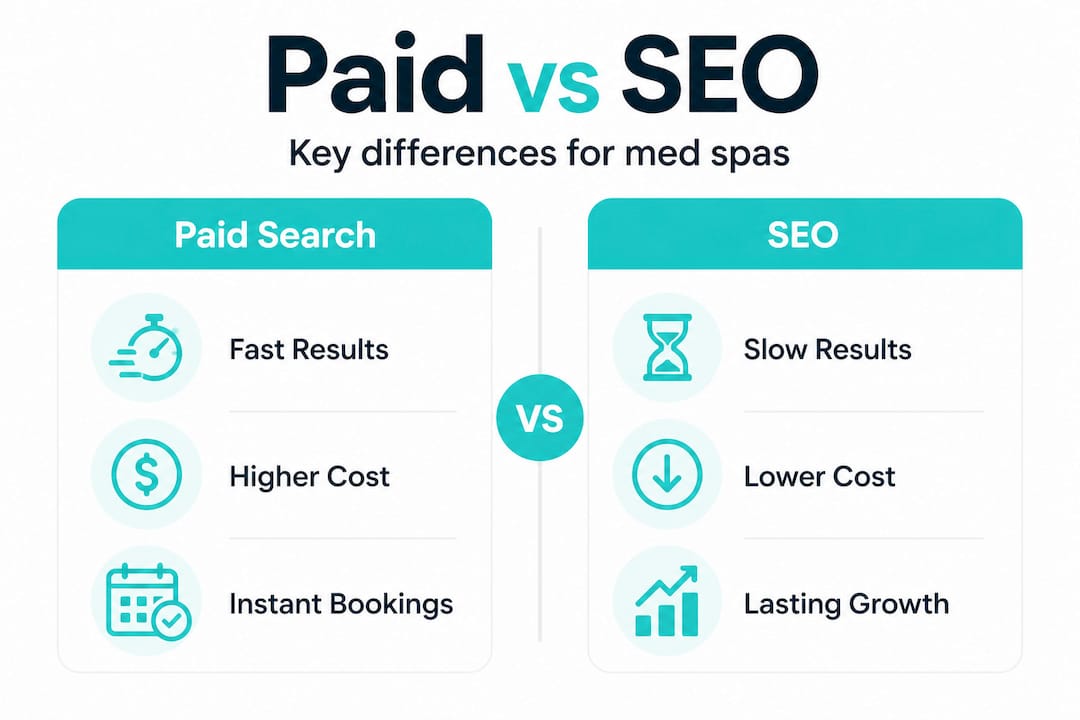
The smart move for most med spas is running both. Paid search fills your calendar now. SEO builds the organic foundation that reduces your dependence on ad spend over time. Neither replaces the other. When you understand paid advertising for med spas as a complement to organic strategy, not a substitute, you start making much better budget decisions.
Essential building blocks: what makes paid search work for med spas
Once you understand what paid search is, the next step is knowing how to build campaigns that actually produce booked appointments. This is where most med spa owners stumble. They either set up one broad campaign targeting every service or they copy a generic ad template. Neither approach works in a specialized, high-value market like aesthetics.
Here is a step-by-step framework for building effective paid search campaigns:
- Start with service-specific campaigns. Create separate campaigns for Botox, fillers, laser treatments, body contouring, and any other core service. Never lump everything into one campaign. This allows you to control budgets per service, write relevant ad copy, and send traffic to dedicated landing pages.
- Prioritize transactional keywords. Focus on phrases like “Botox near me,” “lip filler consultation,” or “med spa in [city name].” These transactional keyword phrases signal high buying intent. Avoid generic educational terms unless you are running awareness campaigns with a separate budget.
- Build matching landing pages. Sending someone who clicked on a “laser hair removal” ad to your homepage is a budget killer. Create a dedicated page for each service that mirrors the ad message, includes a clear booking button, and loads fast on mobile.
- Add negative keywords immediately. This step is where a large portion of wasted ad spend hides. Negative keywords prevent your ads from showing for searches like “med spa jobs,” “cheap Botox DIY,” or “how to do fillers at home.” These searches will never convert into consults. Block them from day one.
- Set up conversion tracking before spending a dollar. Track phone calls, form submissions, and online booking completions as conversions. If you cannot see which clicks lead to booked consults, you are flying blind.
- Review your Search Terms report weekly. Google does not always show your ads for exactly the keywords you entered. The Search Terms report reveals the actual queries triggering your ads. Mining this report weekly for new negative keywords is one of the highest-value tasks in paid search management.
“The ROI math for med spas is actually very forgiving. A new patient with a lifetime value of $3,000 to $10,000 can justify a cost per lead between $50 and $150, provided that lead converts to a booked consult.”
This is why tracking lead generation for med spas down to the booked consult level is so important. A $120 cost per booked consult sounds expensive until you realize that patient might return for $5,000 in treatments over two years.

Pro Tip: Use call tracking software like CallRail alongside Google Ads. Many med spa patients call directly from a search ad rather than filling out a form. Without call tracking, you are missing a significant portion of your actual conversions and undervaluing your campaigns.
You can get deeper paid search expert tips from specialists who work exclusively with med spas, which makes a real difference when you are competing in dense local markets.
Budgeting and bidding: finding the right balance
Now that your campaigns are structured correctly, the question becomes how much to spend and how to let Google’s algorithms work in your favor without losing control.
The most practical budget framework for med spas is the 80/20 rule. Put 80% of your budget into proven campaigns targeting your best-performing services in your local area. Reserve 20% for testing new services, new audiences, or new ad formats. This prevents the common mistake of either being too conservative (not testing anything new) or too aggressive (splitting limited budgets across too many experiments at once).
Manual CPC vs. Smart Bidding: know when to use each
This is one of the most misunderstood decisions in Google Ads for med spas.
| Bidding type | Best for | Requires | Risk level |
|---|---|---|---|
| Manual CPC | New campaigns, low data | Daily monitoring | Low (you control bids) |
| Target CPA | Campaigns with history | 30-50 conversions | Medium |
| Maximize Conversions | Budget-capped campaigns | Conversion tracking | Medium |
| Target ROAS | High-volume campaigns | Strong conversion history | High if data is thin |
Google’s Smart Bidding strategies use machine learning to optimize bids in real time, factoring in signals like device, location, time of day, and audience behavior. But they only work well after a campaign has accumulated enough conversion data. Most experts recommend waiting until you have at least 30 to 50 conversions before switching from Manual CPC to a Smart Bidding strategy.
Starting a new campaign on Smart Bidding is a common and expensive mistake. Google’s algorithm needs historical data to make good decisions. Without it, you are essentially paying for the machine to learn on your budget with no guarantee of efficient results.
Google Ads vs. Meta Ads for med spas
Both platforms have their place, but they capture users at very different stages of intent. Google Ads reach people who are actively searching for services right now. Meta Ads (Facebook and Instagram) reach people based on demographics and interests, not search intent. Google typically wins on conversion quality. Meta often wins on cost per lead volume.
The smartest approach is to use programmatic ad strategies that layer both platforms, then let your tracking data tell you which channel drives actual bookings, not just clicks. For paid ad optimization at a higher level, understanding where your converting patients actually come from is the only number that matters.
Pro Tip: Do not compare Google and Meta by cost per click. Compare them by cost per booked consult. A $5 Meta lead that never shows up is worth less than a $90 Google lead that books a $900 treatment.
Advanced strategies: audience, automation, and tracking in 2026
Budget and structure get you in the game. Advanced strategies keep you competitive as the paid search landscape continues to evolve.
The most important shift happening right now is the move away from keyword-only targeting toward audience-first thinking. Google’s algorithms are increasingly rewarding advertisers who combine strong keyword intent with rich audience signals. This means uploading your patient email lists as customer match audiences, building remarketing lists from website visitors, and using in-market audiences to reach people who have shown interest in aesthetic treatments.
For your ads themselves, responsive search ads with 15 headlines are now the standard. Google’s system tests combinations automatically to find what resonates. Most med spa campaigns use far fewer than 15 headlines, leaving performance gains unused. Write all 15 headlines and at least 4 description lines. Include your location, service name, a unique differentiator, and a strong call to action in different combinations. Let the algorithm find the winners.
Key advanced tactics to implement now:
- First-party data activation: Upload your existing patient list to Google Ads to create lookalike audiences and exclude current patients from new patient campaigns
- Remarketing lists for search ads (RLSA): Bid higher on past website visitors who search for your services again
- Conversion value rules: Assign different values to different conversion actions (a booked consult is worth more than a phone call that lasted 30 seconds)
- Performance Max campaigns: Use these selectively, with strong asset groups and clear audience signals, as a supplement to your core search campaigns
- Weekly performance reviews: Check cost per booked consult, not just impressions or click-through rates
One important note: Smart Bidding requires at least 30 to 50 conversions in a 30-day window before it can optimize effectively. Rushing into automation before hitting that threshold produces unpredictable results. Build your data foundation first.
For more ideas on boosting med spa sales through digital channels, pairing advanced paid search with strong local search visibility creates a compounding effect that is very hard for competitors to match.
What most med spas get wrong and what actually works
Here is the uncomfortable truth: most med spas measure paid search success by the wrong numbers. They celebrate low cost per click, high click-through rates, and page impressions, then wonder why their treatment rooms are not filling up. Clicks are not consults. Leads are not revenue.
The real question is always: how much did it cost to get a patient into the chair? Everything else is noise.
We have seen med spas with impressive click-through rates running campaigns that were quietly bleeding money, because the traffic was going to generic pages with no clear booking path. We have also seen lean campaigns with modest click-through rates generating consistent $80 to $120 cost per booked consult, which makes complete financial sense when lifetime value is $4,000 or more per patient.
The second most common mistake is skipping negative keywords and never reviewing the Search Terms report. Without this, Google will happily spend your budget on searches from nursing students looking for job postings, people searching for “DIY filler kits,” or users in cities three states away. These clicks add up fast. Service-specific campaigns with tight negative keyword lists and weekly Search Terms reviews are the operational standard for any profitable paid search program.
The third mistake is treating Google and Meta as either/or choices. Google captures intent. Meta builds awareness and supplements volume. The best-performing med spa advertising programs use both, with distinct goals, creative approaches, and conversion tracking for each channel.
Finally, do not underestimate the value of consistent testing. Ad copy that works in January may wear out by March. Offer-based ads sometimes outperform service-focused ads for certain treatments. The only way to know is to test systematically and let your lead generation strategies evolve with real data, not assumptions.
Drive more bookings with expert med spa paid search support
Applying these strategies takes time, testing, and deep platform knowledge that most med spa owners do not have bandwidth to develop while running a practice. Aesthetic Brink Lab works exclusively with med spas, building paid search programs that are engineered to produce booked consults, not just impressions. Explore med spa digital advertising strategies to see how a full-funnel approach drives measurable results. If you are ready to streamline your entire marketing operation, learn how to automate your med spa marketing to stay consistent without adding hours to your week. And if social channels are part of your growth plan, our med spa social media guide connects paid and organic into a single cohesive strategy.
Frequently asked questions
How is paid search different from local SEO for med spas?
Paid search delivers instant visibility by placing your ads at the top of search results, while local SEO builds your presence in map packs and organic listings over time. Both channels serve different purposes and work best together.
What’s a realistic cost per booked consult for med spas using paid search?
Most med spas see a cost per booked consult between $50 and $150, which is financially sound when you factor in a lifetime value of $3,000 to $10,000 per new patient.
Should I use Smart Bidding right away for new med spa campaigns?
Not right away. Wait until your campaign accumulates 30 to 50 conversions with solid tracking in place before enabling Smart Bidding strategies for the best performance results.
How can negative keywords help my med spa ads?
Negative keywords block your ads from showing on irrelevant searches, like job listings or DIY queries, protecting your budget and directing spend only toward people who are likely to book.
Why do some med spas report lower costs with Meta ads than Google?
Meta ads generally produce a lower cost per lead because they target by interest rather than intent, but Google Ads capture patients who are actively searching for your specific services, which typically means higher conversion quality.