
TL;DR:
- Running Facebook ads successfully for med spas requires a solid account and campaign structure, along with accurate tracking.
- A full-funnel approach using education, retargeting, and optimized creative maximizes booking conversions and scale.
Running Facebook ads sounds straightforward until you’re staring at Meta’s campaign manager wondering why your botox promotion got three clicks and zero bookings. This facebook ads step by step guide was written specifically for med spa owners and marketers who want to stop guessing and start converting. You’ll get the exact account structure, budget logic, creative tactics, and optimization habits that actually work for the wellness and beauty space in 2026. No generic advice pulled from e-commerce playbooks.
Table of Contents
- Key takeaways
- Facebook ads step by step: building your foundation
- Building your campaign structure
- Writing ads that actually book appointments
- Launching, monitoring, and optimizing your campaigns
- My honest take on Facebook ads for med spas
- How Aestheticranklab helps med spas run smarter ads
- FAQ
Key takeaways
| Point | Details |
|---|---|
| Set up your foundation first | Meta Business Manager, a verified Facebook Page, and a payment method are all required before launching any ad. |
| Follow the three-level structure | Every Facebook campaign has campaign, ad set, and ad levels. Each controls different settings and must align with your goal. |
| Allocate budget by funnel stage | Spend 60 to 70% on prospecting, 20 to 30% on retargeting, and 10 to 15% on retention for sustainable growth. |
| Lead with education, then convert | Show potential clients educational content before pushing a direct offer. Trust converts in the med spa space. |
| Track with both pixel and CAPI | Using the Meta pixel alongside the Conversions API gives you the most accurate data for campaign decisions. |
Facebook ads step by step: building your foundation
Before you write a single headline or choose an image, your Meta account structure needs to be airtight. Skipping this part is where most med spa campaigns fall apart before they ever go live.
Running Facebook ads in 2026 requires three things at minimum: a Meta Business Manager account, a verified Facebook Page connected to your med spa, and an active payment method. Meta Business Manager is the hub where your Page, ad account, pixel, and team permissions all live. Think of it as the back office of your advertising operation.
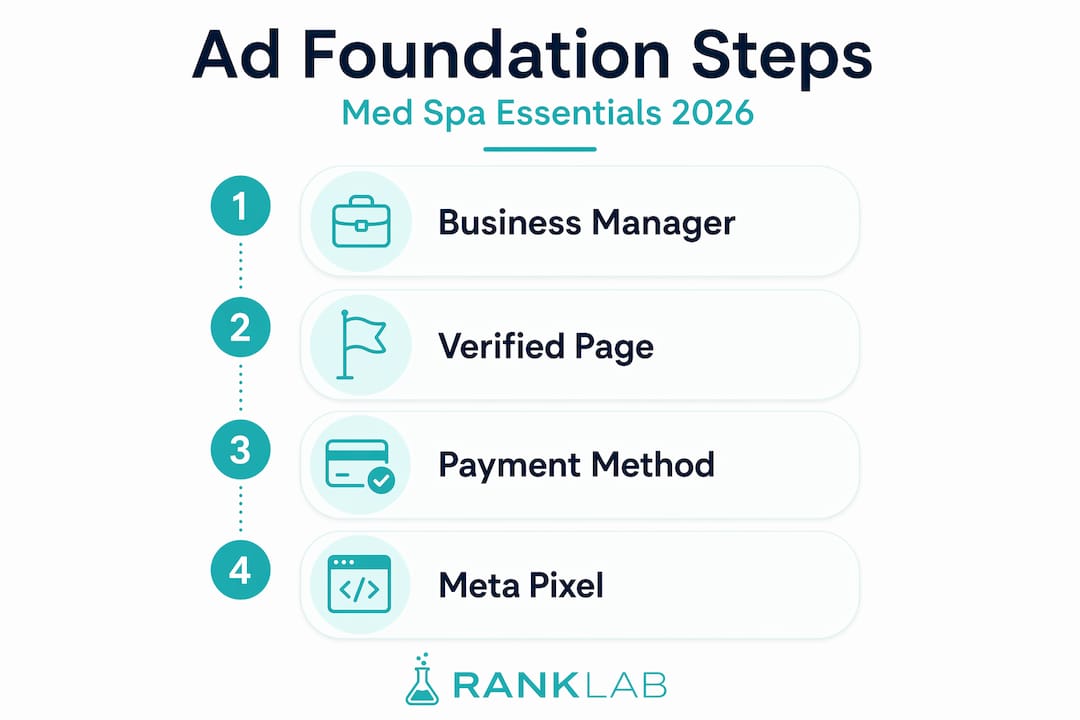
Here is a quick reference for everything you need in place before launching:
| Asset | What it is | Why it matters |
|---|---|---|
| Meta Business Manager | Central account manager | Controls all assets and team access |
| Facebook Page | Your med spa’s public profile | Required to run any ad |
| Ad Account | Where campaigns are created | Tied to your billing and spending |
| Meta Pixel | Website tracking code | Records actions like bookings and form fills |
| Payment Method | Credit card or bank on file | Required before any ad goes live |
If you already have a personal Facebook account, you can create Business Manager at business.facebook.com. Create a Page for your med spa if you have not already, connect it to the ad account inside Business Manager, and install the Meta pixel on your website. That last step is non-negotiable. Without the pixel, you are flying blind on what happens after someone clicks your ad.
Pro Tip: Name your ad accounts, pixels, and Pages consistently from the start. Once you are managing multiple campaigns and team members, a clean naming convention saves hours of confusion.
Building your campaign structure
Facebook organizes advertising into three levels: campaign, ad set, and ad. Getting clear on what each level controls is the difference between a focused campaign and a chaotic one.
The campaign level is where you choose your objective. For med spas, the most useful objectives are Leads (for booking form fills), Traffic (for sending people to your website), and Conversions (for tracking specific actions like appointment bookings). Your objective tells Meta’s algorithm what result to optimize for, so it matters more than most beginners realize.
The ad set level is where you control your audience, budget, placement, and schedule. Meta now uses AI for audience targeting more than ever, which means your manual interest targeting is less critical than your conversion data quality. That said, for med spas starting out, building an audience around interests like skincare, wellness, beauty treatments, and medical aesthetics gives the algorithm a solid starting point. Meta recommends an audience size of at least 2 million before refinement to give the system enough room to find your best prospects.

The ad level is where your actual creative lives: the image or video, the headline, the body copy, and the call to action.
Here is how common campaign objectives map to med spa marketing goals:
| Campaign objective | Best use case | Expected outcome |
|---|---|---|
| Leads | Booking form fills, free consultations | Direct contact info from interested clients |
| Traffic | Driving people to service or blog pages | Increased site visits for retargeting pools |
| Conversions | Online booking or purchase tracking | Trackable ROI tied to real revenue events |
| Brand Awareness | New area openings, seasonal launches | Increased reach with lower CPMs |
Budget allocation by funnel stage is one of the most overlooked decisions in a Facebook advertising guide. The proven breakdown for 2026: 60 to 70% of your total budget goes to prospecting campaigns (cold audiences who have never heard of you), 20 to 30% goes to retargeting (people who visited your site or engaged with your content), and 10 to 15% goes to retention (existing clients you want to reactivate). Prospecting is the least efficient per conversion but it feeds every other stage. Without it, your retargeting pool dries up.
Pro Tip: Start with one campaign per objective. Med spa owners who launch five campaigns on day one with small budgets split across dozens of ad sets never exit Meta’s learning phase. Consolidate first, then scale.
Writing ads that actually book appointments
Creative is where most med spa ads lose the sale before it ever starts. The platform can do a lot with the right data, but it cannot save a bad ad.
Here is what works for med spa ad formats in 2026:
- Single image ads work well for promoting specific treatments like HydraFacials or CoolSculpting with a clear before and after visual or a clean product shot.
- Video ads outperform images for explaining services that clients are unfamiliar with, like microneedling or laser resurfacing. A 15 to 30 second walkthrough from your provider builds trust fast.
- Carousel ads let you showcase multiple services or treatment steps in a single unit. Great for seasonal packages.
- Stories and Reels placements reach a younger demographic and work well for short, punchy content with real staff personality.
Your primary text (the copy above the image) should speak to the problem your client is trying to solve, not just the name of the treatment. “Tired of dull, uneven skin?” lands harder than “Now offering HydraFacials.” Your headline (the bold text under the image) should include a clear benefit or offer. Your call to action should match where the person is in the funnel. “Learn More” works for cold audiences. “Book Now” works for warm retargeting audiences who already know you.
Using the Meta Ads Library for competitor research is a move most med spa marketers skip entirely. You can search any business name and see every ad they are currently running, including their CTAs, creative formats, and offer structures. This is free intelligence. Use it.
The most common mistake in ad creation is changing too many elements at once when something is not working. Testing one variable at a time gives you clean data. Change only the headline while keeping everything else the same. Or test two images with identical copy. When you change five things simultaneously, you have no idea what moved the needle.
Pro Tip: Before running any direct offer ad (like “20% off Botox this week”), run an educational piece first. A short video explaining how a treatment works warms up cold audiences and significantly improves conversion rates on your offer ads.
Launching, monitoring, and optimizing your campaigns
You have your account set up, your campaign structured, and your creative ready. Here is how to go from draft to live campaign without missing a step.
- Review every ad for Meta’s advertising policies before submitting. Med spas often get flagged for before and after photos or claims that imply medical guarantees. Read Meta’s health and wellness ad policies specifically before launch.
- Submit your ads for review. Meta’s review process typically takes a few hours to 24 hours. New accounts sometimes take longer.
- Once live, do not touch anything for the first 48 to 72 hours. Meta needs time to start learning. Early edits reset the learning phase and cost you data.
- After the learning phase, look at your Cost Per Result (also called Cost Per Action or CPA) as your primary metric. For med spas, a lead costing under $20 to $35 is generally healthy depending on your service.
- Check your frequency metric weekly. When frequency climbs above 3 or 4 on a cold audience, your creative is getting stale. Refresh the image or copy.
- Use A/B testing for headline variations once you have at least 50 conversions in a campaign. Let data decide, not opinions.
One of the biggest technical decisions you can make is implementing the Meta Conversions API. Server-to-server tracking via CAPI recovers conversion data that the pixel alone misses because of browser privacy restrictions and ad blockers. This means your campaign gets better data, the algorithm learns faster, and your cost per booking goes down over time.
Fragmented ad set structures also kill optimization. If you have ten ad sets each spending $5 per day, none of them will generate enough weekly conversions to exit learning. Consolidate to fewer, higher-budget ad sets and watch your results improve.
Pro Tip: Connect your CRM data to Meta through offline conversion imports. Closed revenue data tied back to your campaigns gives you real ROAS, not just platform-reported estimates that often overstate performance.
My honest take on Facebook ads for med spas
I have seen med spa owners spend thousands of dollars on Facebook ads and get almost nothing back. In most of those cases, the problem was not the platform. It was the strategy underneath it.
The number one issue I see is treating Facebook like a direct-response vending machine. You put in money, you expect bookings immediately. That model works when you have a fully built retargeting audience and strong conversion data feeding the algorithm. For most med spas starting out, it does not work. You need to build before you can harvest.
What actually works is a full-funnel approach. Educational content at the top. Warm retargeting with specific offers in the middle. Reactivation campaigns for past clients at the bottom. Most med spa campaigns I review skip straight to the offer with a cold audience and then conclude that “Facebook ads don’t work.”
I also think the conversation about Meta’s Advantage+ automation is more nuanced than most guides admit. Advantage+ is powerful, but it requires quality conversion data to work. If your pixel is broken or your CRM is not connected, you are handing the algorithm garbage to learn from. Fix the data pipeline first, then hand more control to automation.
The med spas I have seen scale ads sustainably are not the ones with the best creative. They are the ones with the most disciplined account structures and the cleanest tracking setup.
— Keith
How Aestheticranklab helps med spas run smarter ads
If this guide showed you that running Facebook ads effectively takes more than clicking “Boost Post,” you are not alone. The account structure, tracking setup, creative strategy, and budget logic covered here represent weeks of trial and error for most med spa owners trying to figure it out independently.
Aestheticranklab is a digital marketing agency built exclusively for med spas. From paid advertising services to full social media management, every service is designed around how med spa clients actually find, research, and book treatments. If you want to understand the broader picture before committing to paid ads, the med spa digital advertising guide is a solid starting point. And if you are thinking about how automation can support your campaigns at scale, the med spa marketing automation page covers how the right systems reduce manual workload while improving results.
FAQ
What do I need to start Facebook ads for my med spa?
You need a Meta Business Manager account, a verified Facebook Page, an active payment method, and the Meta pixel installed on your website. These four elements are required before any campaign can go live.
How much should a med spa spend on Facebook ads?
There is no fixed number, but a practical starting budget is $1,000 to $2,000 per month. Allocate the majority to prospecting campaigns and reserve a portion for retargeting people who have already visited your website or engaged with your content.
Why are my Facebook ads not generating bookings?
The most common reasons are cold audiences receiving direct offer ads without prior education, a broken pixel that prevents conversion tracking, or a fragmented campaign structure that never exits Meta’s learning phase. Consolidating your ad sets and fixing your tracking setup resolves most cases.
How often should I refresh my med spa Facebook ads?
Monitor your frequency metric weekly. When a cold audience has seen your ad more than three or four times on average, swap in new creative. For retargeting audiences, a two to three week refresh cadence works well.
What is the Meta Conversions API and do I need it?
The Meta Conversions API sends conversion data directly from your server to Meta, bypassing browser-level tracking limitations. Paired with the pixel, it significantly improves data accuracy and helps the algorithm optimize toward real bookings rather than estimated results.