
TL;DR:
- Getting consistent, HIPAA-compliant online reviews boosts med spa visibility and client trust.
- Responding quickly to reviews and using generic requests enhances reputation and SEO.
- Long-term success comes from ongoing review management and improving client experience.
Getting a steady stream of positive online reviews is one of the hardest things med spa owners deal with. Clients leave happy, but they rarely think to post about it. Worse, HIPAA compliance adds a layer of complexity that makes even asking for a review feel risky. The truth is that reviews directly shape how many new clients find and trust your practice. A strong review profile lifts your local search rankings and fills your booking calendar. This guide walks you through everything: preparing your team, requesting reviews safely, handling negative feedback, and measuring real results.
Table of Contents
- Why med spa reviews matter for growth
- Preparing your team and tools to request reviews
- How to request reviews without risking HIPAA violations
- Responding to and leveraging reviews for more bookings
- Troubleshooting common review challenges and tracking success
- What most med spas miss about reviews (and what really works)
- Ready to grow? Partner with med spa review experts
- Frequently asked questions
Key Takeaways
| Point | Details |
|---|---|
| HIPAA-compliant review strategy | Always use approved templates and never confirm patient details to stay safe and earn more reviews. |
| Timely responses boost growth | Respond to every review within 24 hours to increase trust, SEO, and bookings. |
| Training and consistency matter | Equip your team and use tools for consistent, effective review generation. |
| Turning feedback into improvement | View negative or critical reviews as opportunities to enhance your med spa’s services. |
Why med spa reviews matter for growth
Reviews are not just social proof. They are a core part of how your med spa gets discovered, evaluated, and chosen by new clients. Most people read at least five to ten reviews before booking an aesthetic treatment, and a single-star improvement in your average rating can meaningfully increase the number of calls and appointments you receive.
The connection between reviews and search optimization for med spas is direct. Google’s local algorithm weighs both the volume and recency of your reviews when deciding where to rank your business in the local map pack. A med spa with 200 reviews and a 4.8-star average will almost always outrank a competitor with 30 reviews, even if that competitor has a newer website.
Here is a quick look at where med spa clients typically discover and leave reviews:
| Platform | Best use | Impact level |
|---|---|---|
| Google Business Profile | Local search and maps | Very high |
| Social discovery and sharing | High | |
| Yelp | Broad consumer trust | Medium |
| RealSelf | Aesthetic-specific credibility | High for aesthetics |
| Website testimonials | Conversion on your own site | Medium |
Each platform serves a slightly different audience, but Google remains the most important for search visibility. Your client testimonials value extends beyond Google though. RealSelf visitors are actively researching cosmetic procedures, which means they are closer to booking than a casual Google user.
Key reasons reviews matter for your med spa’s growth:
- Trust signals: New clients with no prior relationship trust peer reviews more than any ad you run
- SEO fuel: Fresh reviews tell Google your business is active and relevant
- Conversion boost: A profile with consistent reviews converts more profile visitors into booked clients
- Competitive edge: Most of your local competitors are not actively managing reviews
Responding to reviews also matters more than most med spas realize. Responding to every review with HIPAA compliance boosts SEO, builds trust, and can increase revenue by up to 15%. That is a significant return for a process that takes only minutes per day. These online review tips become especially valuable once you build a consistent system around them.
Now that you know the impact reviews have, let’s prepare to get more of them effectively.
Preparing your team and tools to request reviews
Before you send a single review request, your team needs to be aligned and your tools need to be in place. Skipping this step is why most review programs fizzle out after two weeks. A solid foundation makes the process repeatable and safe.
Start with staff training. Every person who interacts with clients, from your front desk to your injectors, should understand why reviews matter and how to talk about them without crossing HIPAA lines. This does not need to be a long training session. A 15-minute team meeting and a one-page reference guide is enough to get everyone on the same page.

HIPAA-compliant templates are essential when responding to or requesting reviews. Pre-written scripts remove the guesswork and protect your practice. Your team should never improvise when it comes to anything that touches client privacy.
Here is a simple tool comparison to help you choose the right setup:
| Tool type | Examples | Key benefit |
|---|---|---|
| Google Business Profile | Native Google tool | Free, direct impact on search |
| Reputation software | Podium, Birdeye | Automates multi-platform requests |
| CRM with review features | Jane App, Zenoti | Integrates with booking workflow |
| Email marketing tools | Mailchimp, Klaviyo | Good for follow-up sequences |
Building review requests into your post-visit workflow is the most important step. The best moment to ask is right after checkout, when the client’s experience is fresh and their satisfaction is highest.
Here is what a solid post-visit workflow looks like:
- At checkout: Staff verbally mentions that a review link will be sent shortly
- Within 2 hours: Automated SMS or email goes out with a direct review link
- Day 3 follow-up: Optional second touchpoint for clients who did not respond
- Monthly audit: Review your request-to-review conversion rate and adjust messaging
Pro Tip: Use a QR code at your front desk that links directly to your Google review page. Clients who are happy right after their appointment will often post a review before they even get to their car.
These systems connect directly to your broader reputation management strategies and make the whole process feel effortless for both your team and your clients. With your team and tools ready, it’s time to start requesting reviews from your clients.
How to request reviews without risking HIPAA violations
Asking for reviews in a medical setting requires more thought than most industries. The wrong message, even one that seems harmless, can inadvertently confirm that someone is a patient, which is a HIPAA violation. Here is how to ask for reviews in a way that is both effective and fully compliant.
The golden rule: never reference anything specific about the client’s visit, their treatments, or their health. Keep every request generic and focused on the overall experience of visiting your business.
Here are compliant request scripts you can adapt:
- In-person script: “We love hearing from guests. If you enjoyed your visit, we would really appreciate it if you shared your experience on Google. It only takes a minute and it helps us grow.”
- Email script: “Thank you for choosing [Spa Name]. If you have a moment, we would be grateful if you left us a review on Google. Your feedback helps others find us.”
- SMS script: “Hi [First Name], thanks for visiting [Spa Name]. We hope you had a great experience! Would you mind leaving us a quick Google review? [Link]”
Notice that none of these mention what the client came in for or confirm any health-related information. The language stays warm but stays safe.
Timing matters as much as wording. Sending your request within 24 hours of the visit dramatically increases your response rate. The experience is fresh, the emotion is positive, and the client is more likely to act.
Never confirm patient status or mention treatments in any review-related communication. Use HIPAA-compliant templates and invite anyone who leaves negative feedback to discuss their concerns offline, away from the public review thread.
Pro Tip: Include a direct link in every request. Every extra click a client has to make reduces your conversion rate. A link that takes them directly to the review box can double your submission rate compared to just asking them to “find you on Google.”
For more guidance on messaging that converts, check out these review request templates built specifically for med spas. Once you start receiving responses, managing those reviews is the next critical step.
Responding to and leveraging reviews for more bookings
Every review you receive is a public conversation. How you respond, or whether you respond at all, sends a clear message to the next potential client reading your profile. Silence can be just as damaging as a bad review.
Respond to every review within 24 hours. Never confirm patient status, mention treatments, or include any protected health information in your reply. A warm, generic response is always the right choice.
Best practices for responding to reviews:
- Positive reviews: Thank the client by first name only, express genuine appreciation, and invite them back without referencing what they came in for
- Negative reviews: Acknowledge their concern without confirming or denying their visit, apologize for any frustration, and invite them to contact you directly to resolve it
- Fake or suspicious reviews: Flag the review through the platform’s reporting tool and do not engage publicly
- No-response reviews (star only): A brief, friendly thank-you still adds value and shows future clients you are attentive
Pro Tip: Create five to seven response templates for your team so no one has to write from scratch. Rotate them to keep responses feeling fresh rather than robotic.
Once you have built a library of strong reviews, put them to work in your marketing. Positive reviews, with client permission, can be featured on your website, in email campaigns, and on social media. This is one of the proven med spa marketing trends that consistently generates new bookings without paid spend.
Connecting your review strategy to your broader lead generation ideas creates a flywheel effect. Better reviews bring more organic traffic, which leads to more appointments, which creates more opportunities to collect reviews. After establishing a routine for managing reviews, track results and troubleshoot any issues for continual improvement.
Troubleshooting common review challenges and tracking success
Even a well-run review program hits obstacles. Knowing how to handle them quickly keeps your momentum going and protects your reputation.
Common challenges and how to deal with them:
- Fake reviews: Report them using the platform’s flagging tool and document everything. Google and Yelp both have processes for removing reviews that violate their policies
- Review gating: Do not filter clients before asking for reviews. Only ask happy clients and it could be considered review manipulation, which violates platform guidelines
- Low request conversion: Test different messaging, sending times, and channels. SMS often outperforms email for review requests
- HIPAA missteps in responses: If a team member responds incorrectly, correct it immediately and reinforce training
Tracking your results turns your review program from a guessing game into a measurable growth channel. Here are the key metrics to watch:
| Metric | What it tells you | How to track |
|---|---|---|
| Average star rating | Overall client satisfaction | Google Business dashboard |
| Review volume (monthly) | Program activity and momentum | Manual count or software |
| Response rate | Team consistency | Reputation management tool |
| Request-to-review rate | Messaging effectiveness | CRM or email analytics |
| Booking changes | Revenue impact | Your scheduling software |
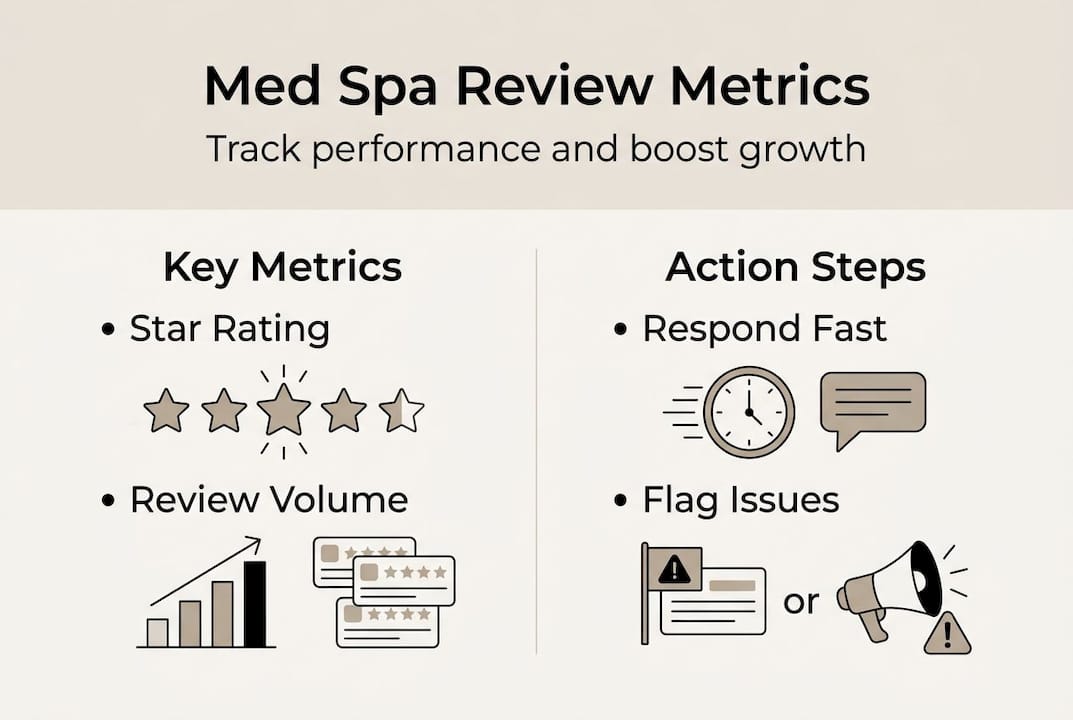
A successful review program leads to increased trust, stronger SEO, and up to 15% higher revenue. Track your numbers monthly and compare them quarter over quarter. If your average rating is climbing and your booking volume is increasing at the same time, your program is working.
When results plateau or you face a reputation crisis you cannot manage alone, it may be time to bring in outside support. Agencies that specialize in copywriting strategies for bookings and reputation management can often identify blind spots that are hard to see from inside your own business.
What most med spas miss about reviews (and what really works)
Here is something we see constantly: med spas run a review push, collect 30 reviews in a month, then stop. Six months later, their rating has gone stale and their ranking has slipped. Reviews are not a campaign. They are a practice.
The spas that win long-term are not the ones with the most reviews. They are the ones with the most consistent reviews. A review posted last week signals to Google and to clients that your business is active, relevant, and trusted right now. Ten reviews from three years ago signal the opposite.
There is also a deeper issue. Review generation cannot outpace service quality. If you push hard for reviews without investing in the actual client experience, you will collect inconsistent feedback that reveals cracks in your operation. That feedback, even if you manage it well publicly, creates a slow erosion of trust.
The med spas we see grow the most sustainably are those that treat reviews as a reflection of their client relationships. When understanding the med spa ecosystem becomes a priority, review generation stops being a marketing task and starts being a natural outcome of excellent care.
Ready to grow? Partner with med spa review experts
Building a review strategy that is consistent, HIPAA-compliant, and actually drives bookings takes more than good intentions. At Aesthetic Rank Lab, we help med spas turn their reputation into a real growth engine. Our med spa local SEO services are designed to amplify the reviews you collect and push your practice higher in local search. Pair that with targeted digital advertising for med spas and you have a system that attracts new clients month after month. Explore our med spa marketing case studies to see how other practices have grown with the same strategies covered in this guide.
Frequently asked questions
How do med spas ask for reviews without violating HIPAA?
Med spas should use generic, HIPAA-compliant language in all review requests and never confirm patient identities or reference treatments. HIPAA rules require avoiding confirmation of patient status in any review-related communication.
How quickly should med spas respond to online reviews?
Med spas should respond to every review within 24 hours to boost trust, reputation, and SEO. Timely responses to reviews improve search rankings and client confidence in your practice.
What should a med spa do about fake or negative reviews?
Med spas should flag fake reviews through the platform’s reporting tools and respond to negative feedback professionally, always inviting the reviewer to discuss their concerns offline. Inviting dissatisfied reviewers offline protects your reputation while keeping your HIPAA compliance intact.
Which platforms matter most for med spa reviews?
Google, Facebook, Yelp, and RealSelf are the most influential platforms for med spa client reviews. Google Business Profile carries the most weight for local search visibility and should be your first priority.