
Most med spa owners assume targeting is about picking the right age group or gender. It is not. The clients booking your Botox appointments and laser treatments are driven by intent, lifestyle, and specific outcomes they want to achieve. Demographic data tells you who someone is. Intent tells you why they are ready to book. When you align your marketing to both, your conversion rates climb and your ad spend stops going to waste. This guide walks you through segmentation, channel strategies, service personalization, and how med spa targeting compares to what regular salons do.
Table of Contents
- What does targeting mean for med spas?
- Segmenting the med spa market: Who are your ideal clients?
- Med spa targeting strategies: Digital, local, and traditional methods
- How med spas tailor services for their target market
- Med spa vs regular salon: Targeting approaches compared
- Ready to turn your targeting into booked appointments?
- Frequently asked questions
Key Takeaways
| Point | Details |
|---|---|
| Targeting goes beyond demographics | Med spa targeting focuses on deeper client needs and preferences, not just basic demographics. |
| Segmentation drives marketing success | Using demographics, psychographics, and treatment interests helps you focus your outreach and increase bookings. |
| Digital and local strategies are key | Combining online marketing with local SEO and personalized service yields the best targeting results. |
| Personalized services attract loyal clients | Tailoring consultations, pricing, and messaging to each segment leads to higher retention and conversions. |
| Med spas require higher client standards | Targeting for med spas means addressing client expectations around safety, wellness, and outcomes more precisely than salons. |
What does targeting mean for med spas?
In most industries, targeting means identifying a broad audience and pushing a message at them. For med spas, it is more precise than that. You are not selling a product off a shelf. You are offering medical-grade treatments that require trust, education, and a clear understanding of what a client actually wants from their body and their health.
Targeting in the med spa context means identifying the specific people most likely to book, return, and refer others. It means understanding their motivations, not just their zip code. A 45-year-old woman interested in skin rejuvenation has different needs than a 32-year-old man exploring body contouring. Same demographic bracket, completely different marketing message.
The unique challenge med spas face is that they sit at the intersection of wellness and aesthetics. Some clients come for medical reasons, others for confidence, and many for both. Med spa targeting combines both medical-grade and wellness approaches to attract diverse clients, which means your strategy must speak to multiple motivations without diluting your brand.
“Effective med spa marketing is not about reaching everyone. It is about reaching the right person with the right message at the right moment in their decision journey.”
Key factors that shape effective targeting include:
- Client intent: Are they researching, comparing, or ready to book?
- Treatment awareness: Do they know what they need, or do they need education first?
- Trust threshold: Med spa clients require more reassurance than salon clients before committing.
- Lifecycle stage: First-time visitors need different messaging than loyal returning clients.
Segmenting the med spa market: Who are your ideal clients?
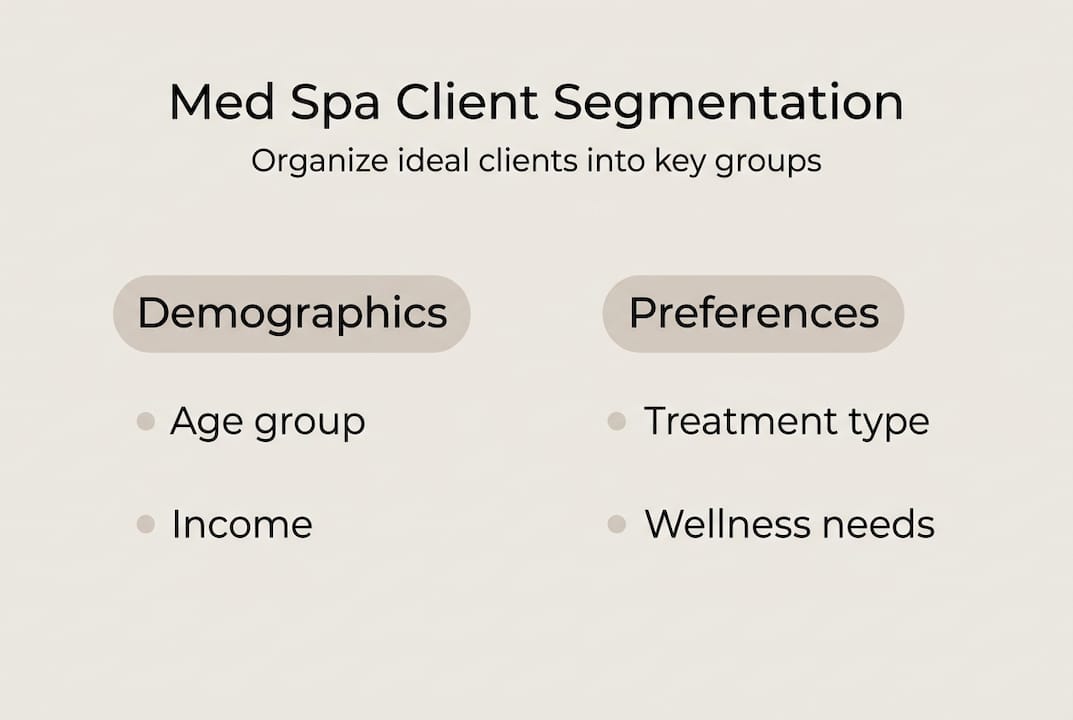
Segmentation is the process of dividing your potential client base into groups that share common characteristics. When you know your segments, you stop guessing and start marketing with precision. Effective segmentation involves demographics, psychographics, and treatment preferences, and each layer adds more accuracy to your targeting.
Here is a breakdown of the most useful segmentation factors for med spas:
| Segmentation type | Examples | Marketing application |
|---|---|---|
| Demographic | Age 30-55, female, household income $80K+ | Tailor offers and pricing tiers |
| Psychographic | Health-conscious, appearance-focused, career-driven | Align messaging to values and lifestyle |
| Behavioral | Repeat bookers, seasonal clients, referral-driven | Loyalty programs and referral incentives |
| Treatment-based | Injectables, laser, body sculpting, wellness | Segment email lists by service interest |
Once you map out these segments, your med spa content ideas become much sharper. Instead of posting generic before-and-after photos, you create content that speaks directly to the concerns of each group.
Psychographic segmentation is where most med spas leave money on the table. Knowing that a client earns $100K per year is useful. Knowing that she prioritizes self-care, reads wellness blogs, and books treatments as a form of stress management is far more powerful. That insight shapes your copy, your visuals, and even the tone of your front desk conversations.
Practical steps to build your segments:
- Survey existing clients about their motivations and treatment goals.
- Review your booking data to find patterns in treatment types and visit frequency.
- Use your CRM to tag clients by service category and engagement level.
- Analyze which content on your website or social media drives the most appointment requests.
Med spa targeting strategies: Digital, local, and traditional methods
With your segments defined, the next question is where and how to reach them. Successful med spa marketing blends digital with local strategies for maximum reach, and the most effective practices combine both rather than choosing one over the other.
Here is a comparison of the main targeting channels:
| Channel | Pros | Cons |
|---|---|---|
| Local SEO | High intent traffic, long-term ROI | Takes time to build |
| Paid advertising | Fast results, precise targeting | Ongoing cost, requires optimization |
| Social media | Visual storytelling, community building | Algorithm-dependent reach |
| Email marketing | Direct, personalized, high ROI | Requires a quality list |
| Traditional (print, events) | Local brand awareness | Hard to track, lower precision |
For most med spas, the highest-return starting point is med spa local SEO. When someone searches “lip filler near me” or “laser hair removal in [your city],” you want to appear at the top. That search represents a client who is already past the awareness stage and ready to act.

Med spa social media plays a different role. It builds familiarity and trust over time. Clients who follow you for months before booking are often your most loyal ones because they already feel like they know your team and your results.
Med spa paid advertising accelerates everything. Google Ads and Meta campaigns let you target by location, age, interests, and even life events like upcoming weddings or new parenthood. The key is matching your ad creative to the specific segment you are targeting.
Here are the most effective targeting actions to implement now:
- Optimize your Google Business Profile with updated photos, services, and weekly posts.
- Run geo-targeted Meta ads to audiences within 10 miles of your location.
- Build email sequences for each treatment category with educational content and offers.
- Partner with local businesses like gyms, bridal boutiques, and wellness studios for referrals.
- Collect and respond to Google reviews consistently to boost local search rankings.
- Use retargeting ads to re-engage website visitors who did not book.
Pro Tip: Do not spread your budget across every channel at once. Pick two or three that align with where your best clients already spend time, master those, and then expand. Diluted effort produces diluted results.
For a deeper look at marketing steps for med spas, the most consistent performers combine local visibility with a strong digital follow-up system.
How med spas tailor services for their target market
Targeting does not stop at the ad click. What happens after a potential client lands on your website or walks through your door determines whether they book and whether they come back. Service tailoring is the bridge between your marketing and your client experience.
Personalization, pricing, and tailored consultations are critical for client loyalty and conversion. A client who feels like your treatments were designed for her specific concerns is far more likely to rebook than one who felt like she received a generic package.
Here is how to tailor your services by segment:
- For first-time clients: Offer a complimentary consultation that focuses on listening before recommending. This reduces anxiety and builds trust immediately.
- For high-income clients: Position premium packages with added value like priority scheduling, exclusive products, or membership perks rather than discounting.
- For wellness-focused clients: Frame treatments in terms of health outcomes, not just appearance. Words like “restore,” “balance,” and “rejuvenate” resonate more than “fix” or “correct.”
- For results-driven clients: Use before-and-after documentation, treatment timelines, and outcome tracking to show measurable progress.
Pricing strategy is also a targeting tool. Premium pricing for aesthetics signals quality and filters your audience toward clients who value outcomes over discounts. If you compete on price, you attract price-sensitive clients who will leave the moment a competitor offers a deal.
Your med spa web design plays a major role here too. The way your website presents services, pricing, and consultation options either reinforces or undermines the premium positioning you are trying to build.
Pro Tip: Make sure your messaging addresses both wellness and aesthetic priorities. Clients rarely come in for purely cosmetic reasons. They want to feel better, not just look better. When your copy reflects that, it connects on a deeper level.
Med spa vs regular salon: Targeting approaches compared
Understanding how med spa targeting differs from salon targeting helps you avoid the mistake of borrowing strategies that simply do not fit your business model. The two are not interchangeable.
Med spas must meet higher client expectations around wellness, safety, and outcomes. That changes everything about how you market, who you target, and what you promise.
| Factor | Med spa | Regular salon |
|---|---|---|
| Client expectations | Medical-grade results, safety, expertise | Convenience, style, relaxation |
| Decision process | Research-heavy, trust-driven | Impulse or routine-based |
| Marketing tone | Clinical authority with warmth | Friendly, trend-focused |
| Pricing sensitivity | Lower, outcome-focused | Higher, price-comparison common |
| Loyalty drivers | Results, personalization, safety | Convenience, relationship, price |
Key differences in targeting approach:
- Med spas require more educational content because clients need to understand treatments before committing.
- Safety and credentials must be visible in all marketing materials. Certifications, provider bios, and before-and-after galleries are not optional.
- The sales cycle is longer. A salon client might book same-day. A med spa client may research for weeks before their first appointment.
- Referrals carry more weight in med spas because trust is the primary purchase driver.
“When a client chooses a med spa over a salon, they are making a decision based on trust in outcomes, not just convenience. Your marketing must earn that trust before they ever walk in.”
You can explore real-world examples of how this plays out in practice through med spa targeting case studies that show how different positioning strategies affect booking rates and client retention.
Ready to turn your targeting into booked appointments?
Knowing your segments and channels is only half the equation. The other half is having a website and marketing system that converts that targeted traffic into actual appointments. At Aesthetic Brink Lab, we build Smart Website ecosystems designed exclusively for med spas, paired with full-service digital marketing that covers local SEO, paid advertising, social media, and more. Every strategy we use is built around your specific client segments and treatment offerings. If you are ready to stop guessing and start growing with a system built for your business, explore what we do and see how we help med spas like yours fill their books.
Frequently asked questions
What is the most effective way to target med spa clients?
Combining digital marketing, local SEO, and personalized services reaches med spa clients most effectively. Each channel serves a different stage of the client decision journey.
How should a med spa segment its market?
Segment your market by demographics, psychographics, and treatment preferences to sharpen your targeting. Effective segmentation helps you craft messages that speak directly to each client group’s motivations.
What makes med spa targeting different from regular salons?
Med spas require a trust-first approach because clients are making decisions about medical-grade treatments, not just style services. Higher client expectations around safety and outcomes mean your marketing must lead with credibility.
Why is personalization important in med spa targeting?
Personalized consultations and tailored service recommendations build the trust that turns first-time visitors into loyal clients. Clients who feel seen and understood are far more likely to rebook and refer others.
How can med spas use content to attract targeted clients?
Content aligned with specific treatment goals and client concerns drives qualified traffic and builds authority over time. Targeted content ideas for med spas help you attract the right audience rather than a broad, unqualified one.