
Most med spa owners know they need better marketing, but the moment someone mentions a “martech stack,” eyes glaze over. The term sounds like something reserved for Fortune 500 companies with dedicated IT departments, not a boutique aesthetic practice in suburban Dallas. That assumption is costing you clients. The right combination of marketing technology can automate your follow-ups, fill your appointment book, and give you clear data on what’s actually driving revenue. This guide breaks down exactly what martech means for med spas, which tools matter most, and how to put them to work without the overwhelm.
Table of Contents
- What martech means for the modern med spa
- Core components of a med spa martech stack
- Why integration and compliance are non-negotiable
- Trends shaping med spa martech in 2026
- Best practices for implementing martech in your med spa
- Unlock next-level growth with med spa martech support
- Frequently asked questions
Key Takeaways
| Point | Details |
|---|---|
| Martech simplifies growth | Integrated martech solutions streamline lead management, patient engagement, and marketing results for med spas. |
| HIPAA compliance matters | Always choose martech tools that secure patient data and meet HIPAA standards to avoid costly risks. |
| AI drives client acquisition | AI and automation now power med spa marketing, providing both speed and greater visibility in a digital-first world. |
| Stack optimization boosts ROI | Building the right stack at the right growth stage maximizes returns and keeps operations running smoothly. |
What martech means for the modern med spa
Martech is simply the blend of marketing strategy and technology. For med spas, that means using software platforms to manage leads, communicate with clients, track performance, and convert inquiries into booked appointments. It is not one tool. It is a coordinated system.
The misconception that martech is only for large, multi-location clinics keeps smaller practices stuck in manual workflows. A solo injector running a boutique spa can benefit just as much as a regional chain, often more, because the efficiency gains hit harder when your team is lean. Automating a single follow-up sequence, for example, can recover appointments that would otherwise fall through the cracks.
Here is what a basic med spa martech setup typically covers:
- CRM (Client Relationship Management): Tracks every lead, inquiry, and client interaction in one place
- Email and SMS marketing: Sends automated sequences for consultations, post-treatment care, and promotions
- Analytics platforms: Shows you which campaigns drive bookings and where leads drop off
- EMR integration: Connects patient records to marketing workflows without manual data entry
- Review management: Monitors and responds to online reviews automatically
All-in-one platforms are preferred over patching together disconnected tools. Leading options include Aesthetix CRM, PatientNow, HubSpot, and Zenoti. Explore more strategies and tool comparisons on the med spa marketing blog to stay current as the landscape shifts.
Core components of a med spa martech stack
Think of your martech stack like the treatment menu at your spa. Each tool has a specific job, and together they create a seamless client experience from first click to loyal return visit.
| Tool | Primary function | Example platforms |
|---|---|---|
| CRM | Lead tracking and client communication | Aesthetix CRM, HubSpot |
| EMR/Practice management | Patient records and scheduling | PatientNow, Zenoti |
| Marketing automation | Email, SMS, and follow-up sequences | HubSpot, Klaviyo |
| Analytics | Campaign performance and revenue tracking | Google Analytics, Looker |
| Review management | Reputation monitoring and response | Birdeye, Podium |
These tools do not work in isolation. When your CRM talks to your EMR, staff can see a client’s full history before a consultation. When your analytics connect to your email platform, you can see exactly which campaign drove a booking. The most effective stacks use Aesthetix CRM, PatientNow, HubSpot, Google Analytics, and Zenoti in coordinated setups.
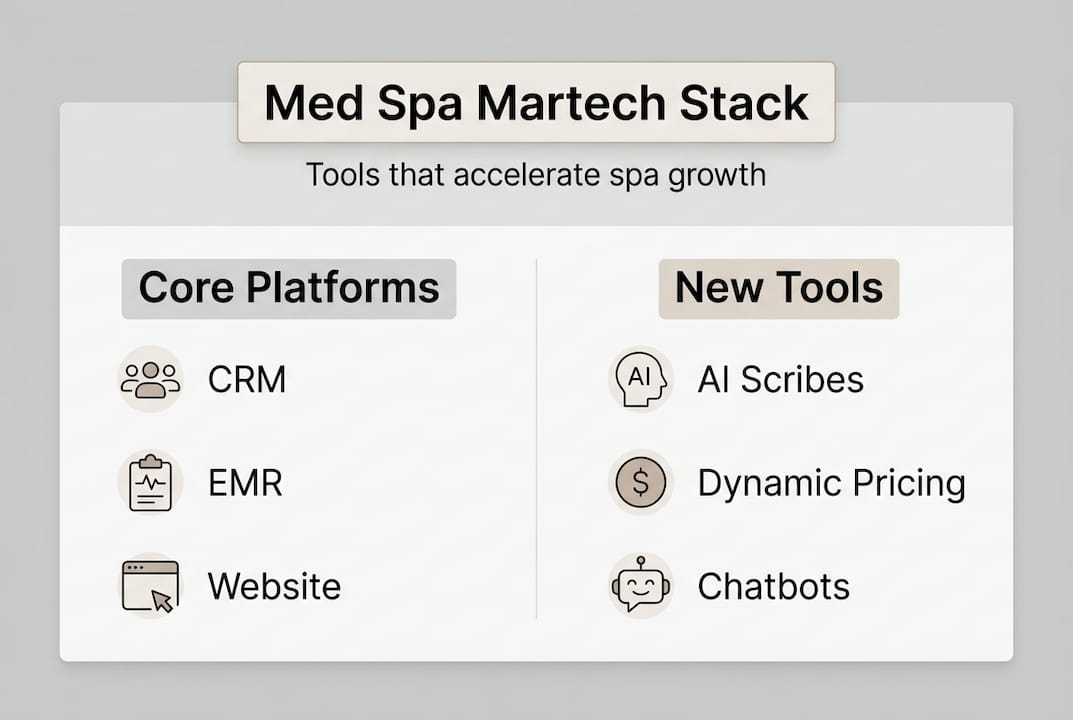
Beyond the classics, 2026 has introduced tools that would have seemed futuristic just a few years ago. AI scribes transcribe and summarize patient consultations in real time. Conversational AI handles direct message inquiries on Instagram and SMS at 2 a.m. Dynamic pricing engines adjust promotional offers based on appointment availability and demand patterns.
Pro Tip: When evaluating any new platform, ask the vendor directly whether it offers native integration with your existing EMR. Native integrations share data automatically. Third-party connectors often break, create sync delays, and require manual fixes that eat up staff time.
Your website is the hub where all of this martech activity lands. Investing in website design for med spas that is built to capture and convert leads makes every other tool in your stack perform better.

Why integration and compliance are non-negotiable
Here is where many med spas get into trouble. They buy a handful of tools, set them up in silos, and wonder why their data never tells a clear story. Worse, they use marketing platforms that were not built for healthcare, creating serious HIPAA exposure.
HIPAA compliance is not optional for any system that touches patient data, and that includes your marketing workflows. If your email platform stores patient names alongside treatment history, it must meet HIPAA standards. HIPAA compliance is core to platforms like Aesthetix and PatientNow, and regulated claims in your marketing content require internal approval workflows before they go live.
Here are the top three compliance pitfalls med spas face:
- Using non-HIPAA email platforms for patient communication. Standard Gmail or Mailchimp accounts do not meet HIPAA requirements. Switch to platforms that offer a Business Associate Agreement (BAA).
- Publishing unreviewed medical claims in automated campaigns. Automation is powerful, but it can fire off content that makes unapproved treatment claims. Build an approval step into every automated sequence.
- Failing to audit third-party integrations. Every tool connected to your patient data must also be HIPAA-compliant. One weak link in the chain creates liability for the entire practice.
“Regulated claims in marketing workflows need approval processes built in from the start, not added as an afterthought. Compliance is a system design issue, not just a legal checkbox.”
For multi-location med spas, integration becomes even more critical. Centralized data pipelines let ownership see performance across all locations without manually pulling reports. Disconnected tools mean duplicated work, inconsistent client experiences, and blind spots in your revenue data. Your social media management strategy also needs to sit inside a compliant, integrated system, especially when running paid campaigns that reference specific treatments.
Trends shaping med spa martech in 2026
The pace of change in martech is fast. What separated high-performing med spas from average ones last year is now table stakes. Here is what is actually moving the needle right now.
AI and automation have moved from novelty to necessity. Conversational AI tools handle DM inquiries, qualify leads, and book consultations without a human in the loop. AI scribes reduce documentation time so providers can focus on the client in the room. These are not experimental features anymore. They are live in competitive practices across the country.
Dynamic pricing is gaining traction as med spas look to maximize revenue per appointment slot. Instead of flat promotional pricing, dynamic engines adjust offers based on real-time demand, time of day, and provider availability. Think of it like airline pricing, applied to your Botox schedule.
AIO/SEO is the trend with the biggest long-term implications. 43% of consumers now use AI for product and service recommendations. That means your med spa needs to be visible not just on Google, but inside AI-generated answers on tools like ChatGPT and Perplexity. AIO (AI Optimization) is the practice of structuring your content so AI systems surface your practice in relevant recommendations.
| Feature | Traditional martech | AI-powered martech |
|---|---|---|
| Lead follow-up | Manual email sequences | Conversational AI responds instantly |
| SEO visibility | Keyword-optimized pages | AIO-structured content for AI search |
| Pricing strategy | Fixed promotions | Dynamic pricing based on demand |
| Documentation | Manual provider notes | AI scribe transcription |
| Review responses | Staff-written replies | Automated, personalized responses |
Pro Tip: Start building your AIO/SEO foundation now, before your competitors do. Structure your service pages with clear, factual, question-and-answer style content. AI systems favor concise, authoritative answers when generating recommendations.
Review AI marketing success stories from practices that have already made this shift, and explore integrated marketing solutions designed to keep your med spa visible across both traditional and AI-powered search.
Best practices for implementing martech in your med spa
Knowing what tools exist is one thing. Actually implementing them without disrupting your operations is another. Here is a practical sequence that works for most med spas.
- Audit your current tech. List every tool you pay for, what it does, and whether your team actually uses it. Most practices discover they are paying for overlapping tools or underusing platforms they already own.
- Define your goals before buying anything. Are you trying to reduce no-shows? Increase consultation bookings? Improve retention? Your goals determine which tools you need, not the other way around.
- Prioritize integration from day one. Choose platforms that connect natively. If a vendor cannot show you a live integration with your EMR, move on.
- Plan for compliance upfront. Confirm HIPAA compliance and request a BAA before onboarding any platform that touches patient data.
- Scale your stack with your revenue. At $500K annual revenue, a more robust stack with data pipelines and advanced automation starts to pay for itself. Below that threshold, a lean, well-integrated setup often outperforms an expensive but fragmented one.
Once your stack is live, track these KPIs consistently:
- New inquiry volume: Are your campaigns generating qualified leads?
- Consultation conversion rate: What percentage of inquiries become booked appointments?
- Client retention rate: Are clients returning for follow-up treatments?
- Revenue per appointment: Are upsells and package offers working?
- Cost per acquisition: What does it actually cost to bring in one new client?
Avoid the thin stack trap. A thin stack means you have a CRM that does not connect to your email platform, analytics that do not tie back to revenue, and staff manually copying data between systems. Avoid thin stacks by using data pipelines that keep every tool in sync and give you a single source of truth for decision-making. The med spa marketing blog covers specific tool comparisons and setup guides to help you move faster.
Unlock next-level growth with med spa martech support
Understanding martech is the first step. Implementing it correctly, without losing months to trial and error, is where expert support pays off. Aesthetic Rank Lab works exclusively with med spas, combining full-service digital marketing with a Smart Website ecosystem built to capture and convert leads from every channel. Whether you need med spa social media solutions that stay compliant, integrated marketing services that connect your entire stack, or inspiration from practices that have already scaled, you will find it here. See real-world results from med spas that made the shift and never looked back.
Frequently asked questions
What is martech, and why isn’t it just software?
Martech is the combined use of marketing strategy and integrated technology platforms to grow your practice. All-in-one martech stacks are preferred over patchwork solutions because disconnected tools create data gaps and manual work that cancel out the efficiency gains.
Do med spas need HIPAA-compliant marketing tools?
Yes, any platform that handles patient data, including email and CRM tools, must meet HIPAA standards. HIPAA compliance is core to purpose-built platforms like Aesthetix and PatientNow, and regulated marketing claims require built-in approval workflows.
When should a med spa upgrade its martech stack?
Most experts recommend investing in a robust stack at $500K annual revenue or when manual tasks are visibly slowing growth. Scale at $500K revenue and use data pipelines to connect tools for measurable ROI.
What martech trends could impact med spa marketing in 2026?
AI-driven tools, AIO/SEO tactics, and dynamic pricing strategies are the key trends shaping med spa marketing right now. AI scribes, dynamic pricing, and conversational AI are already live in competitive practices and will become standard expectations within the next 12 to 18 months.