
TL;DR:
- Generating blog ideas requires understanding your audience, identifying content gaps with AI tools, and organizing topics into clusters to build authority. Continuous measurement and iteration ensure your content strategy remains aligned with audience needs and search trends. Using structured prompts and a systematic process helps avoid redundant topics and maximizes content relevance and impact.
Running out of fresh ideas is one of the fastest ways to stall a blog’s growth. Blog content ideas generation sounds simple until you’re staring at a blank editorial calendar for the third week in a row. The good news is that a structured approach to ideation, one that combines AI tools, gap analysis, and strategic planning, can produce a steady pipeline of blog topics that actually resonate with real readers and rank in both traditional and AI-powered search. This guide walks you through that exact process from setup to execution.
Table of Contents
- Key takeaways
- Blog content ideas generation: what you need first
- Step-by-step methods for generating blog ideas
- Organizing ideas into topic clusters
- Common mistakes in blog content ideation
- Measuring success and iterating your process
- My take on generating blog ideas that actually work
- How Aestheticranklab can support your content strategy
- FAQ
Key takeaways
| Point | Details |
|---|---|
| Know your audience first | Map your readers’ intent stages before generating ideas to avoid irrelevant or low-impact topics. |
| Use AI for gap-based ideation | Tools like Yoast and Claude surface content gaps your site is missing rather than recycling obvious ideas. |
| Organize ideas into topic clusters | Group related posts around pillar content to build authority and prevent keyword overlap. |
| Validate before you invest | Run short content sprints to test ideas before committing to long-form posts. |
| Measure and refine continuously | Use analytics and audience feedback to improve your ideation process over time. |
Blog content ideas generation: what you need first
Before you generate a single idea, you need clarity on three things: who you’re writing for, what your content already covers, and where the gaps are. Skipping this step is why most content calendars fill up with redundant posts that fail to move the needle.
Start by building a content inventory. List every post you’ve published, the topic it covers, and which stage of the buyer’s journey it targets. Awareness, consideration, and decision stage content all serve different purposes. If 90% of your posts are awareness-level, you’re missing readers who are closer to taking action.
You’ll also need a few core tools before diving into ideation:
- Content analytics (Google Search Console, GA4) to see what’s already performing
- Keyword research tools to identify search demand and competition
- An AI assistant (Claude, ChatGPT, or similar) for generating and analyzing topic pools
- A content planner integrated with your CMS when possible
Pro Tip: Match every content goal to a specific audience intent stage before you start generating ideas. If you can’t answer “What does my reader do after reading this?” the topic probably isn’t ready yet.
Mapping content to audience needs also means identifying what competitors cover that you don’t. That gap is your opportunity, and it’s far more productive than starting from scratch with a blank brainstorm session.
Step-by-step methods for generating blog ideas
Once your foundation is solid, the actual ideation becomes much more efficient. Here’s a process that combines AI tools with strategic thinking to generate blog topic inspiration at scale.
Step 1: Run an AI-powered content gap analysis
The Yoast AI Content Planner analyzes your existing content directly inside WordPress and generates targeted blog post ideas designed to fill gaps in your coverage. You can regenerate the suggestions whenever you need a fresh batch. This is a significant improvement over generic brainstorming because the tool works from your actual site data, not just keyword volume.
Step 2: Use a conversational AI assistant for deeper analysis
Claude integrated with WordPress identifies audience search gaps not covered on your site, prioritizes them by relevance, and can draft a content calendar with outlines ready for publication. Feed it context about your audience, your niche, and your goals. The more specific your input, the more targeted the output.
Step 3: Generate a large idea pool and score it
Tools like StoryLab.ai can produce 25 content ideas from a single topic input, then walk you through a scoring process that ranks ideas by relevance and effort. This is useful when you want volume fast. The sprint method works like this:
- Enter a broad topic into the generator
- Review all 25 ideas against your content inventory
- Score each idea on audience fit, search potential, and business relevance
- Rewrite the top scorers with your brand angle
- Assign formats (listicle, how-to, case study, comparison)
- Schedule the winners into your editorial calendar
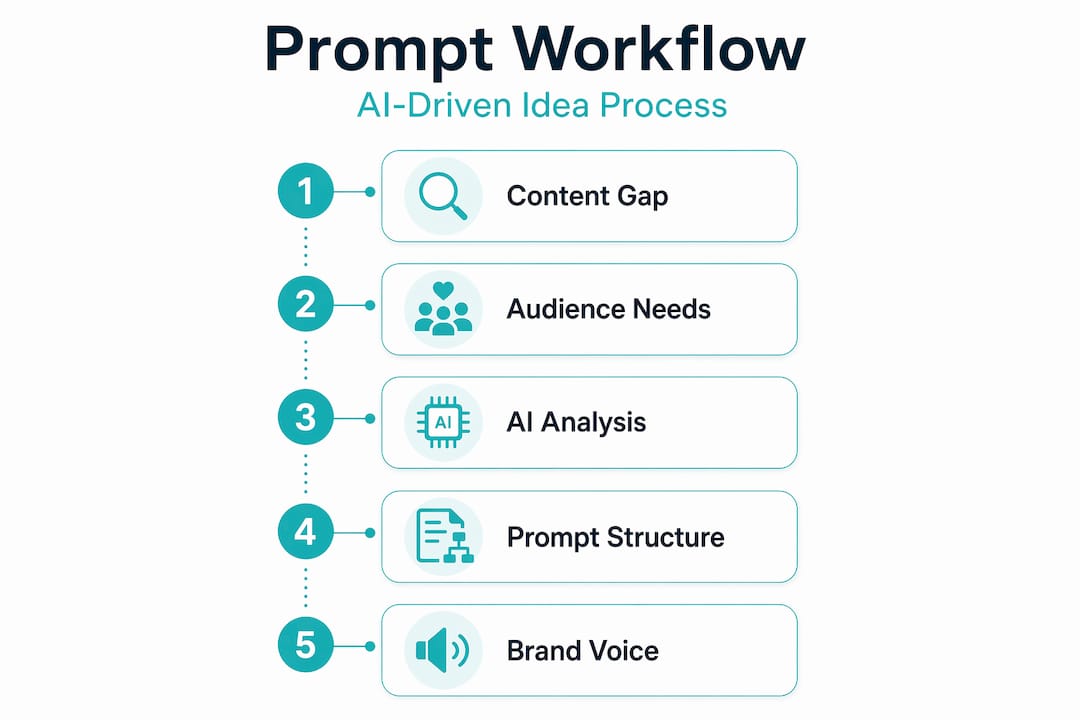
Step 4: Build structured AI prompts
Generic prompts produce generic ideas. Effective LLM content prompts include training documents, guardrails around brand voice, and storytelling ceilings to reduce low-quality output. A strong prompt might look like this: “You are a content strategist for a [niche] blog. Our audience is [describe them]. We already cover [existing topics]. Generate 10 blog post ideas that address questions our readers have but our site hasn’t answered yet.”
Here’s how different tools compare for idea generation:
| Tool | Best for | Input required | Output type |
|---|---|---|---|
| Yoast AI Content Planner | Site-specific gap analysis | WordPress site access | 5 targeted ideas |
| Claude + WordPress | Deep gap analysis and calendars | Audience context and goals | Ideas, outlines, calendars |
| StoryLab.ai | High-volume idea sprints | Single topic keyword | 25 ideas with scoring |
Pro Tip: Always layer your brand voice on top of AI suggestions. AI gives you the raw material. Your editorial judgment turns it into something readers actually want to read.
Organizing ideas into topic clusters
Generating ideas is only half the work. The other half is organizing them so they build on each other rather than competing against each other.

Topic clusters work by grouping related posts around a single pillar page. The pillar page covers a broad topic at depth, while cluster posts tackle specific subtopics and link back to the pillar. This structure signals authority to search engines and keeps readers moving through your content.
Mapping topics to buyer journey stages prevents content overlap and avoids cannibalization where two posts compete for the same search query. Each post in a cluster should serve a distinct intent: one might address “what is X,” another “how to do X,” and a third “X vs. Y comparison.” These are different reader moments, even if they sit under the same topic umbrella.
Topic clusters must cover every relevant user question comprehensively rather than just mention keywords to signal authority and improve AI search citation potential. That means going beyond surface-level lists and actually answering the question in full. A good cluster doesn’t just tell readers what exists. It walks them through it.
Internal linking ties the cluster together. When a cluster post links to the pillar and vice versa, you create a web of relevance that reinforces your authority on the topic. This also guides readers through a logical path from awareness to decision.
Pro Tip: Before publishing any new post, ask which cluster it belongs to and which existing posts it should link to. If you can’t answer both questions, the post isn’t ready for the calendar.
Given that organic search and AI search rankings overlap only 12%, building a diversified cluster portfolio is no longer optional. You need content that performs for traditional search and content that gets cited in AI-generated answers. These are different formats with different structures, and a smart cluster strategy covers both.
Common mistakes in blog content ideation
Even experienced content creators fall into predictable traps when generating blog topics. Recognizing these early saves you months of wasted effort.
- Chasing volume over relevance. Generating 100 ideas means nothing if none of them match what your audience actually searches for. Quality scoring matters more than quantity.
- Ignoring business goals. Every idea should connect to a measurable outcome, whether that’s traffic, leads, or brand authority. “Interesting” is not a strategy.
- Writing vague AI prompts. A prompt like “give me blog ideas for a marketing blog” produces ideas you’ve seen a hundred times. Structured prompts with constraints produce ideas worth publishing.
- Skipping prioritization. Without a scoring system, your calendar fills with the easiest ideas rather than the most impactful ones.
- Not testing before committing. Long-form content is a big investment. Publishing a short post or social thread first tells you whether a topic generates real interest before you spend five hours writing a 2,000-word guide.
Pro Tip: Run a seven-day content sprint on a new idea before building it into a pillar post. Publish something short, watch how your audience responds, and let real data guide your decision to go deeper.
Quick content sprints validate ideas efficiently before you invest in long-form production. This approach protects your time and sharpens your instincts about what resonates.
Measuring success and iterating your process
Generating ideas is an ongoing system, not a one-time task. The bloggers who consistently produce strong content treat ideation as a process they measure and improve.
Here’s what to track after publishing:
- Organic traffic per post: Which topics attract the most readers from search?
- AI search citations: Are your posts showing up as sources in AI-generated answers?
- Engagement metrics: Time on page, scroll depth, and social shares signal whether content actually connects.
- Conversion actions: Are readers clicking through to offers, booking calls, or subscribing?
- Prompt output quality: Are your AI-generated idea lists getting better or worse over time? Refine your prompts based on what produces winners.
Gap-based content ideation significantly reduces generic or redundant topics when you feed your results back into the next round of planning. If a topic underperforms, ask whether the angle was wrong, the format didn’t fit the intent, or the idea itself was too broad. Each answer improves your next ideation session.
Revisit your content inventory every 90 days. Update your cluster maps based on new search trends. Adjust your calendar when a topic cluster starts showing diminishing returns. The bloggers who do this consistently outperform those who treat ideation as a set-it-and-forget-it activity.
My take on generating blog ideas that actually work
I’ve worked with enough content teams to know that the ideation bottleneck is almost never a creativity problem. It’s a system problem. When I first started helping marketers build content pipelines, most were brainstorming in a vacuum. Great ideas for blog posts were getting buried because nobody had mapped them to a gap, a cluster, or an audience stage.
What shifted everything for me was embracing gap-based ideation as the starting point, not an afterthought. When you know what your site doesn’t cover and what your audience is actively searching for, the ideas stop feeling random. They feel necessary.
I’ve also learned to trust AI tools only as far as the prompts you give them. I’ve seen content teams produce genuinely creative blog topics by treating AI as a thinking partner rather than a content machine. Feed it context. Give it constraints. Then edit the output with your editorial judgment. The combination is more powerful than either approach alone.
The biggest mistake I still see? Treating blog content ideas generation as a monthly meeting rather than a continuous feedback loop. The best content calendars I’ve reviewed are living documents, updated weekly based on what’s performing and what the audience is asking about. Build that habit and you’ll never stare at a blank calendar again.
— Keith
How Aestheticranklab can support your content strategy
At Aestheticranklab, we work specifically with med spas that want to turn their blog into a real growth engine, not just a publishing schedule. If you’ve made it through this guide, you already understand the work involved in doing content strategy well. Sometimes the smartest move is pairing your own ideation efforts with expert support.
Our team handles everything from med spa SEO audits to full content strategy builds designed for the beauty industry. We also offer marketing automation for med spas that integrates your content calendar with your booking and lead generation systems. If you’re ready to stop guessing and start growing, explore what we offer and see where the gaps are in your current strategy.
FAQ
What is blog content ideas generation?
Blog content ideas generation is the process of systematically identifying topics that your audience searches for and that your site doesn’t yet cover. It combines audience research, gap analysis, and tools like AI content planners to produce a consistent pipeline of relevant topics.
How do I use AI to generate blog post ideas?
Use AI tools with specific prompts that include your niche, existing content, and audience profile. Tools like Claude and the Yoast AI Content Planner analyze your site and suggest gap-filling topics rather than generic suggestions.
What are topic clusters and why do they matter?
Topic clusters group related blog posts around a central pillar page connected through internal links. Hub-and-spoke cluster structures prevent keyword overlap, build topical authority, and increase the chances of being cited in AI search results.
How many blog ideas should I generate at once?
Generate at least 20 to 25 ideas per session so you have enough to score and filter. Tools like StoryLab.ai produce 25 ideas per sprint with a built-in scoring method to identify the highest-potential topics for your calendar.
How do I know if my blog content ideas are working?
Track organic traffic, AI search citations, time on page, and conversion actions for each post. Revisit your ideation process every 90 days and refine your prompts and cluster maps based on what the data shows is resonating with your audience.