
You’re spending real money on digital ads, but the clients booking appointments live three states away or aren’t even close to your zip code. Generic online advertising burns your budget on impressions that will never walk through your door. Geotargeting solves this by directing your ads and content specifically to people in your local area, so every dollar works harder. This guide breaks down what geotargeting is, why it matters for med spas, which tools to use, and how to run campaigns that actually fill your appointment book with local clients.
Table of Contents
- What is geotargeting? Definition and basics
- Benefits of geotargeting for med spas
- How geotargeting works: Tools and techniques
- Applying geotargeting: Campaign strategies for med spas
- Why most med spas underutilize geotargeting
- Connect with geotargeting and grow your med spa
- Frequently asked questions
Key Takeaways
| Point | Details |
|---|---|
| Geotargeting defined | Geotargeting lets med spas focus marketing efforts on the people most likely to book locally. |
| Major benefits | Locally-targeted campaigns increase conversions and reduce marketing waste for med spas. |
| Tools and strategies | Med spas can leverage Google Ads, Facebook Ads, and local SEO for powerful geotargeting. |
| Practical application | Campaigns work best when testing different locations and continuously optimizing. |
| Expert support | Professional guidance makes implementing geotargeting easier and more effective for med spa owners. |
What is geotargeting? Definition and basics
Geotargeting means showing your ads, content, or offers to people based on their physical location. Instead of broadcasting to everyone on the internet, you focus your message on people in a specific city, neighborhood, zip code, or radius around your med spa. The result is that your budget reaches people who can realistically become clients.
It helps to understand how geotargeting differs from geofencing. Geotargeting works at a broader level, like targeting everyone in a metro area or a set of zip codes. Geofencing draws a tight virtual boundary around a specific location, such as a one-mile radius around your building, and triggers ads when someone enters that zone. Both are useful, but geotargeting is typically the starting point for most med spa campaigns.
For targeting med spa clients effectively, geotargeting adds local relevance that generic campaigns simply cannot match. When someone in your city searches for “Botox near me” or scrolls through Instagram, a geotargeted ad puts your med spa in front of them at exactly the right moment.
Geotargeted ads can boost conversion rates by up to 50% compared to generic ads, making location-based targeting one of the highest-leverage moves in your marketing toolkit.
Here are the most common geotargeting channels med spas use:
- Google Ads: Set campaigns to show only within specific zip codes, cities, or a radius around your address
- Facebook and Instagram Ads: Use location targeting to reach users within a defined area, layered with age and interest filters
- Local SEO: Optimize your Google Business Profile and website so you rank in local search results organically
- Programmatic display ads: Serve banner ads to users browsing websites while physically located near your spa
- Email and SMS geo-segmentation: Send promotions to subscribers based on their listed location
Each channel reinforces the others. When a potential client sees your Google Ad, then your Instagram post, then your Google Business Profile, all tailored to their location, trust builds fast.
Benefits of geotargeting for med spas
Generic ads cast a wide net and hope for the best. Geotargeting flips that model by starting with geography and building outward. The practical difference shows up in your numbers.
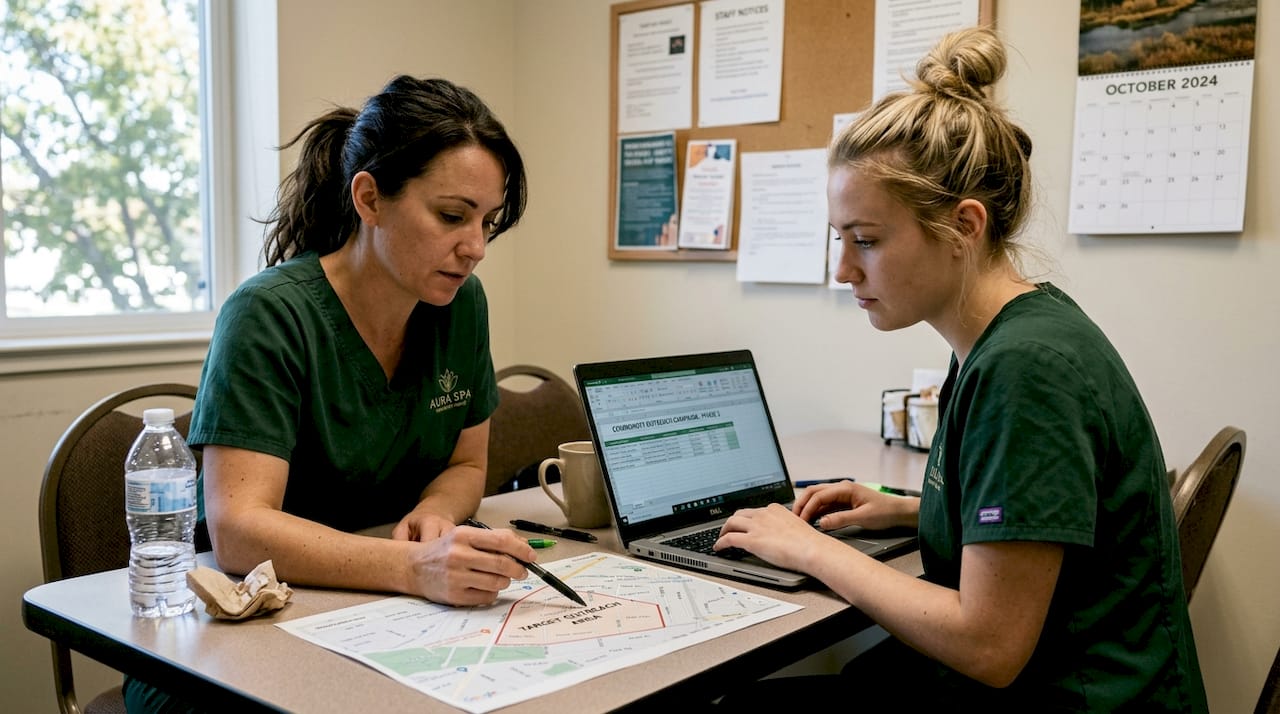
Locally targeted campaigns often outperform broader ones by over 30% for walk-in traffic, and boosting med spa sales through local ad targeting also increases website inquiries from people who are already nearby and motivated.
Here is a direct comparison of what you can expect:
| Ad approach | Avg. conversion rate | Cost per lead | Walk-in traffic impact |
|---|---|---|---|
| Generic national ads | 1.5% to 2% | High | Minimal |
| City-level geotargeting | 3% to 4% | Moderate | Moderate |
| Zip code or radius targeting | 5% to 7% | Low to moderate | High |
| Geofencing (tight radius) | 6% to 9% | Low | Very high |
The benefits go beyond raw conversion numbers. Geotargeting also:
- Reduces wasted spend by eliminating impressions from people who will never visit your location
- Increases ad relevance, which improves your Quality Score in Google Ads and lowers your cost per click
- Builds local brand recognition so your spa becomes the name people think of first in your area
- Supports local SEO for med spas by aligning your paid and organic strategies around the same geographic signals
“The most profitable med spa marketing is not about reaching more people. It is about reaching the right people in the right place at the right time.”
Pro Tip: Layer geotargeting with demographic targeting, such as women aged 30 to 55 within five miles of your spa, to dramatically narrow your audience to your highest-value prospects. This combination typically delivers the strongest return on ad spend.
How geotargeting works: Tools and techniques
Knowing the benefits is one thing. Setting it up correctly is another. Here is a practical breakdown of the tools and steps involved.
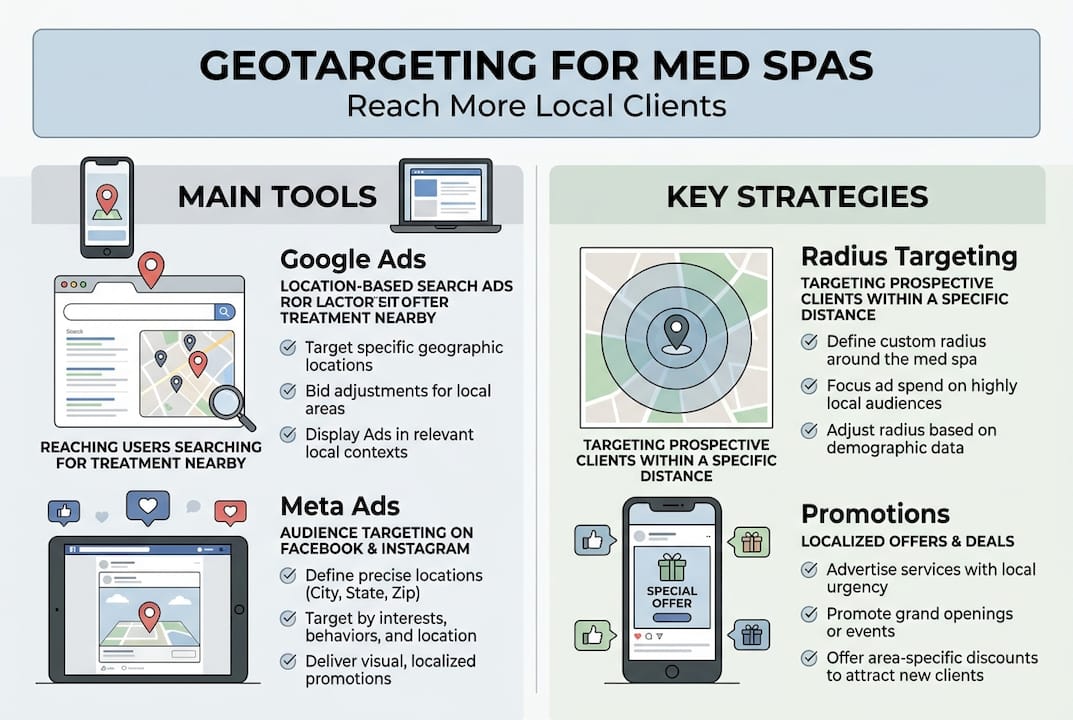
Key geotargeting platforms for med spas:
| Platform | Targeting options | Best use case |
|---|---|---|
| Google Ads | Radius, zip code, city, DMA | Search intent campaigns |
| Facebook and Instagram Ads | Radius, city, zip code, address drop pin | Visual brand awareness |
| Google Business Profile | Local search and maps visibility | Organic local discovery |
| Yelp Ads | City and neighborhood targeting | Review-driven conversions |
Effective geotargeting uses platforms like Google Ads, Facebook, and local SEO guide tools working together, not in isolation.
Here is how to set up geotargeting step by step:
- Define your target area: Start with a 5 to 10 mile radius around your spa, then adjust based on where your current clients actually come from
- Set up Google Ads location targeting: In your campaign settings, choose “Enter another location” and specify your radius or zip codes. Select “People in or regularly in your targeted locations” to avoid wasted impressions
- Configure Facebook location targeting: In Ads Manager, use the Locations section to drop a pin on your address and set a radius. Choose “People living in this location” for the most qualified audience
- Optimize your Google Business Profile: Keep your address, hours, and service area current so you appear in local map results organically
- Sync with your med spa social media content: Post location-specific content that reinforces your geographic relevance across channels
On privacy: geotargeting uses aggregated location data, not individual tracking. Platforms like Google and Meta comply with privacy regulations, so you are not violating any rules by using standard location targeting features. Stay current with platform policies and avoid collecting location data directly on your own site without proper consent disclosures.
For a deeper look at digital tactics across channels, the digital marketing blog covers ongoing updates relevant to med spas.
Applying geotargeting: Campaign strategies for med spas
Tools are only as good as the campaigns you build with them. Here is how to put geotargeting to work in real med spa marketing scenarios.
Campaign ideas that perform well with geotargeting:
- Flash promotions: Run a 48-hour offer on Botox or filler targeted to people within three miles of your spa. Urgency plus proximity drives fast bookings
- Seasonal offers: Target your local area with summer body contouring promotions or holiday skin treatment packages timed to local buying patterns
- Event-based campaigns: If a local event or festival is happening nearby, run ads targeting attendees in that area during the event window
- New client acquisition: Target neighborhoods adjacent to your current client base to expand your reach into untapped local segments
- Referral reinforcement: Serve ads to existing clients in your area to keep your spa top of mind and encourage repeat visits
For content ideas for engagement, pairing location-specific promotions with strong visual content dramatically improves click-through rates.
Pro Tip: Run two or three separate location segments simultaneously, such as your immediate neighborhood, a five-mile radius, and a ten-mile radius, and compare performance. You will quickly learn which distance drives the most cost-effective bookings and can reallocate budget accordingly.
Mistakes to avoid:
- Setting your radius too narrow and missing potential clients just outside your immediate area
- Ignoring local search trends and seasonal demand shifts in your specific market
- Running the same ad creative for every location segment instead of customizing messaging by neighborhood or distance
- Failing to track conversions at the campaign level, which makes optimization impossible
Successful geotargeting requires continuous optimization and tracking for best results. Check your campaign analytics weekly, pause underperforming segments, and reinvest in what works. Explore all available med spa services to build a full-funnel approach around your geotargeting campaigns.
Why most med spas underutilize geotargeting
Here is something we see repeatedly: med spas invest heavily in social media content and broad digital ads, then wonder why their cost per booking keeps climbing. The missing piece is almost always local precision.
Many med spa owners assume that more impressions equal more clients. They focus on follower counts and reach metrics without asking the more important question: how many of those people can actually drive to my location? Digital branding for med spas matters, but without geographic focus, even great branding reaches the wrong audience.
The spas growing fastest in competitive markets are not necessarily spending more. They are spending smarter by tailoring every paid channel to their specific local area. They test zip codes, adjust radius settings monthly, and align their organic SEO with the same neighborhoods their ads target. That consistency compounds over time.
The uncomfortable truth is that most med spas treat geotargeting as a checkbox rather than a strategy. They turn on location targeting once and never revisit it. Real results come from treating your geographic targeting as a living part of your campaign, one that you refine based on actual booking data, not assumptions.
Connect with geotargeting and grow your med spa
If you are ready to stop guessing and start reaching the local clients who are most likely to book, expert support makes a measurable difference. At Aesthetic Rank Lab, we build geotargeting strategies specifically for med spas, combining med spa local SEO services, paid ad management, and social media solutions into a single, coordinated approach. We also help you build the local brand presence that makes every campaign more effective, starting with a strong digital branding guide tailored to your market. Schedule a consultation with our team to get a geotargeting plan built around your specific location, services, and growth goals.
Frequently asked questions
How does geotargeting differ from geofencing for med spas?
Geotargeting uses broader location targeting such as cities or zip codes, while geofencing draws a tight virtual boundary around a specific address or small radius and triggers ads when someone enters that zone.
What platforms support geotargeted advertising for med spas?
Google Ads and Facebook Ads both offer robust geotargeting capabilities, and local SEO tools like Google Business Profile extend your reach into organic local search results.
Can geotargeting help med spas attract more walk-in clients?
Yes, because local ad targeting puts your spa in front of people who are physically nearby and actively searching, which directly increases both walk-in traffic and appointment bookings.
Is geotargeting expensive for small med spas?
Geotargeting is often more cost-effective than broad campaigns because locally targeted campaigns eliminate wasted impressions and focus your budget only on the audience most likely to convert into paying clients.