
TL;DR:
- Effective digital ad campaigns start with a detailed planning stage that clearly defines goals, target audience, budget, and platform suitability. Successful setup for Google and Meta ads requires structured implementation, matched creatives, and ongoing testing, optimization, and data analysis. Most campaign failures stem from poor planning and misaligned messaging rather than execution, emphasizing the importance of strategic foundations and iterative creative testing.
Most marketers and business owners know they need digital ads. Few know exactly how to build them correctly from the start. The gap between “I boosted a post” and running a real step by step digital ad creation process is enormous, and that gap is where budgets disappear. This guide covers the full advertising process: from strategic planning through Google Ads and Meta Ads setup, creative design, and post-launch optimization. Whether you are brand new to paid advertising or cleaning up years of guesswork, you will walk away with a clear, repeatable framework that produces better results.
Table of Contents
- Key Takeaways
- Step by Step Digital Ad Creation: Foundation First
- Creating Google Ads: a step-by-step walkthrough
- Creating Meta ads: campaign to publish
- Creative strategy and ad design best practices
- Verification and optimization after launch
- My honest take on where most ad campaigns actually fail
- How Aestheticranklab helps med spas run better ads
- FAQ
Key Takeaways
| Point | Details |
|---|---|
| Planning precedes everything | Define your goals, audience, and budget before opening any ad platform. |
| Platform setup follows structure | Google Ads and Meta Ads each require specific campaign, ad set, and creative configurations. |
| Creatives must match landing pages | Ad messaging that mismatches the landing page kills conversion rates and wastes spend. |
| Test creatives as experiments | Treat every hook and CTA as a hypothesis to test, not a finished product. |
| Optimize after learning phases | Avoid changing campaigns too early. Let platforms gather data before drawing conclusions. |
Step by Step Digital Ad Creation: Foundation First
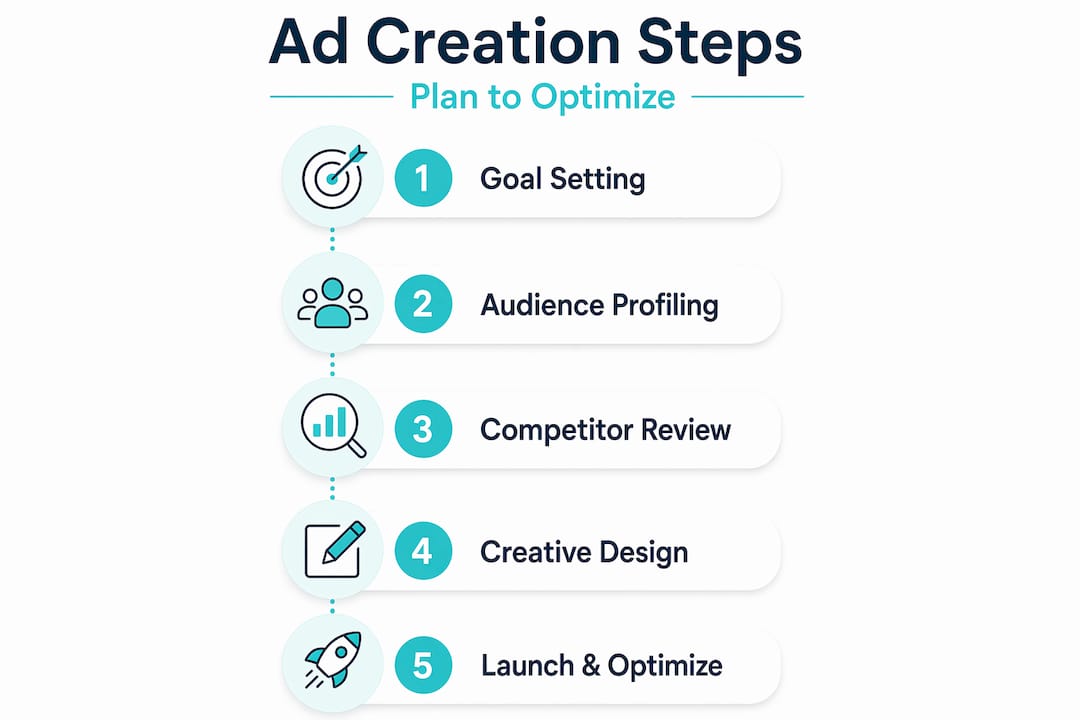
Before you touch a single ad platform, you need a written advertising plan. This is not a suggestion. A structured advertising plan functions like an operating system: it aligns your goals, channels, budgets, targeting logic, and KPIs into one coherent document you can actually execute against.
Start by answering four questions with specificity:
- What is the campaign goal? Sales, lead generation, brand awareness, and app installs each require different platform choices, bidding strategies, and creative formats. Mixing them into one vague objective produces mediocre results across the board.
- Who is the audience? Go beyond demographics. Identify the emotional triggers, purchase objections, and specific desires of your ideal customer. For med spa marketers, that means understanding whether you are speaking to someone researching Botox for the first time or a returning client looking for a membership upgrade.
- What is the budget, and how is it allocated? Splitting budget across too many channels dilutes learning. New advertisers get faster clarity by concentrating spend on one or two channels until they find what works.
- Which platforms fit the goal? Search-intent traffic (people actively looking) belongs on Google Ads. Awareness and interest-stage audiences respond better to Meta, Instagram, or YouTube. Display ads work for retargeting.
Pro Tip: Run a quick competitor analysis before launching. Review what ads your competitors are running using Meta’s Ad Library. You will immediately spot gaps in messaging and formats you can exploit.
A solid digital advertising plan should also include a basic SWOT analysis of your offer. Knowing your strengths and weaknesses relative to competitors shapes the angle of your ad copy long before you sit down to write a single headline.
Creating Google Ads: a step-by-step walkthrough
Google Ads rewards structured thinking. The detailed Google Ads setup follows a clear sequence that mirrors how the platform’s algorithm reads and serves your campaigns. Follow these steps in order:
- Create your account correctly. When setting up a new Google Ads account, choose “create account only” rather than jumping into the Smart Campaign setup. Smart Campaigns limit your control and often waste budget on irrelevant placements.
- Select the right campaign type. For most service businesses, Search campaigns deliver the highest purchase intent. Choose Display for retargeting, Performance Max when you have solid conversion data, and Video for top-of-funnel awareness.
- Configure campaign settings. Set locations precisely. If you serve a city, target that city and exclude surrounding regions unless they convert. Set an ad schedule aligned to your business hours and your audience’s browsing behavior.
- Research and select keywords. Use Google’s Keyword Planner alongside third-party tools. Prioritize exact match and phrase match keywords at launch to control reach and gather clean data. Broad match can expand later once you know what converts.
- Write ads that earn clicks. Google recommends including primary keywords in your headlines, matching your description to the headline’s promise, and optimizing landing pages for the specific offer in the ad. Every headline should address one clear benefit or solve one specific pain.
- Add extensions. Sitelinks, callouts, and call extensions improve click-through rates and give Google more material to serve the most relevant version of your ad.
- Set device targeting and launch. Review how your audience uses mobile versus desktop. Service businesses often see stronger conversion on desktop during business hours. Launch the campaign and then leave it alone for the first several days to allow the platform’s learning phase to stabilize.
Pro Tip: Never launch a Google Ads campaign without verified conversion tracking. Tracking and landing page alignment must be confirmed before spend begins. Launching blind means you will optimize toward traffic volume rather than actual business outcomes.
Creating Meta ads: campaign to publish
Meta Ads Manager gives you far more creative flexibility than Google, but it also requires more deliberate audience configuration. The Meta ad creation workflow starts before you open Ads Manager.
- Set up prerequisites. You need a verified Facebook Business Page, a Meta Business Manager account, a confirmed payment method, and a Facebook Pixel installed on your website. Do not skip the Pixel. Without it, you lose remarketing capability and conversion optimization signals.
- Choose your campaign objective. Meta’s algorithm optimizes delivery based entirely on the objective you select. Leads, conversions, traffic, and awareness each trigger different delivery patterns. Choosing the wrong objective is one of the most common and costly mistakes in the Meta advertising process.
- Configure your ad set. This is where audience targeting happens. Core audiences use demographics, interests, and behaviors. Custom audiences pull from your pixel data, customer lists, or video viewers. Lookalike audiences find new users who resemble your best existing customers. Each serves a different stage of the funnel.
- Choose placements. Meta’s Advantage+ auto-placement option works well once you have conversion data. When starting out, manually selecting placements gives you cleaner performance data per channel. Instagram Feed and Facebook Feed typically outperform sidebar and Audience Network placements for most service businesses.
- Build your creative. Upload your image or video, write your primary text (aim for the first 125 characters to carry the full hook), craft a headline under 27 characters, and write a clear description. Preview the ad across all selected placements before publishing.
- Set budget and schedule, then publish. Meta reviews ads before serving them. Most are approved within 24 hours. Budget and schedule go at the ad set level. Start with daily budgets rather than lifetime budgets to maintain flexibility during the learning phase.
You can explore the med spa social media ad workflow for a deeper look at structuring Meta campaigns specifically for service-based businesses.
Creative strategy and ad design best practices
The platform setup gets your ads seen. The creative determines whether they convert. Effective ad creative strategy follows a system: align your audience and goal first, identify two or three messaging pillars that address real pain points or desires, and then build creatives that bring those pillars to life through visuals and copy.
For static image ads, technical setup matters more than most people realize. Correct document specs, including accurate dimensions, RGB color space, and 72 DPI screen resolution, prevent your ads from appearing blurry or incorrectly cropped across placements. Build at 2x resolution and scale down to retain clarity on retina displays.
Key design principles worth following:
- Use a single focal point per ad. Multiple competing visual elements reduce recall and click-through rates.
- Keep body copy minimal. The ad’s job is to earn the click, not explain every detail.
- Match the visual tone to the landing page. A disconnect between the ad aesthetic and the page it links to breaks user trust immediately.
- Use faces in images when testing for engagement. Ads featuring real human faces consistently outperform product-only visuals in most service categories.
For video ads, plan 4 to 7 modular scenes and write multiple hook variations for the first 2 to 3 seconds. The hook is the only variable that determines whether someone watches the rest. AI-assisted UGC-style videos work particularly well because they feel native to the feed rather than branded and polished.
Pro Tip: Treat every creative as a testable hypothesis. Creative hooks in the first few seconds are the single highest-leverage variable to test. Launch two to four hook variations per concept and let performance data tell you which one earns the right to scale.
Verification and optimization after launch
Launching the campaign is not the finish line. The real work starts when data arrives.

Before launch, confirm two things: your conversion tracking fires correctly on every goal action, and your landing page delivers exactly what the ad promises. Conversion tracking and landing page experience must both be fully functional at launch. One broken element wastes every dollar you spend.
The metrics that matter most depend on your goal:
| KPI | When it matters | What to do if it is poor |
|---|---|---|
| Click-through rate (CTR) | Always | Rewrite headlines or change creative |
| Cost per acquisition (CPA) | Conversion campaigns | Tighten audience or improve landing page |
| Return on ad spend (ROAS) | Revenue-focused campaigns | Increase bids on high-converting audiences |
| Frequency | Awareness campaigns | Rotate creatives before audience fatigue sets in |
Both Google and Meta run learning phases after launch. During these periods, the platform’s algorithm tests delivery across audiences and placements to find optimal serve patterns. Making major changes to budget, targeting, or creatives during the learning phase resets it. Give campaigns at least 7 to 14 days before drawing conclusions, and make only one significant change at a time so you can attribute results clearly.
Audience targeting in Meta should be controlled at the ad set level, with separate ad sets for separate audience segments. This discipline lets you isolate which audience is driving performance rather than blending signals together and guessing.
Pro Tip: Build a simple weekly review cadence: check CTR and CPA trends, flag creatives that are fatiguing (rising CPA plus declining CTR), and queue one new creative test per week. Consistency in optimization beats reactive changes every time.
My honest take on where most ad campaigns actually fail
I have reviewed hundreds of ad accounts, and the pattern is consistent. Campaigns fail at the planning stage, not the execution stage.
Most marketers jump into Ads Manager before they have defined a clear objective, profiled their audience with real specificity, or even confirmed that their landing page converts organic traffic. They spend weeks optimizing ad spend before fixing a landing page that converts at 1%. The math never works.
The second mistake I see constantly is treating ad copy and landing page copy as separate decisions made by separate people at separate times. They are one message split across two surfaces. When your ad promises “20% off your first facial” and your landing page talks about your full service menu, the user feels deceived. Bounce rates spike, quality scores drop, and cost per click goes up.
My third observation: most marketers treat their first set of creatives as final. They spend hours perfecting one image, one headline, one CTA, and then wonder why results plateau after two weeks. The 7-step creative strategy system exists precisely because creative is the variable with the most performance leverage and the shortest shelf life. Build systems for fast iteration, not perfect single executions.
The future of the digital advertising process is moving toward AI-assisted creative production and privacy-first targeting signals. Advertisers who learn to work with platform algorithms rather than against them will have a compounding advantage as third-party data continues to erode.
— Keith
How Aestheticranklab helps med spas run better ads
At Aestheticranklab, we work exclusively with med spas, which means we understand your specific audience, your service categories, and the compliance considerations that shape what you can and cannot say in digital ads. We handle full campaign setup, ad creative development, and ongoing optimization so your team focuses on client care rather than Ads Manager.
If you are ready to move from guesswork to a real paid advertising system, start with our med spa advertising overview to understand the full channel strategy. For practices looking to grow their client base faster, our lead generation resource covers how paid ads fit into a broader acquisition system. Our paid advertising services are built specifically for the med spa market.
FAQ
What is the first step in digital ad creation?
Define your campaign goal and audience before opening any ad platform. A clear objective shapes every decision that follows, from platform selection to creative format.
How long does it take to see results from digital ads?
Most campaigns need 7 to 14 days to exit the learning phase before performance data becomes meaningful. Budget, audience size, and offer quality all affect how quickly results appear.
Why does my ad get clicks but no conversions?
The most common cause is a mismatch between ad messaging and landing page content. When ad text relevance does not match what the landing page delivers, users leave without converting.
How do I choose between Google Ads and Meta Ads?
Use Google Ads for capturing existing search demand and Meta Ads for generating demand among audiences who do not yet know they need your service. Most businesses benefit from running both once they have the budget and data to support each channel.
What creative format works best for digital ads?
There is no single answer. Short-form video with a strong hook in the first 3 seconds performs well on Meta and Instagram. For Instagram-specific strategies suited to service businesses, visual-first formats consistently outperform text-heavy static ads.