
TL;DR:
- Reviews significantly influence med spa bookings, with positive feedback increasing conversion rates to 85%.
- Effective review strategies involve consistent collection, timely responses, and visual storytelling on multiple platforms.
Ninety-seven percent of consumers read reviews before choosing a local business. For med spas, that number carries extra weight. When someone is considering Botox, microneedling, or laser treatments, the decision is personal, the stakes feel higher, and trust is non-negotiable. The role of reviews in online marketing goes far beyond star ratings. Reviews shape first impressions, influence search rankings, and function as your most credible marketing asset. This article breaks down exactly how review strategy translates into booked appointments and a stronger brand reputation for med spas in 2026.
Table of Contents
- Key takeaways
- The role of reviews in online marketing for med spas
- What actually drives review impact on conversion
- Strategies for collecting and leveraging reviews
- Emerging trends shaping reviews in 2026
- My take on review-driven marketing
- How Aestheticranklab helps med spas win with reviews
- FAQ
Key takeaways
| Point | Details |
|---|---|
| Reviews drive bookings directly | Positive reviews increase the likelihood a prospect books by 85%, making them your highest-ROI marketing tool. |
| Recency matters more than volume | Seventy-four percent of consumers only trust reviews from the last three months, so steady collection beats one-time campaigns. |
| Responding is not optional | Eighty percent of consumers are more likely to choose businesses that respond to every review, making engagement a conversion tactic. |
| AI is reshaping discovery | Consumer use of AI tools for local recommendations jumped from 6% to 45% in one year, meaning your review signals now feed AI search results too. |
| Visual reviews convert better | Photos and videos in reviews lift conversion by up to 35%, especially for visual services like aesthetics treatments. |
The role of reviews in online marketing for med spas
In traditional marketing terms, reviews are what researchers call social proof: third-party validation that reduces perceived risk in a buying decision. But in the med spa world, they function as something closer to a clinical second opinion. A prospect considering a chemical peel or body contouring treatment is not just comparing prices. They are trying to answer one question: “Can I trust these people with my face and body?”
That’s precisely why the importance of customer reviews in this niche is disproportionately high compared to, say, a coffee shop or hardware store.
The numbers tell a clear story. Reviews influence buying decisions at every stage of the funnel:
- 97% of consumers consult reviews before choosing a local business, averaging six different review sites
- Positive reviews increase the likelihood of using a business by 85%, while negative reviews deter 77%
- After reading favorable reviews, 54% of consumers visit the business website and 66% conduct additional research
- 27% have spent over $1,000 on a service they discovered through reviews
For med spas, that last data point is significant. Aesthetic services often carry high price points, and reviews are the mechanism that closes the trust gap between a prospect and a premium purchase. Think of reviews as user-generated content in marketing that you do not have to pay for and that carries more credibility than any ad you could run.
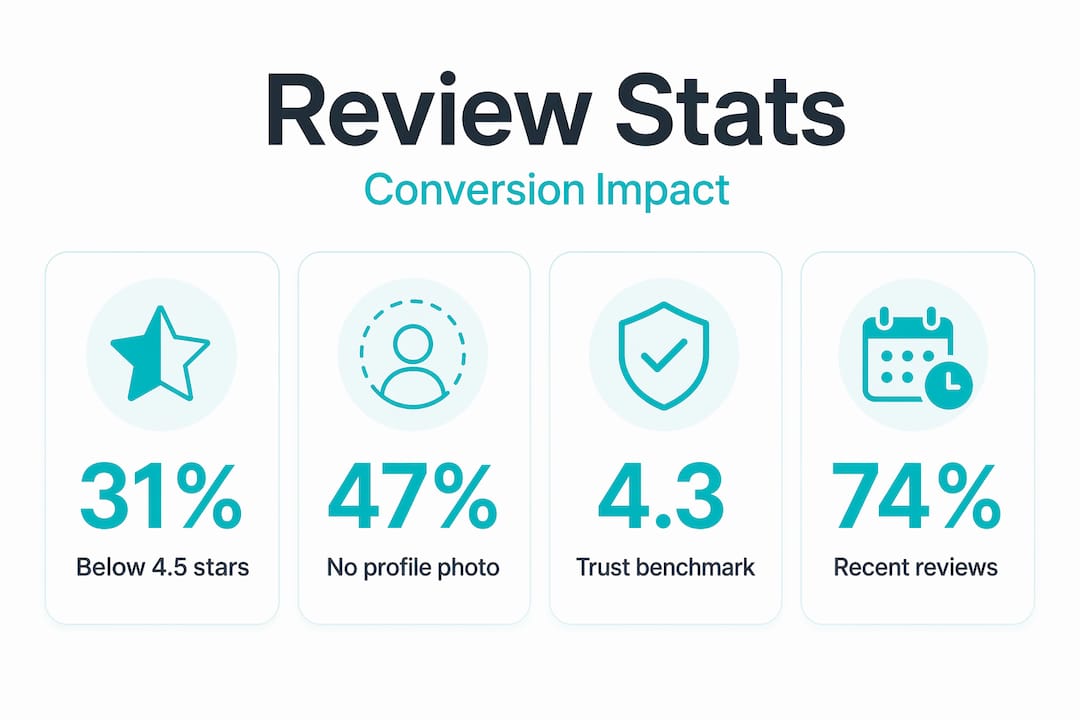
Review quantity, recency, and star rating each play distinct roles. Getting a client to book is rarely one factor. It is the combination of enough reviews (social proof at scale), fresh reviews (recency signals current quality), and a healthy average rating (floor of 4.3 or above) that together convert a curious browser into a booked appointment.

What actually drives review impact on conversion
Not all reviews are created equal. Understanding which review attributes move the needle is where med spa marketers separate effective strategy from wishful thinking.
Star ratings and minimum thresholds
Thirty-one percent of consumers will not use a business rated below 4.5 stars, and 47% won’t engage with businesses that have fewer than 20 reviews. Those are hard floors you need to clear before most of your marketing budget has any real leverage.
Here is something counterintuitive: a perfect 5.0 rating can actually trigger skepticism. Research shows a 4.3-star average with a few honest negatives reads as more credible than a flawless score. Prospects assume perfection means curation or fakery.
The power of recency
74% of consumers only trust reviews from the last three months. A med spa with 200 reviews accumulated over four years but nothing recent reads as a business that stopped caring. For services like injectables where protocols and staff change, recency signals current quality in a way that volume simply cannot.
Visual reviews and storytelling
Photos and video reviews are a category of user-generated content in marketing that med spas are uniquely positioned to leverage. Before-and-after photos shared in reviews carry more persuasive weight than any polished ad image because they come from real clients with no financial incentive. Visual reviews increase conversion by up to 35%, which is particularly meaningful for aesthetic services where the result is the product.
Business responses as trust signals
89% of consumers expect businesses to respond to their reviews, and 80% are more likely to choose a business that responds to every review. Responses work as public demonstrations of how you treat clients. When a prospect reads a review and sees a warm, personalized reply below it, they are not just reading your response to a past client. They are previewing how you will treat them.
Pro Tip: Never copy and paste response templates. Fifty percent of consumers actively dislike templated replies, and in a clinical services context like med spas, generic responses signal exactly the kind of impersonal care people fear.
Strategies for collecting and leveraging reviews
Managing your online reputation is not a passive activity. It requires a system. Here are the proven strategies med spa marketers use to build and leverage their review presence.
Getting more reviews consistently
One of the best practices for collecting reviews is timing. The ideal moment to ask is within 24 to 48 hours of a treatment, when the client’s experience is fresh and positive emotions are high. Common methods that work for med spas:
- Post-appointment text or email with a direct link to your Google Business Profile
- Front-desk verbal request at checkout, followed by the digital prompt
- Automated follow-up sequence through your CRM, triggered at 24 hours post-treatment
- QR code on your thank-you card or post-care instruction sheet
- Staff-level incentives tied to review velocity metrics (not bribery, but encouragement)
The single biggest conversion lift in review impact happens going from zero to one review, a 65% increase in consumer confidence. Every new practice or service line should prioritize that first review immediately.
Responding with speed and personalization
19% of consumers expect a same-day response, and 81% expect a reply within a week. For med spas where clinical complaints occasionally appear, a fast, non-defensive, personalized response can actually increase loyalty rather than damage it. Treat templated replies as a starting draft, never a finished product.
Displaying reviews to reduce booking hesitation
Where you place reviews on your website matters as much as having them. According to Shopify, specific testimonials with photos on high-intent pages reduce decision fatigue more effectively than generic quote carousels buried in a footer. For med spas, place reviews near your service pages, pricing sections, and booking buttons.
Here’s a quick comparison of review display formats by effectiveness:
| Format | Best placement | Conversion impact |
|---|---|---|
| Photo testimonial with name | Service page, near booking CTA | High |
| Star rating aggregate | Header, Google snippet | Medium |
| Video review | Homepage, treatment-specific pages | Very high |
| Text-only quote | Blog posts, email campaigns | Low to medium |
| AI summary snippet | Google search results | Growing |
Pro Tip: Automate review schema generation from your live review platforms to maintain eligibility for Google’s review-rich snippets in search results. This keeps your star ratings visible in search without requiring manual updates, which is particularly valuable for multi-location med spas.
Emerging trends shaping reviews in 2026
The review environment is shifting fast, and what worked in 2023 is not enough in 2026. Here is what med spa marketers need to watch.
The most significant shift is the role of AI in local discovery. Consumer use of AI for local business recommendations rose from 6% to 45% in a single year. AI tools summarize and surface reviews across platforms, meaning your review signals now influence two separate discovery paths: traditional search and AI-generated recommendations.
“AI recommendations depend heavily on consistent review signals across platforms. Businesses with fragmented or thin review profiles lose visibility in AI-assisted discovery.” — BrightLocal LCRS AI Trust Mini-Report (2026)
Other trends reshaping the field include:
- AI summary trust: 50% of consumers trust AI-generated review summaries, though 88% still fact-check them against actual reviews
- Multi-platform presence: Relying solely on Google is no longer enough. Consumers increasingly consult Yelp, RealSelf, and health-specific platforms for aesthetic services
- Authenticity pressure: Legal scrutiny of fake reviews is increasing, making your real review velocity more valuable than ever as a competitive signal
- Response speed expectations: The window for responding to reviews continues to shrink, making manual processes increasingly untenable for growing med spas
The feedback and consumer trust equation is also evolving. Prospects now expect a conversation, not a monologue. Your review presence should function less like a trophy wall and more like an active, transparent dialog with past and future clients.
My take on review-driven marketing
I have worked with enough med spa brands to say this plainly: most of them treat reviews as a passive byproduct of good service rather than an active marketing channel. That is the single most expensive mistake I see.
What I have learned is that the practices generating the strongest long-term growth are not the ones that run a big review push for three weeks and then go quiet. They are the ones that build review collection into the operational rhythm of every appointment. Consistent review velocity, week over week, is what feeds the algorithm, signals credibility to AI tools, and compounds trust over time.
I also want to push back on the obsession with star ratings. I have seen med spas panic over a single 3-star review and craft a response that sounds defensive and clinical. That response often damages trust more than the original review. When you respond to a less-than-perfect review with genuine empathy, specificity, and an offer to make it right, you often convert a public criticism into your most convincing trust signal.
AI tools are changing the game here too, but not in the way most marketers fear. The brands with clean, consistent, multi-platform review profiles are the ones AI surfaces first. This is not a threat. It’s an opportunity to get structured early and pull ahead of competitors who are still treating reviews as an afterthought.
Treat your reputation as an operational priority, not a marketing project. The compounding effect of that mindset is something no ad spend can replicate.
— Keith
How Aestheticranklab helps med spas win with reviews
Everything in this article points to one reality: managing your review presence well requires systems, not just intention. At Aestheticranklab, we work exclusively with med spas to build the infrastructure that makes review-driven growth automatic rather than accidental.
Our approach connects local SEO for med spas with review strategy, so your five-star reputation shows up where clients are actually searching. We help you set up review collection sequences, build response workflows that feel personal at scale, and integrate marketing automation that handles the follow-up your team does not have time for. If you are ready to turn your review strategy into a direct line to more bookings, Aestheticranklab can show you exactly how other med spas have done it. Explore our resources and reach out when you are ready to build something that compounds.
FAQ
How do reviews directly impact med spa bookings?
Positive reviews increase the likelihood of a consumer choosing your business by 85%, while 27% have spent over $1,000 on a service after reading reviews. For med spas, reviews are the primary trust mechanism that converts research-mode prospects into booked clients.
How many reviews does a med spa need to compete?
The effective floor is at least 20 reviews before most consumers will engage, and a minimum 4.3-star average to avoid deterring potential clients. Review recency matters equally, so ongoing collection is more important than raw volume.
What is the best way to ask clients for reviews?
Send a direct text or email with a review link within 24 to 48 hours of the appointment, when satisfaction is highest. A brief, personalized message asking for honest feedback consistently outperforms generic automated blasts.
How should med spas respond to negative reviews?
Respond within 24 hours with a specific, empathetic reply that acknowledges the concern without being defensive. A well-handled negative review publicly demonstrates care and professionalism, which often builds more trust than an uninterrupted stream of five-star responses.
How does AI affect online review strategy in 2026?
AI tools for local business discovery reached 45% consumer adoption in 2026, and AI-generated summaries pull directly from your review data across platforms. Med spas with consistent, multi-platform review profiles get surfaced more often in AI-assisted searches.