
TL;DR:
- Omnichannel marketing creates a unified, customer-centric experience by integrating all channels through shared data and real-time personalization. It improves customer satisfaction, conversions, and brand trust by ensuring seamless interactions across every touchpoint. Success requires aligned technology, consistent branding, and accountability for the entire customer journey.
Most marketers think they understand what is omnichannel marketing, but then describe something closer to a multichannel setup with extra steps. The confusion is understandable. Both approaches involve multiple platforms, both require consistent branding, and both aim to reach customers wherever they are. But the distinction is not cosmetic. Omnichannel marketing integrates every channel into a single, unified customer experience, where data, messaging, and context follow the customer in real time. Get that right, and you stop chasing customers across platforms and start meeting them exactly where they are.
Table of Contents
- Key takeaways
- What is omnichannel marketing, really?
- Core components of an effective omnichannel strategy
- The real benefits of omnichannel marketing
- Practical omnichannel strategy examples and how to get started
- My honest take on where omnichannel actually breaks down
- How Aestheticranklab helps med spas execute omnichannel
- FAQ
Key takeaways
| Point | Details |
|---|---|
| Omnichannel vs multichannel | Omnichannel integrates channels around the customer; multichannel runs channels independently without shared data. |
| Unified data is the foundation | Customer profiles that sync across every touchpoint are what separate a true omnichannel strategy from a fragmented one. |
| Personalization drives results | Real-time, dynamic personalization across channels increases engagement and conversion rates compared to static segmentation. |
| Measurement must be holistic | Tracking omnichannel performance requires a full-journey view, not a sum of individual channel metrics. |
| Technology enables the strategy | CDPs, CRMs, and unified commerce platforms are the infrastructure that makes seamless omnichannel execution possible. |
What is omnichannel marketing, really?
The definition of omnichannel marketing is a customer-centric approach where every channel, whether that is social media, email, a physical location, or a mobile app, works together as one connected experience. Salesforce describes omnichannel as using data from browsing behavior, app usage, and in-store purchases together to personalize interactions wherever a customer shows up next.
That is fundamentally different from multichannel marketing. With a multichannel setup, your brand has a presence on Instagram, sends email newsletters, and maybe runs paid search ads. Each of those channels operates independently. The team running email has no idea what happened on social. The ad platform does not know a customer already converted. The result is a customer who has to reintroduce themselves at every new touchpoint.
Adobe contrasts omnichannel as a holistic integration of channels versus multichannel’s siloed approach. Put plainly: multichannel is channel-focused, while omnichannel is customer-focused.
Omnichannel vs multichannel: a clear comparison
| Factor | Omnichannel | Multichannel |
|---|---|---|
| Channel integration | Fully connected, shared data | Independent, separate systems |
| Customer experience | Continuous and context-aware | Fragmented, often repetitive |
| Personalization | Real-time, dynamic | Static or channel-specific |
| Goal | Unified customer journey | Channel performance by channel |
| Data sharing | Centralized customer profiles | Siloed per channel |
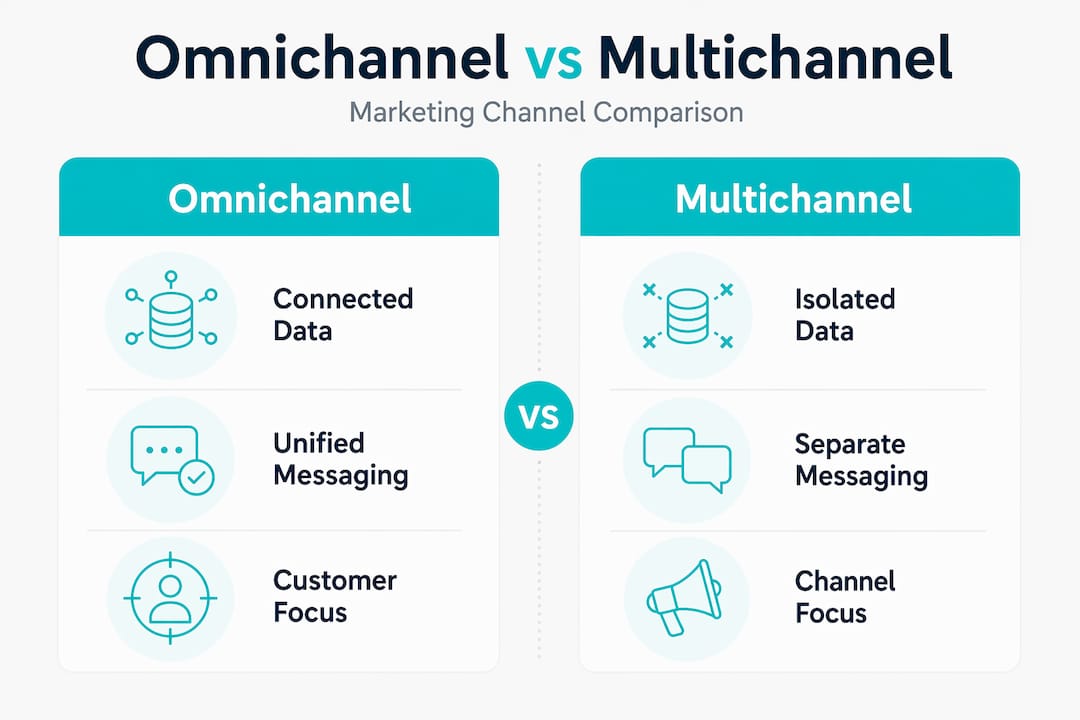
The practical takeaway is this: you can operate ten channels and still not be doing omnichannel marketing. Presence on many channels alone is not omnichannel. Systems must be interconnected to avoid fragmented customer experiences.
Pro Tip: Before investing in more channels, audit whether your existing ones share customer data with each other. If they do not, you are adding complexity without adding cohesion.
Core components of an effective omnichannel strategy
Understanding omnichannel conceptually is one thing. Building a strategy that actually functions requires specific components working together. Here is what powers a real omnichannel system:
-
Unified customer profiles. Every interaction a customer has across any channel feeds into a single profile. A customer data platform (CDP) or CRM pulls together purchase history, browsing behavior, support tickets, and social engagement into one view. Unified profiles synchronized with inventory enable the kind of seamless journeys customers now expect.
-
Real-time inventory and order synchronization. When a customer adds something to their cart on mobile, then walks into a physical location, the staff should see that context. This requires your ecommerce platform, point-of-sale system, and inventory management to communicate in real time.
-
Dynamic personalization. Static audience segments are not enough. True omnichannel personalization requires real-time customer profiles that adapt messaging instantly based on what the customer just did, not what category they fall into.
-
Consistent branding and design across every touchpoint. Your brand voice, visual identity, and tone should be immediately recognizable whether a customer is reading a text message, watching a video ad, or reading a blog post. Inconsistency signals disorganization and erodes trust faster than most marketers realize.
-
Effortless hand-offs between touchpoints. If a customer starts a conversation with a chatbot and then calls your support line, the agent should already have the context from that chatbot session. Coordinated data prevents fragmented and repetitive interactions that frustrate customers and hurt loyalty.
-
Technology that connects the dots. CDPs, CRMs, marketing automation platforms, and unified commerce systems are the infrastructure layer. Without the right technology, the strategy stays theoretical. For med spas specifically, this often means connecting booking software, email platforms, social scheduling tools, and paid ad accounts into a single reporting and personalization layer.
Pro Tip: When evaluating technology vendors, ask specifically how their platform shares data with your existing tools. Integration depth matters far more than the feature list.
The real benefits of omnichannel marketing
When you actually implement an integrated strategy, the benefits of omnichannel marketing show up in measurable ways, not just in theory.
Reduced customer friction. When messaging is consistent and data follows the customer, they do not have to re-explain who they are or repeat information. That reduction in friction directly correlates to higher satisfaction scores and lower abandonment rates. Adobe describes omnichannel marketing as delivering targeted, uninterrupted engagement as customers move across channels and devices.
Higher conversion rates through personalization. A customer who receives a follow-up message referencing exactly what they looked at during a previous visit is far more likely to convert than one who receives a generic broadcast. Relevance converts. Salesforce highlights improved satisfaction and scalability as key advantages omnichannel holds over disconnected multichannel approaches.
Centralized data empowers every team. When your marketing, sales, and service teams all pull from the same customer data pool, decisions get faster and smarter. A customer service rep who can see the last promotional email a customer received before calling is better equipped to resolve issues. A sales team that knows which products a customer has already viewed can skip the cold pitch.

Stronger brand reinforcement. Cohesive messaging does not just feel good. It builds recognition and trust over time. Every consistent interaction compounds. Every inconsistent one chips away at the credibility you have spent money building.
Here is the stat that matters: omnichannel marketing improves customer satisfaction, loyalty, engagement, and conversion rates compared to disconnected multichannel setups. That is not a marginal improvement. It is structural advantage built into how the system works.
Practical omnichannel strategy examples and how to get started
Knowing the theory is useful. Knowing how to apply it is where businesses actually win. Here is how to move from concept to execution when building your omnichannel strategy.
Start by mapping your current customer journey. Before you connect anything, document every touchpoint a customer encounters from first awareness through post-purchase. You cannot integrate what you have not mapped. Most businesses discover touchpoints they did not even know existed during this exercise.
Identify the data gaps. Where does customer data currently get lost? Where do channels fail to communicate with each other? A customer who clicks an email link and lands on a page with no personalization is experiencing a data gap in real time. Find those breaks and prioritize closing them.
Align brand voice across every channel. Pull a sample of your last five email campaigns, your most recent social posts, your SMS copy, and your website homepage. Read them all in sequence. Do they sound like the same brand? If not, that is your first integration problem to fix, before any technology purchase.
Use customer data for real-time personalization. For med spas and beauty businesses, this means connecting booking history, treatment preferences, and communication behavior to deliver messages that feel personal. A client who received a HydraFacial three months ago should receive a timely reminder, not a promotional blast for a service they have never tried. For guidance on executing this well, Aestheticranklab’s med spa personalization guide is worth reading before you start building segments.
Measure the full journey, not just individual channels. This is where most teams get tripped up. Measuring omnichannel performance requires a holistic view of the total customer journey rather than adding up independent channel results. A customer who saw an ad, read an email, visited the website twice, and then booked through Instagram should be counted as one connected journey, not four separate channel wins.
Common obstacles to watch for:
- Disconnected technology stacks that do not share data natively
- Teams structured around individual channels with no cross-channel accountability
- Treating personalization as a one-time campaign rather than an always-on system
- Measuring success by channel-specific metrics instead of customer lifetime value
- Underestimating the internal alignment required to keep messaging consistent
For businesses that want to explore the foundations of integrated marketing further before committing to a full overhaul, reviewing how multichannel strategy works first can help clarify where your current setup sits on the maturity curve.
My honest take on where omnichannel actually breaks down
I have seen a lot of businesses invest in the technology stack and then expect omnichannel to follow automatically. It does not.
In my experience, the biggest failure point is not the software. It is the assumption that having the right tools means the data will be used well. I have watched businesses install a CDP, connect five platforms, and still send emails that ignore everything those platforms captured. The technology creates the possibility. The strategy determines whether the possibility becomes reality.
The other thing I keep seeing is how teams measure success after “going omnichannel.” They still report by channel. Email team reports email opens. Social team reports engagement rate. Paid team reports ROAS. None of those numbers tell you whether the integrated system is working. A holistic journey view is not just a measurement preference. It is the only way to actually know if the investment is paying off.
What I have learned is that omnichannel only works when someone in the organization owns the customer journey end-to-end. Not the email channel. Not the social channel. The full journey. Without that accountability, every team optimizes for itself and the customer experience stays fragmented regardless of what the technology stack looks like.
The businesses I have seen do this well share one trait: they organize around the customer’s experience, not around their own internal channel structure. That sounds obvious. It is genuinely rare.
— Keith
How Aestheticranklab helps med spas execute omnichannel
At Aestheticranklab, we work exclusively with med spas, which means every strategy we build accounts for the specific customer journey a med spa client moves through, from first discovering a treatment to rebooking months later. We connect digital advertising, social media management, and marketing automation into a single, coordinated system so your messaging stays consistent whether a client finds you on Instagram, Google, or email.
If you are ready to stop running channels independently and start building a system where every touchpoint works together, our med spa marketing automation guide is the best place to start. It walks through exactly how to connect your marketing tools into a strategy that runs continuously and personalizes at scale.
FAQ
What is the definition of omnichannel marketing?
Omnichannel marketing is a customer-centric strategy that integrates all channels, both online and offline, into one connected experience using shared data and consistent messaging. Unlike multichannel marketing, the customer’s context and history follow them across every touchpoint.
How does omnichannel differ from multichannel marketing?
Multichannel marketing runs multiple channels independently with separate data and goals. Omnichannel connects those channels into a unified system where customer data is shared in real time and the experience feels continuous rather than fragmented.
What are the main benefits of omnichannel marketing?
The core benefits include higher customer satisfaction from reduced friction, better conversion rates through real-time personalization, and stronger brand trust built through consistent messaging across every channel.
What technology do you need for omnichannel marketing?
A customer data platform (CDP) or CRM is the foundation, along with marketing automation tools, synchronized inventory systems, and a unified commerce platform. The key requirement is that all systems share customer data with each other rather than operating in isolation.
How do you measure omnichannel marketing success?
Measure omnichannel performance by tracking the full customer journey rather than individual channel metrics. Look at customer lifetime value, cross-channel conversion paths, and retention rates instead of siloed metrics like email open rates or social reach alone.