
TL;DR:
- Online reputation significantly impacts med spa bookings, trust, and revenue.
- Consistent management using tools and proactive responses build long-term client trust.
- Avoid ignoring or responding defensively to reviews; engage professionally to protect your brand.
One negative review posted on a Friday night can cost your med spa dozens of bookings before Monday morning. That’s not an exaggeration. Prospective clients research treatments online, read what others say, and make decisions fast. If your reputation isn’t actively managed, someone else’s bad experience becomes your lost revenue. This guide walks you through every layer of online reputation management, from setting up the right tools to building lasting client trust. You’ll leave with a clear, practical framework you can start using right away.
Table of Contents
- Why your med spa’s reputation matters online
- Setting up your reputation management toolkit
- Gathering, monitoring, and responding to feedback
- Building and maintaining client trust long-term
- Avoiding common mistakes and optimizing your process
- Our take: Med spa reputation management in a competitive age
- Level up your med spa’s reputation with expert help
- Frequently asked questions
Key Takeaways
| Point | Details |
|---|---|
| Online reviews matter | Most med spa clients check online feedback before booking, making reputation management essential for success. |
| Respond to all feedback | Timely, professional replies to both positive and negative reviews build trust and attract new clients. |
| Use the right tools | Leveraging dedicated reputation management platforms simplifies monitoring and fast responses. |
| Stay proactive | Consistent feedback requests and transparent communication prevent small issues from escalating and help maintain a stellar reputation. |
Why your med spa’s reputation matters online
Your online reputation is, in many ways, your most valuable business asset. It shapes how new clients find you, whether they trust you, and whether they book. Unlike a billboard or a paid ad, your reputation works around the clock, influencing decisions you never even see happening.
The financial stakes are real. A med spa with a strong review profile books more consultations, generates more referrals, and commands higher prices. A spa with a weak or inconsistent reputation loses those opportunities quietly, without ever knowing what it missed. Boosting med spa sales is directly tied to how well your reputation performs in search results and on review platforms.
“Your reputation is the first impression you make on every potential client who searches for you online. Make it count.”
So what actually shapes your online reputation? Several factors work together:
- Star ratings and review volume on Google, Yelp, and RealSelf
- Social media mentions and tagged content from clients
- Local SEO signals like your Google Business Profile accuracy
- Response behavior, meaning how and how fast you reply to feedback
- Overall sentiment trends across platforms over time
Online review statistics confirm that most consumers rely heavily on reviews when choosing a med spa. That means a handful of unaddressed complaints or a stale review profile can quietly redirect potential clients to a competitor who looks more engaged and trustworthy.
The good news is that reputation is manageable. It’s not something that just happens to you. With the right habits and tools, you can actively shape how your med spa is perceived.
Pro Tip: Set up a monthly review sentiment audit. Look at the language clients use across all platforms, not just the star rating. Patterns in word choice often reveal service gaps before they become bigger problems.
With the importance of reputation clear, let’s examine the essentials you need before taking action.
Setting up your reputation management toolkit
Before you can manage your reputation, you need visibility. That means being present on the platforms where your clients are already talking, and having the right tools to listen.
Start with these must-have platforms:
- Google Business Profile: The single most important listing for local search visibility
- Yelp: Still heavily used in the wellness and beauty space
- RealSelf: Specific to aesthetic treatments and highly trusted by med spa clients
- Facebook: Combines reviews with social proof and community engagement
Once your profiles are claimed and optimized, you need software to help you monitor and respond efficiently. Reputation management tools confirm that centralized platforms help med spas monitor and respond efficiently across channels, which saves time and prevents things from slipping through the cracks.
| Tool | Key feature | Best for |
|---|---|---|
| Birdeye | Multi-platform monitoring | Busy practices with high review volume |
| Podium | SMS-based review requests | Automating client outreach |
| ReviewTrackers | Sentiment analysis | Spotting trends across locations |
| Google Alerts | Free brand mention tracking | Basic monitoring on a tight budget |
Beyond software, your internal process matters just as much. Designate one team member to own reputation management each week. Create response templates for common scenarios, both positive and negative, so replies are fast and consistent. Templates should feel personal, not robotic, so customize them before sending.
Strong visual content for engagement also feeds your reputation indirectly. When clients see polished, authentic content on your profiles, it reinforces trust before they even read a single review. Pair that with fresh content ideas for med spas to keep your online presence active and credible.
Pro Tip: Automate your review request process by connecting your booking software to a tool like Podium or Birdeye. Trigger a review request SMS two hours after each appointment while the experience is still fresh.
Now that your toolkit is ready, it’s time to build a plan for actively managing your reputation.
Gathering, monitoring, and responding to feedback
Having the tools is one thing. Using them consistently is what actually moves the needle. A proactive feedback workflow separates med spas that grow through reputation from those that just react to problems.
Here’s a step-by-step approach:
- Request feedback right after the appointment. Send an SMS or email within two hours. Keep it short, warm, and include a direct link to your preferred review platform.
- Monitor all platforms daily. Use your reputation management software to get real-time alerts. Don’t let a new review sit unanswered for more than 24 hours.
- Respond to every review. Positive reviews deserve a genuine thank-you. Negative reviews require empathy, accountability, and a clear path to resolution.
- Log feedback internally. Track recurring themes in a simple spreadsheet. If three clients mention wait times in one month, that’s a process issue, not just a review problem.
- Close the loop. When a client raises an issue and you fix it, let them know. A follow-up message can turn a frustrated client into a loyal one.
The data on this is clear. Responding to negative reviews thoughtfully can increase client trust and retention significantly, and businesses that actively engage with reviews see measurable conversion lifts.

Think about improving med spa client experience as the foundation. Reviews are just the visible output of the experience you create. When targeting med spa clients with precision, the clients you attract are more likely to leave thoughtful, positive feedback. You can also use social media for feedback by monitoring comments and DMs as informal but valuable review signals.
Pro Tip: When responding to a negative review, never argue. Acknowledge the frustration, apologize for the experience, and invite them to contact you privately to resolve it. This approach shows future readers that you handle problems professionally.
Managing feedback well leads naturally to building and protecting trust with your clients.
Building and maintaining client trust long-term
Reputation management isn’t a one-time fix. It’s an ongoing commitment to how your brand shows up, day after day. The med spas that win long-term are the ones that build trust into every client touchpoint, not just their review responses.
Here are the trust-builders that matter most:
- Showcasing certifications and credentials prominently on your website and profiles
- Publishing before-and-after galleries with client consent to demonstrate real results
- Sharing case studies that walk through client journeys and outcomes
- Being transparent about pricing and treatment expectations upfront
- Responding to questions publicly on social media and Google Q&A
Consistent branding and transparency improve long-term reputation and client retention, according to Forbes. That consistency is what makes your med spa feel reliable rather than risky to a first-time client.
| Approach | Proactive reputation management | Reactive reputation management |
|---|---|---|
| Timing | Ongoing, before problems arise | After negative events occur |
| Tone | Confident and consistent | Defensive or rushed |
| Outcome | Sustained trust and growth | Damage control with variable results |
| Cost | Lower over time | Higher due to crisis response |
Strong digital branding for med spas ties all of this together. Your visual identity, messaging, and tone across platforms should feel cohesive. And local SEO for med spas ensures that when someone searches for treatments near them, your well-branded, well-reviewed practice shows up first.
“Trust is built in drops and lost in buckets. Reputation management is the daily habit of adding drops.”
With the foundations of long-term trust set, it’s important to learn from common pitfalls and keep optimizing your reputation process.
Avoiding common mistakes and optimizing your process
Even well-intentioned med spas make reputation management mistakes. Some are obvious. Others are subtle but just as damaging.
The most common mistakes include:
- Ignoring negative reviews entirely, which signals to future clients that you don’t care
- Delayed responses that let frustration fester publicly for days or weeks
- Defensive or dismissive replies that escalate the situation instead of resolving it
- Soliciting fake reviews, which violates platform policies and destroys credibility if discovered
- Inconsistent monitoring, meaning you only check reviews when something goes wrong
- Treating all feedback the same, rather than identifying patterns that point to real service issues
Ignoring negative feedback or responding emotionally can harm your brand more than the original review itself. The review might reach 50 people. A defensive public response can reach thousands.
To optimize your process, schedule a quarterly reputation audit. Review your average star rating trends, response time averages, and the sentiment of recent feedback. Compare your performance across platforms and identify where gaps exist. Train your staff regularly on why reputation matters and how their daily interactions feed into it.
Improving engagement with visuals is also part of optimization. A visually strong, active profile on Google and social media makes your overall reputation more resilient because it gives clients more positive signals to weigh against any negative feedback.
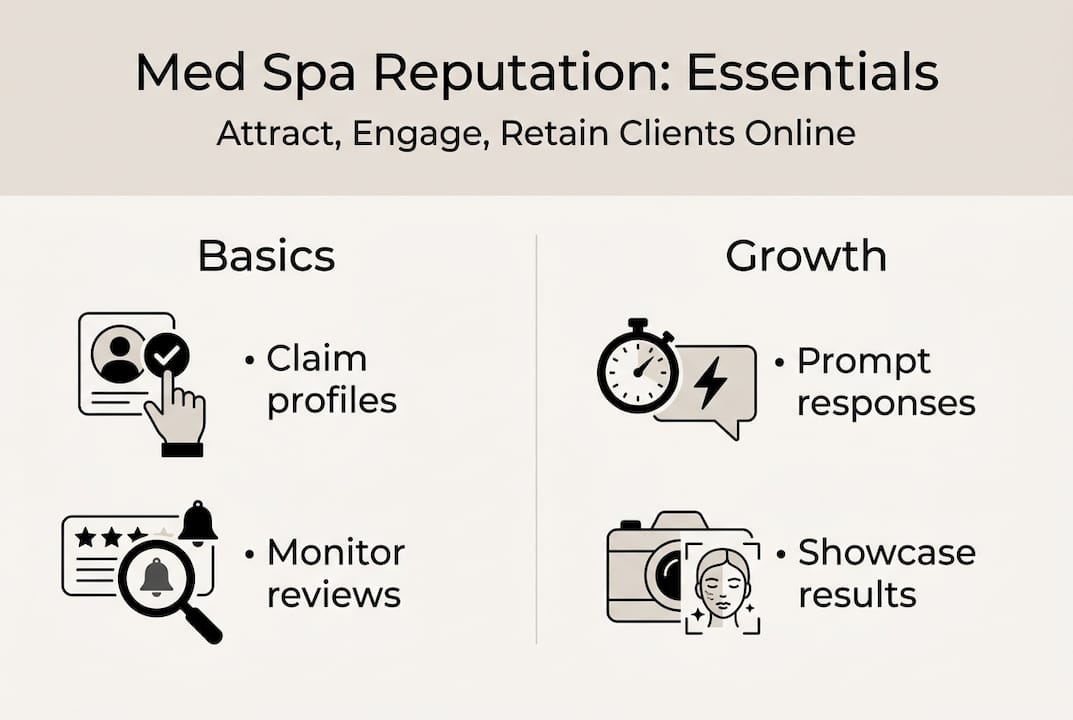
Pro Tip: Set up Google Alerts for your med spa’s name and your top providers’ names. You’ll catch mentions on blogs, news sites, and forums that wouldn’t show up in your review software, giving you a fuller picture of your brand’s online presence.
Now, reflect on the bigger picture for reputation management success.
Our take: Med spa reputation management in a competitive age
Here’s something most reputation guides won’t tell you: a perfect five-star rating can actually make clients suspicious. Real businesses have imperfect experiences. When every review sounds identical and glowing, sophisticated clients notice. What actually builds trust is how you handle the messy moments.
We’ve seen med spas with 4.3-star averages outperform competitors sitting at 4.9 because their responses to criticism were honest, human, and solution-focused. The response is often more powerful than the review itself.
The other myth worth challenging is that one bad review can ruin your business. It can’t, unless you let it sit unanswered while your competitors actively engage with theirs. The med spas that struggle are the ones that treat reputation as a static score rather than a living, evolving conversation with their community.
Algorithms change. Platforms rise and fall. Client expectations shift. The med spas that will win the next decade are the ones building genuine relationships, not just chasing stars. You can see how this plays out in real med spa case studies where authentic engagement consistently outperforms polished but hollow marketing.
Reputation management is not a marketing tactic. It’s a business philosophy.
Level up your med spa’s reputation with expert help
Managing your reputation while running a busy med spa is a lot to carry. At Aesthetic Rank Lab, we specialize in helping med spas like yours build and protect their online presence with strategies that actually convert. Our med spa social media services keep your profiles active and engaging, while our med spa local SEO ensures you show up when clients are searching for treatments near them. Combined with proven med spa sales strategies, we give you a full system for turning your reputation into a consistent source of new bookings. Reach out to us and let’s build something that works.
Frequently asked questions
What’s the fastest way to repair a negative reputation online?
Quickly address negative reviews with empathy, show visible improvements, and encourage new positive feedback to shift public perception. Timely, sincere responses and proactive outreach are key to fast reputation recovery.
Should I respond to every review my med spa receives?
Yes, replying to all reviews, positive and negative, shows you value client feedback and builds trust. Engagement with reviews is critical for business reputation and referral growth.
How can I encourage more positive reviews from satisfied clients?
Request feedback immediately after appointments via SMS or email, and make the process simple with direct links to review pages. Prompting for reviews while the client experience is fresh produces the best results.
What should I avoid when handling online criticism?
Avoid ignoring, deleting, or responding defensively to negative reviews and always remain professional while addressing concerns directly. Emotional or defensive replies can escalate criticism and damage brand perception far beyond the original complaint.