
TL;DR:
- Most med spas struggle to track their marketing ROI accurately, leading to wasted budgets and missed growth opportunities. Effective tools and metrics are essential for measuring, analyzing, and optimizing return on investment across campaigns and channels. Regular verification and strategic adjustments based on reliable data empower practices to maximize profitability and competitive advantage.
You’re spending thousands every month on ads, social media, email campaigns, and promotions, yet you genuinely cannot say which one brought in your last 20 new clients. This is one of the most common and costly problems in the med spa industry. Without a reliable way to measure your marketing return on investment (ROI), every budget decision is a guess. This guide walks you through exactly how to define, track, analyze, and optimize your med spa marketing ROI so you can stop guessing and start growing with confidence.
Table of Contents
- What is ROI and why does it matter for med spas?
- Essential tools and metrics for measuring ROI
- Step-by-step guide: Tracking med spa ROI for your marketing campaigns
- Common mistakes and troubleshooting tips
- Verifying your ROI results and applying insights
- The uncomfortable truth about med spa ROI: What most owners miss
- Take your med spa ROI to the next level
- Frequently asked questions
Key Takeaways
| Point | Details |
|---|---|
| Define ROI for your spa | Knowing exactly how ROI works clarifies marketing decisions and investments. |
| Track campaigns systematically | Consistent tracking with proper tools ensures your marketing delivers measurable results. |
| Avoid common mistakes | Steer clear of pitfalls like ignoring seasonality or failing to track every client touchpoint. |
| Verify and apply insights | Cross-check ROI figures and use them to develop smarter growth plans. |
| Go beyond numbers | Consider retention, reputation, and client satisfaction as part of your ROI for long-term success. |
What is ROI and why does it matter for med spas?
ROI, or return on investment, is the ratio of profit generated from a campaign compared to what you spent on it. The basic formula is straightforward:
ROI = (Revenue from campaign minus Campaign cost) divided by Campaign cost, multiplied by 100
So if you spend $2,000 on a Google Ads campaign and it brings in $8,000 in booked services, your ROI is 300%. Simple in theory. In practice, med spas face unique challenges that make this calculation trickier and more important than for most businesses.
Med spas operate with high-margin services, meaning a single Botox client or laser package can represent significant revenue. But those services also come with seasonal demand peaks in the fall and spring before major social events, plus a recurring clientele model where one client retained for two years is worth far more than two one-time clients. Tracking ROI in this environment requires accounting for those layers, not just raw revenue from a single campaign.
Here is why tracking ROI matters most for your med spa:
- Higher profit through smarter spending: When you know which campaigns return the most, you shift budget toward what works and cut what does not.
- Competitive edge: Many small and mid-size med spas skip ROI analysis entirely. Mastering it puts you ahead of most local competitors.
- Justifiable growth investments: When you want to expand services or hire staff, solid ROI data backs up your case.
Understanding how to allocate your med spa marketing budget across channels becomes dramatically easier once you have historical ROI data in hand. Without it, even experienced marketers end up funding underperforming channels simply out of habit or assumption.
| Marketing Channel | Typical Cost | Typical ROI Range |
|---|---|---|
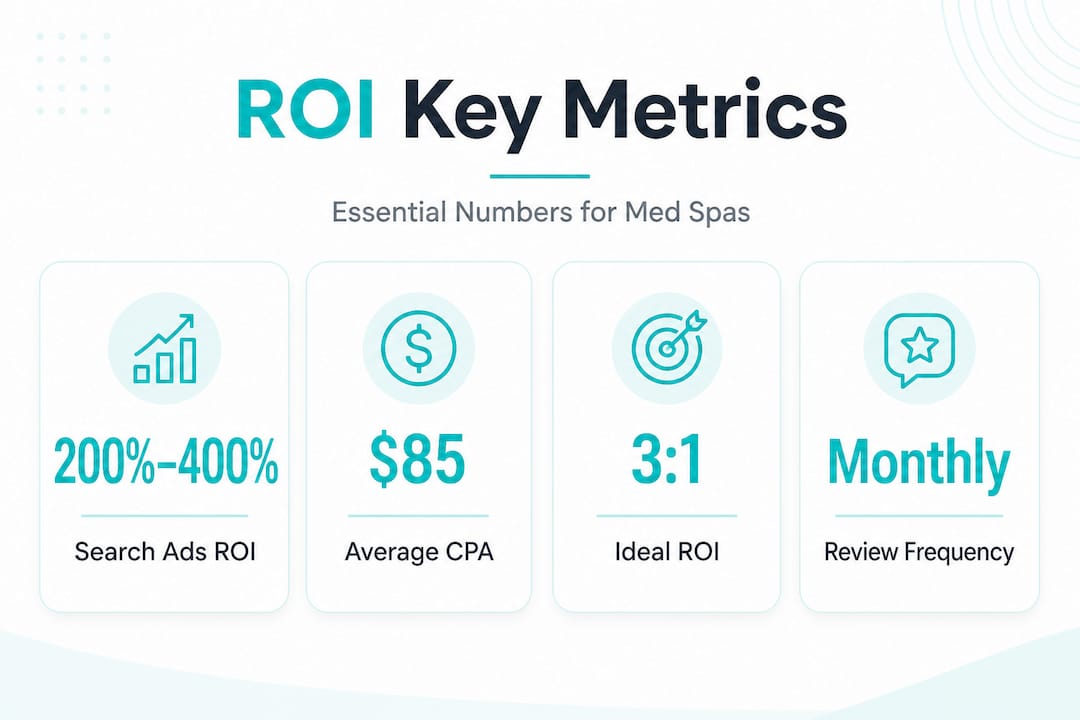
| Google Ads (search) | $1,000–$5,000/month | 200–500% |
| Social media ads | $500–$3,000/month | 100–350% |
| Email marketing | $200–$800/month | 300–700% |
| SEO (organic) | $1,000–$4,000/month | 400–900% (long term) |
Now that you know why tracking ROI is indispensable, let’s look at what you’ll need to get started.
Essential tools and metrics for measuring ROI
The right toolkit makes the difference between vague impressions and hard numbers. Most med spas already use some of these tools but rarely integrate them in a way that produces usable ROI data.
Tools you need:
- CRM system: A customer relationship management platform like HubSpot or a med spa specific CRM tracks client history, communication touchpoints, and campaign attribution.
- Booking software: Platforms like Jane App, Mindbody, or Zenoti connect appointment data directly to marketing activity when set up properly.
- Google Analytics 4 (GA4): Tracks website traffic, lead sources, and conversion events tied to specific campaigns.
- Point of Sale (POS) integration: Connects purchase data to the marketing source that originally brought in each client.
Beyond tools, you need to track the right metrics. Understanding med spa treatments and their revenue profiles helps you weight these metrics correctly for your business model.

| Metric | What it measures | Why it matters |
|---|---|---|
| Cost per acquisition (CPA) | Total spend divided by new clients gained | Shows how expensive it is to win each client |
| Client retention rate | Percentage of clients who return | High retention multiplies ROI over time |
| Average ticket size | Average revenue per appointment | Reveals upsell opportunities |
| Client lifetime value (CLV) | Total revenue from one client over their entire relationship | The true measure of marketing efficiency |
| Conversion rate | Percentage of leads who book | Identifies where your funnel leaks |
Staying current on marketing trends for med spas helps you pick tools that match where the industry is heading, not just where it has been.
Pro Tip: Use an integrated dashboard tool like Google Looker Studio to pull data from Google Analytics, your CRM, and your booking software into one view. This removes the manual work of reconciling spreadsheets and cuts down on tracking errors that skew your ROI numbers.
Investing in med spa marketing automation can further reduce the manual effort required to maintain clean, connected data across all these systems. With the right automation in place, attribution happens behind the scenes, and your team spends time on strategy instead of data entry.
With the right tools set up, you’re ready to start tracking ROI across different marketing activities.
Step-by-step guide: Tracking med spa ROI for your marketing campaigns
Here is a practical, repeatable process for tracking ROI on any campaign you run. Follow these steps for every major marketing initiative.
-
Set a clear, measurable goal. Before you launch anything, define what success looks like in concrete numbers. Is it 15 new Botox clients this month? A 20% increase in laser bookings? Your goal shapes everything that follows, including how you set up tracking and what you count as a conversion.
-
Assign unique tracking links or codes to each campaign. Use UTM parameters (short URL tags) for every digital campaign so Google Analytics can separate traffic from Facebook ads, email newsletters, and Google Ads. For offline promotions, create unique promo codes so front desk staff can log the source when a client books.
-
Configure conversion tracking in your analytics tools. Set up goals in GA4 for key actions: booking form submissions, phone call clicks, and consultation requests. Link these conversion events back to the specific campaigns that drove them.
-
Record your total campaign spend accurately. Include ad spend, creative costs, agency fees, staff time, and any promotional discounts given. Many med spa owners undercount spend by ignoring design or content creation costs, which inflates apparent ROI.
-
Calculate ROI after each campaign cycle. Pull revenue data from your POS or booking software, match it to the campaign source, subtract total spend, and apply the ROI formula. Compare the result against your original goal.
-
Adjust and repeat. Use what you learn to reallocate budget, test different messaging, or shift timing. Campaigns rarely hit peak performance on the first run. Iteration is how ROI improves over time.
Learning how to boost med spa sales goes hand in hand with understanding which campaigns actually drive those sales, not just which ones look busy on a dashboard.
For practices investing in social platforms, tracking med spa social media ROI deserves its own measurement framework because organic social, paid ads, and influencer content each require different attribution methods.
Pro Tip: Block two hours on the last Friday of every month for a dedicated ROI review. Bring your campaign spend reports and booking data into one meeting. Monthly reviews catch problems early enough to correct them before you burn the next month’s budget on something that is not working.
After tracking your campaigns, it’s important to monitor and review your results for continuous improvement.
Common mistakes and troubleshooting tips
Even med spa owners who understand ROI in theory make consistent errors that distort their numbers and lead to poor budget decisions. Knowing what to watch for saves you from compounding a small mistake into a major financial misstep.
Common ROI tracking mistakes:
- Mixing in-house promotions with digital campaign results. If your receptionist offers walk-in clients a loyalty discount and those clients are counted under your Google Ads attribution, your digital ROI looks better than it actually is. Separate these buckets carefully.
- Ignoring seasonal demand patterns. A campaign that runs in January will likely produce weaker results than the same campaign in September, simply because demand is lower. Year-over-year comparisons give more accurate insights than month-over-month ones during off-peak seasons.
- Failing to track every client touchpoint. A client might see your Instagram ad, visit your website three times, and finally book after receiving an email. Crediting only the email ignores the other channels that built trust. Multi-touch attribution models distribute credit more accurately.
- Overlooking negative ROI signals from competitor positioning. Doing a med spa competitor analysis regularly helps you spot if competitors are undercutting your offers or targeting the same audience more effectively.
- Underestimating the role of visual content in conversion rates. Poor creative can tank an otherwise well-targeted campaign, making the channel look ineffective when the real issue is the ad itself.
Male-focused aesthetics is a fast-growing market segment, and understanding male-focused treatments can also reveal untapped revenue that standard ROI analysis misses if you have not segmented your data by client demographics.
“The most costly mistake is making decisions without reliable ROI data.”
When your numbers feel off, start troubleshooting by checking data connections first. A broken UTM link, a misconfigured GA4 goal, or a booking software update that reset attribution settings can all silently corrupt your data for weeks before anyone notices.
Beyond avoiding mistakes, let’s talk about how to verify your ROI numbers and use them to grow strategically.
Verifying your ROI results and applying insights
Calculated ROI is only useful if you trust it. Verification is the step most med spa owners skip, and it is the step that turns data into genuine strategy.
Here is how to validate and apply your results:
- Cross-check with historical data. Compare this quarter’s ROI against the same quarter last year. If numbers differ significantly without a clear reason, something in your tracking setup may have changed.
- Benchmark against industry peers. Industry reports and platforms covering anti-aging med spa growth show general performance ranges for the sector. If your ROI is dramatically below or above typical ranges, investigate before assuming the number is correct.
- Audit your attribution model. Ask your marketing team or agency to walk you through exactly how each conversion is attributed. Simple last-click models are easy but often inaccurate. A more sophisticated model may reveal surprising insights about which touchpoints are doing the real work.
- Develop specific action plans from findings. If email campaigns consistently outperform paid social, increase email frequency and list-building efforts. If a specific treatment promotion generates outsized ROI, run it again with a larger budget and broader reach.
- Invest in med spa lead generation strategies that compound over time. Some channels, like SEO and referral programs, build value slowly but deliver some of the strongest long-term ROI numbers.
Verification is not about doubting your team. It is about making sure the decisions you build on top of the data are sound. The more confidently you can trust your numbers, the bolder and smarter your next investment can be.
Let’s wrap up by sharing lessons learned from years of helping med spas optimize their ROI.
The uncomfortable truth about med spa ROI: What most owners miss
Here is what years of working exclusively with med spas has taught us: most owners measure the wrong version of ROI.
They look at campaign revenue and campaign spend, calculate a ratio, and call it done. But that number is missing three factors that often matter more than the initial transaction. Brand reputation, client experience, and retention are the real multipliers of marketing ROI, and they almost never appear in a standard campaign report.
A client who had a mediocre experience but still booked once counts as a conversion in your data. A client who left a glowing Google review and referred three friends also counts as a conversion, but they represent ten times the long-term value. Treating those two outcomes as equivalent is a serious analytical error.
Many owners also confuse busy metrics with profitable ones. High website traffic, strong social media engagement, and a full booking calendar all feel like success. But if your average ticket size is low and your retention rate is poor, none of that activity is building a sustainable business. Profitable metrics are revenue per client, lifetime value, and the ROI of retention campaigns specifically, not just acquisition campaigns.
The other shift we consistently recommend is moving from reactive to proactive ROI management. Most owners look at ROI after a campaign ends and ask, “Did that work?” The better question is: “Based on what I know about past performance, what should I expect this campaign to return before I spend a dollar?” That shift requires historical data, yes, but it transforms ROI from a report into a planning tool.
Channels like programmatic advertising for med spas are increasingly available to practices of all sizes and can dramatically improve targeting precision, but only if you already have solid ROI baselines to measure against. Without those baselines, you are optimizing in the dark.
Take your med spa ROI to the next level
If you have been tracking ROI inconsistently or not at all, the next step is building a system that works automatically. Aesthetic Rank Lab specializes in exactly this for med spas across the United States. Our med spa lead generation services are built to attract high-value clients while feeding measurable data back into your reporting. Our med spa marketing automation tools connect your marketing stack so attribution happens without manual effort. And our med spa social media strategies are designed to produce trackable bookings, not just likes. Every solution we offer is built with ROI visibility at the center.
Frequently asked questions
What ROI should my med spa aim for in marketing campaigns?
Many med spas target an ROI of at least 3:1, meaning three dollars in revenue for every dollar spent, but your ideal number depends on your service margins and how strong your client retention rate is.
Which software makes ROI tracking easiest for med spas?
CRM systems and integrated booking analytics platforms are best for automating ROI calculations, since they centralize client data and connect it directly to your marketing sources.
How often should I review med spa ROI results?
Monthly reviews are the minimum. They help you spot underperforming campaigns quickly enough to correct course before you waste another full month’s budget.
Can ROI tracking help identify which treatments are the most profitable?
Yes. Segmenting your data by treatment type shows exactly which services generate the highest revenue and profit margin, letting you prioritize promotions accordingly.