
TL;DR:
- Trust signals in med spas now prioritize medical oversight, provider transparency, and regulatory compliance to build client confidence.
- Effective placement of credentials, authentic photos, and verified reviews on websites is essential, as first impressions form rapidly.
- Regular audits and genuine compliance communication differentiate credible clinics from outdated marketing practices in 2026.
Clients searching for Botox, laser treatments, or body contouring are not just shopping for a price. They are deciding whether to trust you with their face, their safety, and their money. The role of trust signals in med spas has never been more consequential, and most owners are working from an outdated playbook. Flashy decor and a five-star average used to be enough. In 2026, patients are checking medical director credentials, scrutinizing before-and-after photos for authenticity, and walking away from anything that feels evasive. This guide breaks down exactly which signals matter, why they matter now, and how to put them to work.
Table of Contents
- Understanding the core trust signals in med spas
- Navigating evolving regulations and their trust implications
- Showcasing trust signals effectively: website and client-facing communication
- Comparing trust signals: traditional versus 2026 standards
- Building client trust through actionable strategies and ongoing compliance
- The overlooked truths about trust signals in med spas
- How Aesthetic Rank Lab helps med spas build credible trust signals
- Frequently asked questions
Key Takeaways
| Point | Details |
|---|---|
| Medical oversight | Displaying a licensed medical director prominently is the strongest trust signal clients seek in med spas. |
| Regulatory compliance | Meeting 2026 standards for drug tracing and AI transparency builds safety and client confidence. |
| Authentic proof | Showcase metadata-verified photos and genuine client reviews visibly to avoid skepticism and bounce. |
| Modern versus old signals | Shift focus from flashy aesthetics and discounts to data-backed medical credibility and certifications. |
| Patient education | Proactively informing clients about safety protocols and compliance fosters long-term trust and growth. |
Understanding the core trust signals in med spas
Before you think about Google reviews or Instagram aesthetics, there is one trust signal that sits above everything else: documented medical oversight. Every legitimate med spa must have a licensed physician (MD or DO) as medical director providing on-site supervision, and this is the single most important factor in both patient safety and client confidence. Patients may not know the specific legal requirement, but they feel the difference between a clinic that operates under physician supervision and one that does not.
Displaying your medical director’s credentials is not just a legal checkbox. It is an active trust-building tool. Put the director’s name, license number, and board certifications on your website, on your consultation paperwork, and in your waiting room. Clients who see this before they ever meet a provider feel measurably safer. A surprising number of med spas bury this information in a footer or leave it off entirely, which creates an immediate credibility gap.
Beyond the medical director, provider-level transparency matters. Clients want to know who will be treating them, what their training includes, and whether they have performed a specific procedure dozens of times or three. Displaying individual staff bios with procedure-specific experience counts is one of the most underused trust signals in aesthetics.
Here are the foundational trust signals every med spa should have in place:
- Licensed medical director with visible name, credentials, and board certification
- Individual provider bios including training, certifications, and procedure experience
- Documented consultation process that shows patients what to expect before any treatment
- Consent forms and safety protocols referenced transparently in your communications
- State license and business registration displayed or easily accessible on your website
Pro Tip: Link your medical director’s state medical board profile directly on your website. Most state boards have a public license lookup. Giving patients a one-click path to verify credentials signals confidence and removes one of the most common silent objections.
For additional strategies on building a stronger clinic reputation, these signals form the foundation that everything else builds on.
Navigating evolving regulations and their trust implications
The regulatory landscape for med spas changed significantly in 2026, and ignoring those changes is not just a compliance risk. It is a trust risk. Patients are more informed than ever, and regulators are actively targeting deceptive practices in the aesthetics space.
California’s AB 489, effective January 1, 2026, now requires med spas to conspicuously disclose any AI use that simulates professionals in marketing content. Metadata-stamped before-and-after photos are required to prove authenticity, partly in response to FTC enforcement against fabricated or digitally manipulated results. If your marketing uses AI-generated images or AI-scripted testimonials without disclosure, you are not just risking a fine. You are eroding the trust of every patient who later discovers it.
The FDA has also stepped up enforcement on drug sourcing. A 2026 FDA warning letter to a Texas med spa highlights mandatory compliance with DSCSA (Drug Supply Chain Security Act) drug tracing rules. Verified sourcing means patients can trust that the Botox, fillers, or peptides used in their treatment came from legitimate pharmaceutical channels, not gray-market suppliers.
Patients who know your clinic verifies its drug supply chain are patients who feel safe. Traceability is not just a regulatory burden. It is a marketing asset you are probably not using yet.
Here is a quick checklist of regulatory trust signals your med spa should be communicating actively:
- AI disclosure statements on any marketing content that uses generative AI tools
- Metadata-verified photos for all before-and-after imagery used in advertising
- DSCSA-compliant sourcing documentation available upon patient request
- FTC-compliant review requests that do not incentivize or fabricate patient feedback
- Advertising review process to catch false efficacy claims before they go live
A good reputation management framework treats regulatory compliance as part of the brand story rather than a back-office obligation. When you show clients you follow these rules, you separate yourself from the dozens of med spas in your market who do not.
For a real-world example of how AI disclosure appears in current aesthetics marketing, see how this microblading provider handles it at the service level.

Showcasing trust signals effectively: website and client-facing communication
Knowing which trust signals to use is only half the job. Placement is where most med spas fail. First impressions form in 50 milliseconds, and if your credentials, real patient photos, and verified reviews are buried below the fold, 60% of visitors will bounce before they ever see them.
Medical director credentials and a brief bio belong in the hero section of your homepage, not on an “about” page that requires three clicks to find. Certified treatment photos with metadata stamps should appear on every service page. A real review, with a full name and specific procedure, should be visible without scrolling on any page where a patient might decide to book.
High-value cosmetic patients require verifiable evidence including procedure counts, training specifics, and compliance details. Generic claims like “our team of experts” or “industry-leading results” do exactly nothing for a patient who has already visited four other med spa websites before yours.
Here is a comparison of old versus current trust signal placement:
| Trust signal | Old approach | 2026 standard |
|---|---|---|
| Medical director credentials | Footer or “about” page only | Above the fold on homepage |
| Before-and-after photos | Unverified, stock-adjacent | Metadata-stamped, real patients |
| Client reviews | Star rating widget only | Named reviews with procedure detail |
| Certifications | Not displayed | Visible badge on every service page |
| Compliance disclosures | Buried in terms of service | Proactively stated in marketing copy |
Pro Tip: Run a 10-second test on your homepage. Show it to someone unfamiliar with your clinic for exactly ten seconds, then ask: “Do you know who oversees the medical treatments here?” If they cannot answer, your credentials are not placed prominently enough.
For deeper guidance on med spa UX design that converts browsers into booked patients, layout decisions like these have measurable impact on inquiry rates. And do not underestimate the power of well-placed testimonials when they are paired with specific procedures and real outcomes.
Comparing trust signals: traditional versus 2026 standards
The aesthetics industry has a long history of using visual signals to convey luxury and quality. Elegant waiting rooms, designer furniture, and high-end packaging are not irrelevant, but patients now weigh clinical credibility above aesthetic ambiance. Patients prefer clinical accreditation seals and outcome-based pricing over flashy decor and discount-focused advertising.
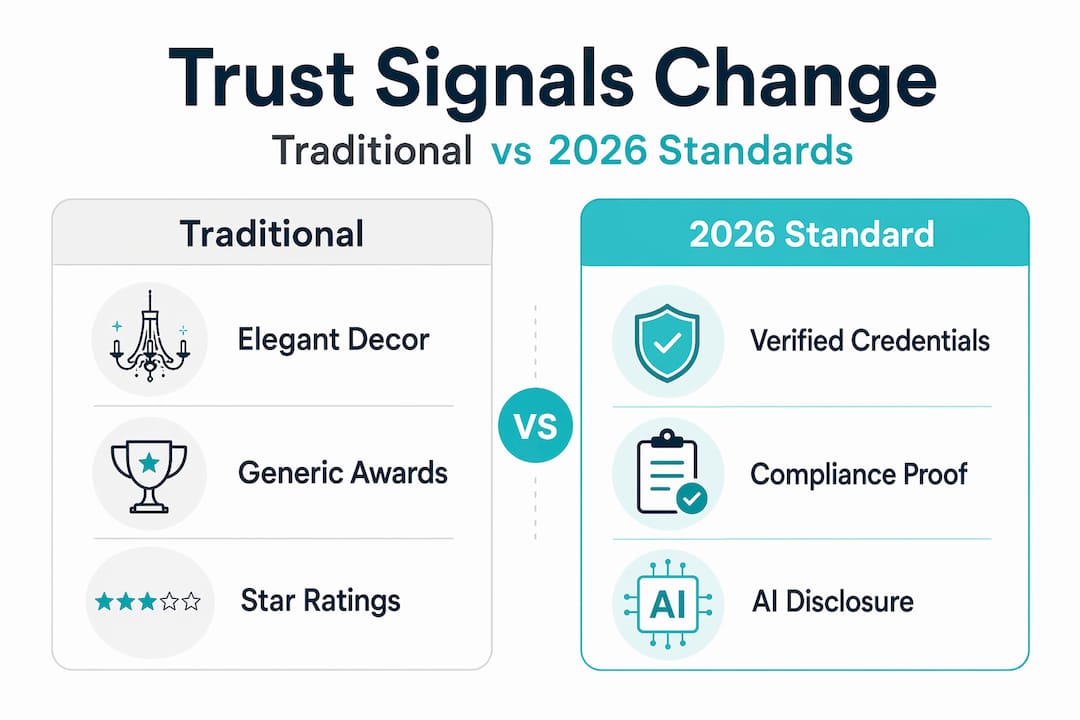
This shift is important for how you allocate your trust-building budget. A $15,000 interior renovation sends one message. Investing that money in obtaining a third-party accreditation, building a documented outcomes database, and overhauling your website to surface credentials sends a different, more trusted message in 2026.
| Legacy trust signal | Why it worked before | Why it falls short now |
|---|---|---|
| High-end interior design | Implied quality and safety | Patients know decor does not equal credentials |
| Influencer endorsements | Built social proof quickly | Audiences have grown skeptical of paid promotions |
| Discount pricing and specials | Attracted price-sensitive clients | Now associated with risk and gray-market sourcing |
| Generic five-star rating | Created confidence at a glance | Patients check for recency, response rate, and detail |
| “Years of experience” copy | Sounded authoritative | Not verifiable without license and procedure data |
Negative trust signals are just as powerful as positive ones. Avoid these specifically:
- No visible medical director information on the website
- Botox parties or pop-up treatment events without proper medical supervision disclosed
- Before-and-after photos without watermarks, dates, or consent documentation
- Discount language without safety framing, such as “Botox for $8/unit, no consultation required”
- Unresponsive or generic review replies that suggest no one is managing patient feedback
Understanding where 2026 marketing trends are heading helps you prioritize which trust signals to build first.
Building client trust through actionable strategies and ongoing compliance
Trust is not built in a single website update. It is built through systems that operate consistently. Here is a practical framework for integrating trust signals into your daily operations:
- Conduct a compliance audit covering medical director documentation, drug sourcing records, AI disclosure practices, and advertising review processes. Do this quarterly, not annually.
- Obtain third-party certifications. Voluntary certifications like Medspa Board are emerging as major differentiators as patient sophistication grows and federal enforcement increases.
- Build an FTC-compliant review program. Ask for reviews after specific positive interactions, disclose any treatment provided in exchange for feedback, and never fabricate or incentivize false reviews.
- Train staff on regulatory and communication standards. Your front desk and treatment providers are trust signals too. How they answer questions about credentials or sourcing matters enormously.
- Invest in patient education before the consultation. Pre-consultation content like procedure explainers, provider bios, and safety FAQ pages reduce anxiety and build trust before a client ever walks through your door.
- Use standing orders and treatment documentation proactively. When patients see that your protocols are written, reviewed, and physician-authorized, it communicates a level of rigor that sets you apart.
For proven strategies to collect more authentic reviews, the systems matter as much as the ask. And maintaining those reviews as part of a broader reputation management approach keeps your trust signals current and credible over time.
Pro Tip: Create a one-page “trust page” on your website that consolidates your medical director credentials, certifications, drug sourcing policy, and review disclosure practices in one place. Name it something patient-centered like “Why choose us” or “Our safety standards.” Patients who find it convert at significantly higher rates.
The overlooked truths about trust signals in med spas
Here is what most trust signal guides miss: patients are doing homework you do not know about. Practitioners recommend that clients verify state medical board licenses for directors and providers online before booking. Many of your prospective patients are doing exactly that and you have no idea. If your medical director’s license has a gap, a restriction, or an expired status, it surfaces in a five-second public search. That patient never calls.
Most med spas treat trust signals as marketing assets to be displayed. The smarter frame is to treat them as operational standards that happen to be visible. The difference is not semantic. Clinics that display a “certified” badge as a marketing move often fail to update it when the certification lapses. Clinics that treat certification as an operational standard keep it current automatically because it reflects how they actually run.
There is also a dangerous overreliance on star ratings. A 4.9-star average looks impressive until a patient reads that your most recent five reviews are vague, undated, and suspiciously similar in phrasing. Authentic, specific, named reviews from real procedures beat a higher numerical average from a trust standpoint.
The most powerful and underused trust signal in aesthetics is vocal compliance. Do not just be compliant. Communicate it. Put your AI disclosure policy in your email footer. Reference your drug sourcing standards in your consultation welcome packet. Train your providers to say, out loud, “Our protocols were reviewed and approved by Dr. [Name].” Most of your competitors are silently compliant, at best. Being loudly, transparently compliant is a genuine differentiator.
For a broader perspective on how these signals connect to your overall value proposition, trust is not a feature. It is the category.
How Aesthetic Rank Lab helps med spas build credible trust signals
Building and communicating the right trust signals takes more than good intentions. It takes a website built to put credentials front and center, marketing that stays ahead of FTC and AI disclosure rules, and reputation systems that generate authentic reviews consistently.
At Aesthetic Rank Lab, we work exclusively with med spas. Our Smart Website design approach puts medical oversight, certifications, and verified patient results where prospective clients actually look. Our digital advertising programs are built for compliant, trust-forward aesthetics marketing, not generic beauty ads. And our reputation management services help you build the kind of review profile that converts skeptical browsers into booked patients. If your trust signals are not working as hard as your team, we can fix that.
Frequently asked questions
Why is having a licensed medical director important for med spas?
A licensed medical director provides official physician oversight that makes treatments legally compliant and clinically safe, and it is the single most critical trust signal that separates credible med spas from risky ones in the eyes of informed patients.
What new regulations affect med spa trust signals in 2026?
California’s AB 489 requires explicit AI disclosure in marketing, and the FDA’s DSCSA enforcement requires verified drug tracing, both of which directly impact how patients evaluate your credibility.
How can med spas use their websites to build trust with clients?
Place medical credentials, metadata-verified photos, and named client testimonials above the fold, because first impressions form in 50 milliseconds and most visitors will never scroll far enough to find trust signals buried lower on the page.
What are the most damaging negative trust signals for a med spa?
No visible medical director, unverified before-and-after photos, discount pricing without safety context, and generic or recently inactive reviews all trigger skepticism in today’s more informed patient base, often before they ever contact your clinic.
How often should a med spa update or audit its trust signals?
A quarterly compliance audit covering medical oversight documentation, certifications, review authenticity, and advertising disclosures keeps your trust signals accurate and prevents the kind of lapses that a single patient Google search can expose.