
TL;DR:
- Multi-channel marketing involves strategically reaching audiences across independent platforms optimized for each touchpoint. It outperforms single-channel efforts in engagement and customer retention, especially when channels are integrated with cohesive messaging. Success relies on solid data infrastructure, focused channel selection, and deliberate scaling to build a durable, personalized customer experience.
Multi-channel marketing gets misunderstood constantly. Most business owners assume it simply means posting on Instagram and sending the occasional email. That’s not it. What is multi-channel marketing, really? It’s a coordinated approach to reaching your audience across multiple independent touchpoints, each optimized for its own strengths, all working toward the same business goal. If you’re a marketing professional or business owner trying to drive better engagement and more sales, understanding how this strategy actually works, and how it differs from related concepts, will change how you allocate your budget and build your campaigns.
Table of Contents
- Key takeaways
- What multi-channel marketing actually means
- The business case: why it works
- How to implement multi-channel marketing
- Common challenges and how to handle them
- Applying multi-channel strategy across the funnel
- My honest take on where most businesses go wrong
- Grow your med spa with multi-channel marketing support
- FAQ
Key takeaways
| Point | Details |
|---|---|
| Multi-channel marketing defined | It uses multiple independent channels to reach audiences, each running its own optimized strategy. |
| Multi-channel vs. omnichannel | Omnichannel integrates channels for seamless experience; multi-channel runs them with more independence. |
| Data silos are the biggest risk | Without centralized data, campaigns contradict each other and attribution becomes unreliable. |
| Start small, scale deliberately | Connect your two best-performing channels first before expanding to avoid breaking your tech stack. |
| Cohesion beats volume | Using fewer channels with consistent messaging outperforms spreading thin across many platforms. |
What multi-channel marketing actually means
The multi-channel marketing definition, at its core, is this: your brand exists and communicates across more than one channel, and each channel is intentionally selected and managed to reach your audience where they already spend time. Those channels can include email, paid social media, SMS, organic search, physical direct mail, in-store displays, or any other platform your customers use.
Here’s where most people get confused. Multi-channel marketing does not mean your channels are deeply synchronized in real time. In fact, channels often run independently without full data coordination between them. That’s a defining characteristic, not a flaw. It becomes a flaw only when you mistake independence for inconsistency.
Multi-channel vs. omnichannel vs. cross-channel
These three terms get used interchangeably, and they shouldn’t. Here’s the distinction that actually matters for strategy:
- Multi-channel marketing: Multiple channels, each with its own execution. The focus is on reach. A customer might see your Facebook ad without any awareness that they also received your email.
- Omnichannel marketing: Channels are deeply integrated and share data in real time. The customer experience is seamless across touchpoints, so what they do on one channel directly influences what they see on another.
- Cross-channel marketing: A middle ground. Channels are aware of each other and share some data, but not to the full degree of omnichannel.
| Approach | Channel coordination | Focus | Best for |
|---|---|---|---|
| Multi-channel | Low to moderate | Reach and presence | Growing brand awareness |
| Cross-channel | Moderate | Consistency | Mid-funnel nurturing |
| Omnichannel | High | Customer experience | Retention and loyalty |
For most businesses, multi-channel is the right starting point. Omnichannel requires significant tech infrastructure and data maturity. Trying to skip ahead to full omnichannel integration without the foundation in place usually ends in frustration.
The business case: why it works
The performance data behind multi-channel marketing is not subtle. Campaigns across three or more channels outperform single-channel efforts by up to 494% in engagement. That’s not a marginal improvement. That’s a structural advantage.

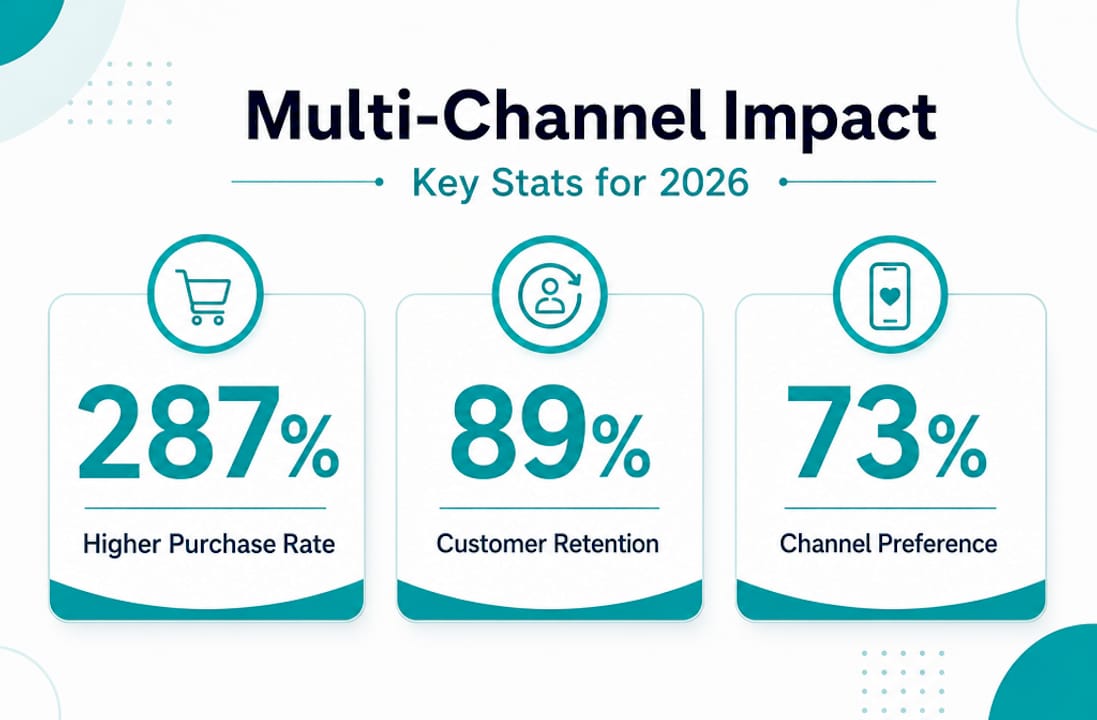
Customer retention tells the same story. Companies with solid multi-channel strategies retain 89% of their customers, compared to just 33% for businesses relying on a single channel or a poorly executed multi-channel approach. The lifetime value gap is equally significant: customers who interact across multiple channels carry 90% higher lifetime value than those who engage through only one.
There’s also a consumer behavior angle worth understanding. 73% of consumers actively prefer shopping across multiple channels. They browse on mobile, research on desktop, and convert in-store or through email. A single-channel approach simply doesn’t match how people actually make decisions in 2026.
Consistent branding compounds the financial impact. When messaging stays coherent across every touchpoint, businesses see 10 to 20% revenue increases tied directly to that consistency. And when personalization is layered on top? Business leaders report customers spend 38% more when their multi-channel experience feels tailored to them.
For med spas and beauty businesses in particular, these numbers are highly relevant. Clients researching treatments don’t commit after one touchpoint. They read reviews, scroll Instagram, check your website, and read an email before booking. Multi-channel presence meets them at every one of those moments.
How to implement multi-channel marketing
Getting this right requires discipline. The biggest mistake marketers make is treating channel expansion as progress. Adding five new channels in a quarter without proper data infrastructure creates more chaos than growth.
Here’s a process that actually works:
-
Audit your current channels. Before adding anything, map where your audience already engages with you. Which channels drive real conversions? Which ones generate clicks but no downstream behavior? Use actual data, not assumptions.
-
Start with your two strongest channels. Connecting your two highest-performing channels first lets you establish a unified customer view before scaling. This is how you avoid the broken tech stack problem that kills multi-channel strategies early.
-
Define consistent messaging. Your tone, offer language, and visual identity should be recognizable across every channel. The execution adapts per platform (short copy on SMS, detailed content in email), but the core message stays aligned.
-
Build automation and data triggers. Automation is what makes multi-channel manageable at scale. A new lead from a Facebook ad should automatically enter an email nurture sequence. A client who books a consultation should trigger an SMS reminder and a post-visit follow-up. Coordination through automation is what separates a real multi-channel strategy from a pile of disconnected campaigns.
-
Assign channel-specific KPIs. Each channel has its own native strengths. Email performs best for retention and upsell. Paid social drives awareness and top-of-funnel traffic. SMS converts at high rates for time-sensitive offers. Measuring each channel against its actual purpose, rather than a universal metric, gives you accurate performance data.
Pro Tip: Don’t measure every channel purely by direct conversion. Email that builds trust may not get last-click credit, but it closes deals. Set channel-level KPIs that reflect the role each channel plays in your funnel.
Personalization sharpens everything. Behavioral targeting, meaning messages triggered by what a user has already done, outperforms batch-and-blast campaigns by a wide margin. If a client viewed your Botox service page three times but didn’t book, that signal should trigger a specific follow-up, not a generic newsletter. For visual content that converts in the beauty space, consider how client engagement through visual content can become a dedicated layer within your multi-channel stack.
Common challenges and how to handle them
No honest guide to multi-channel marketing skips over what goes wrong. The challenges are real, and they show up at predictable places.
Data fragmentation is the most common and most damaging. 65.7% of marketers report that consolidating fragmented data is one of their biggest obstacles. When each channel lives in its own reporting silo, you end up making budget decisions based on incomplete information. A customer data platform (CDP) or centralized data warehouse solves this, but it requires upfront investment in both technology and process.
Attribution is another place where multi-channel strategies break down. Last-click attribution, which gives all credit to the final touchpoint before conversion, systematically undervalues every awareness and nurturing channel that came before it. Multi-touch attribution models distribute credit more accurately across the full channel mix, giving you a realistic picture of what’s actually driving results.
Channel independence versus brand cohesion creates real tension. The channels in a multi-channel system are meant to operate with some autonomy, but if each team or vendor runs their channel without awareness of the others, the customer receives contradictory messages. You can preserve channel independence without losing coherence by centralizing the messaging framework even when execution is decentralized.
“Multi-channel marketing strategies focused on cohesion enable unified brand storytelling rather than disconnected promotions across channels.” — Callloop, 2025
When you’re ready to evolve toward omnichannel, the shift is less about adding channels and more about deepening data integration. You build a single customer view first, then use that view to synchronize experiences in real time. Most businesses aren’t ready for that step until their multi-channel foundation is stable.
Applying multi-channel strategy across the funnel
Multi-channel marketing isn’t one-size-fits-all across the customer journey. Different channels serve different funnel stages, and mapping that relationship deliberately makes your campaigns significantly more effective.
-
Awareness stage: Paid social ads, display advertising, and short-form video introduce your brand to new audiences. The goal is reach and first impression. Don’t try to convert here.
-
Consideration stage: Retargeted ads, organic search content, and email nurture sequences take over. The customer knows you exist. Now they’re evaluating whether you’re the right choice. This is where educational content, testimonials, and before-and-after results do their heaviest lifting.
-
Conversion stage: Direct email offers, SMS with time-limited promotions, and a conversion-optimized website close the deal. These channels should reinforce each other. A client who received your email offer and then sees a retargeted ad for the same offer is far more likely to book. For practical tactics that connect digital and in-person touchpoints, boosting med spa sales through coordinated channel use is worth studying in detail.
-
Retention stage: Post-visit email sequences, loyalty SMS programs, and CRM-triggered reactivation campaigns keep clients coming back. Client retention through CRM integration is one of the highest-ROI investments in any multi-channel stack.
Track success at each stage with metrics tied to stage-specific goals. Awareness lives in reach and impressions. Consideration lives in click-through and time on site. Conversion lives in bookings and revenue. Retention lives in repeat visit rate and client lifetime value.
My honest take on where most businesses go wrong
I’ve watched businesses invest in multi-channel marketing and come out frustrated because they confused presence with performance. They added platforms, published content, ran ads, and sent emails. But nothing was connected. The client got a promotion in email for a service they’d already booked. The SMS reminder fired a week too late. The retargeted ad showed them something irrelevant.
What I’ve learned is that the limiting factor in almost every struggling multi-channel strategy is not channel selection. It’s data. Until you have a single view of your customer, with their purchase history, channel interactions, and behavioral signals in one place, your personalization is theater. You’re sending the right type of message to the wrong person at the wrong time.
The businesses I’ve seen execute multi-channel marketing well all started smaller than you’d expect. Two channels, deeply integrated, with clean data flowing between them. Then they scaled. That incremental approach builds something durable instead of something that looks impressive but falls apart under its own weight.
Experimentation matters, but it has to be disciplined. Test one variable at a time. Measure with the right attribution model. Don’t abandon a channel because it didn’t produce last-click conversions. Some channels build the trust that other channels convert. Treat your channel mix like a team, not a competition.
— Keith
Grow your med spa with multi-channel marketing support
At Aestheticranklab, we work specifically with med spas to build marketing systems that perform across every channel your clients use. From social media marketing to full med spa marketing automation, our approach is built around clean data, coordinated messaging, and results you can actually measure. If you want to generate more leads across channels without managing five disconnected vendors, explore our lead generation strategies built for med spas, or browse our client case studies to see what a real multi-channel strategy looks like in practice.
FAQ
What is multi-channel marketing in simple terms?
Multi-channel marketing means promoting your business across multiple platforms (email, social media, SMS, search, and more), with each channel optimized for its own strengths and audience behavior.
How is multi-channel different from omnichannel marketing?
Multi-channel marketing runs channels with relative independence and focuses on reach, while omnichannel integrates all channels in real time to deliver a seamless customer experience at every touchpoint.
What are the main benefits of multi-channel marketing?
Businesses using three or more channels see purchase rates 287% higher than single-channel efforts and retain up to 89% of customers, compared to just 33% with limited channel strategies.
How many channels should I start with?
Start with your two highest-performing channels and integrate them fully before expanding. Incremental integration prevents tech stack failures and gives you a stable foundation for scaling.
What makes a multi-channel strategy fail?
The most common cause of failure is data fragmentation. Without a centralized customer data platform, 65.7% of marketers report making decisions on contradictory metrics, which leads to misaligned campaigns and wasted budget.