
TL;DR:
- Effective med spa keyword research prioritizes relevant, high-intent local terms that attract booked patients over general traffic. Utilizing tools like Google Search Console and competitor analysis helps identify real search queries and content opportunities that turn visitors into clients. Continuously refining your strategy based on patient intent leads to sustainable growth and higher appointment conversions.
Your website is live, your services are listed, and you’re posting on social media, yet your treatment rooms still have gaps in the schedule. The problem is often not your services or your prices. It’s that the wrong people are finding you online, or nobody is finding you at all. Keyword research is the foundation that decides whether your website attracts a 45-year-old woman in your zip code searching for “Botox near me” or a teenager browsing general skincare blogs. This guide walks you through a practical, proven workflow built specifically for med spa owners and marketing managers who want more booked appointments, not just more website clicks.
Table of Contents
- What you need before starting the med spa keyword research process
- Mapping your ideal patient: Laying the foundation for relevant keyword selection
- Step-by-step keyword research workflow for med spas
- Filtering and prioritizing: How to choose keywords that drive real client bookings
- Tracking success: How to monitor and refine your med spa keyword strategy
- Why effective med spa keyword research is about patient value, not just traffic
- Take your med spa keyword and marketing strategy to the next level
- Frequently asked questions
Key Takeaways
| Point | Details |
|---|---|
| Relevance over volume | Target keywords focused on real patient intent, not just those with the highest search traffic. |
| Leverage Google Search Console | Use Search Console to uncover queries actually bringing patients to your site for fast wins. |
| Refine with patient personas | Align keyword choices with your ideal med spa client to increase quality leads and bookings. |
| Continuous improvement | Track results and update your strategy regularly to maximize long-term client acquisition. |
What you need before starting the med spa keyword research process
Now that you understand why the right keywords matter, let’s prepare the resources and tools used by leading med spa marketers.
Before you type a single search query into a tool, you need the right data sources in place. Starting without them is like trying to navigate a new city without GPS. You might eventually get somewhere, but you’ll waste a lot of time.
Here are the core tools and sources to set up before you begin:
- Google Search Console (GSC): This is your most valuable starting point. Google Search Console is a high-leverage “real-data” layer for med spa keyword research because it shows you the actual queries real people typed before landing on your site.
- Google Keyword Planner: A free tool inside Google Ads that helps you discover new keyword ideas and estimate monthly search volume for treatment-specific terms.
- Your existing website analytics: Pull data from Google Analytics to understand which pages already get traffic and which ones are invisible.
- Competitor websites: Browse the top three to five local competitor sites and note which services they highlight, how they name treatments, and what topics they blog about.
- Industry-specific content: Platforms focused on aesthetics and wellness help you understand how real patients talk about treatments like microneedling, dermal fillers, and laser resurfacing.
One of the most powerful tactics you can use early is pairing GSC data with med spa local geotargeting strategies. When you combine real search query data with geographic targeting, you stop guessing and start acting on evidence.
| Tool | What it tells you | Cost |
|---|---|---|
| Google Search Console | Real queries driving current traffic | Free |
| Google Keyword Planner | Search volume and keyword ideas | Free |
| Google Analytics | Behavior and page performance | Free |
| Paid SEO tools | Competitor keywords, backlinks, gaps | Paid |
Pro Tip: Connect GSC to your website before you do anything else. Even 30 days of data reveals patterns in how patients are already finding you, and that shortcut alone can save hours of guesswork.
Mapping your ideal patient: Laying the foundation for relevant keyword selection
With your toolkit ready, the next step is understanding who your best prospective patients really are and how to focus your keyword choices accordingly.
Skipping this step is one of the most expensive mistakes a med spa can make. If you don’t know who you’re targeting, your keyword list becomes a random mix of terms that attract curious browsers instead of ready-to-book patients.
Start by writing out the profile of your ideal client. Consider these characteristics:
- Age and gender: Most med spa clients are women between 30 and 55, though this varies by service and location.
- Income level: High-intent patients often search with specific treatment names rather than generic terms because they already know what they want and can afford it.
- Location: A patient in your city is far more valuable than someone three states away reading about a treatment they’ll never book with you.
- Primary concern: Are they looking for anti-aging treatments, body contouring, acne solutions, or skin rejuvenation? Each concern maps to a different keyword cluster.
- Stage in the decision process: Are they researching options, or are they ready to call and book today?
This last point is critical. The difference between high-intent keywords and “vanity traffic” is the difference between a full schedule and impressive-looking analytics that don’t pay your staff. Vanity traffic and irrelevant matches can inflate metrics without real inquiries, so your workflow must check for relevance and intent, not just volume.
Consider two searches: “how does Botox work” versus “Botox injections [your city].” The first suggests someone in early research mode. The second is a patient who likely has their credit card nearby. Solid med spa local SEO practices help you rank for that second type of search and capture those high-value moments.
A useful qualifying checklist for any keyword you’re considering:
- Does this search reflect a real treatment we offer?
- Is the searcher likely located in our service area?
- Does the search suggest readiness to book, not just browse?
- Would this patient be a good fit for our services and price point?
Understanding patient intent in aesthetics means recognizing that patients who seek professional treatments are motivated by specific, personal goals, and your keywords should mirror those goals precisely.
Med spas that invest in paid search for med spas alongside organic SEO often use this patient persona exercise to sharpen their ad targeting too, which significantly reduces wasted ad spend.

Step-by-step keyword research workflow for med spas
Once you know your target patient, here’s a proven workflow to create a focused keyword list that turns searchers into appointments.
This is where the actual work happens. Follow these steps in order for the cleanest, most useful results.
-
Log into GSC and open the Queries report. Viewing the Queries section in GSC exposes terms already bringing visitors to your site and reveals content gaps where you could rank but currently don’t. Export this list.
-
Sort by clicks, not impressions. Impressions tell you who saw your link. Clicks tell you who actually wanted to know more. Focus on clicks first to find your current winners.
-
Open Google Keyword Planner and enter your top five services. For example, type in “lip filler,” “laser hair removal,” “CoolSculpting,” “chemical peel,” and “microneedling.” The tool will generate dozens of related queries with volume estimates.
-
Add city and regional modifiers. Take each service and attach your location. “Lip filler Houston,” “laser hair removal Austin TX,” and “med spa near Scottsdale” are examples of how local intent transforms a generic term into a bookable lead source.
-
Scan competitor websites manually. Visit the top three competitors in your market. Read their service pages, blog titles, and meta descriptions. Note any terms you are not currently targeting.
-
Group keywords by treatment category. Organize your list into clusters: injectables, laser treatments, skin care, body contouring, and wellness. This becomes the blueprint for your website structure and content ideas for med spas.
-
Flag quick wins separately. Quick wins are keywords where you already rank on page two or three. A small content improvement can push these onto page one fast.
| Keyword | Monthly volume | Intent | Priority |
|---|---|---|---|
| Lip filler Houston | 880 | High, booking | Immediate |
| Botox near me | 2,400 | High, local | Immediate |
| How does microneedling work | 1,600 | Low, research | Content blog |
| Med spa specials [city] | 320 | High, deal-seeking | Seasonal page |
| Anti-aging skincare tips | 5,400 | Very low, vanity | Avoid |
Pro Tip: Set a 90-minute timer for your first keyword research session. You don’t need to find every possible term in one sitting. A focused list of 20 to 30 high-intent keywords beats a sprawling list of 200 average ones every time.
Filtering and prioritizing: How to choose keywords that drive real client bookings
Now that you have a broad set of keyword possibilities, it’s crucial to separate those that bring in real patients from those that just inflate your analytics.
High search volume feels exciting. It’s tempting to go after terms like “anti-aging tips” or “skincare routine for 50s” because thousands of people search for them monthly. But those searchers are not looking for your med spa. They’re looking for a YouTube video or a magazine article. Ranking for those terms won’t fill your calendar.
A keyword workflow must include explicit relevance checks for intent and patient fit, not just search volume. Apply this decision matrix to every keyword before you commit to it:
| Keyword | Local intent? | Treatment match? | Booking likely? | Keep? |
|---|---|---|---|---|
| Botox clinic Dallas | Yes | Yes | Yes | Yes |
| Best anti-aging foods | No | No | No | No |
| Dermal fillers near me | Yes | Yes | Yes | Yes |
| Skincare tips for dry skin | No | Marginal | No | No |
| Chemical peel cost [city] | Yes | Yes | Yes | Yes |
“The med spas that win at search aren’t the ones with the most traffic. They’re the ones whose website visitors actually become clients. One booked appointment from a targeted keyword beats 500 bounced visitors from a generic one.”
Common mistakes to avoid when filtering your keyword list:
- Chasing high volume over high intent. A keyword searched 100 times per month with strong booking intent beats one searched 5,000 times by people who will never visit your clinic.
- Ignoring negative keywords. In paid search especially, terms like “DIY Botox” or “free skincare samples” will drain your budget without producing leads.
- Overlapping too many similar keywords on one page. Each service page should target one primary keyword and two to three closely related variants. Crowding a page with ten similar terms confuses search engines and dilutes your ranking power.
Strong med spa lead generation depends directly on this filtering step. Skipping it means attracting traffic that looks good in reports but never translates to revenue. The tactics that truly boost med spa sales are always rooted in understanding who is searching and why.
Tracking success: How to monitor and refine your med spa keyword strategy
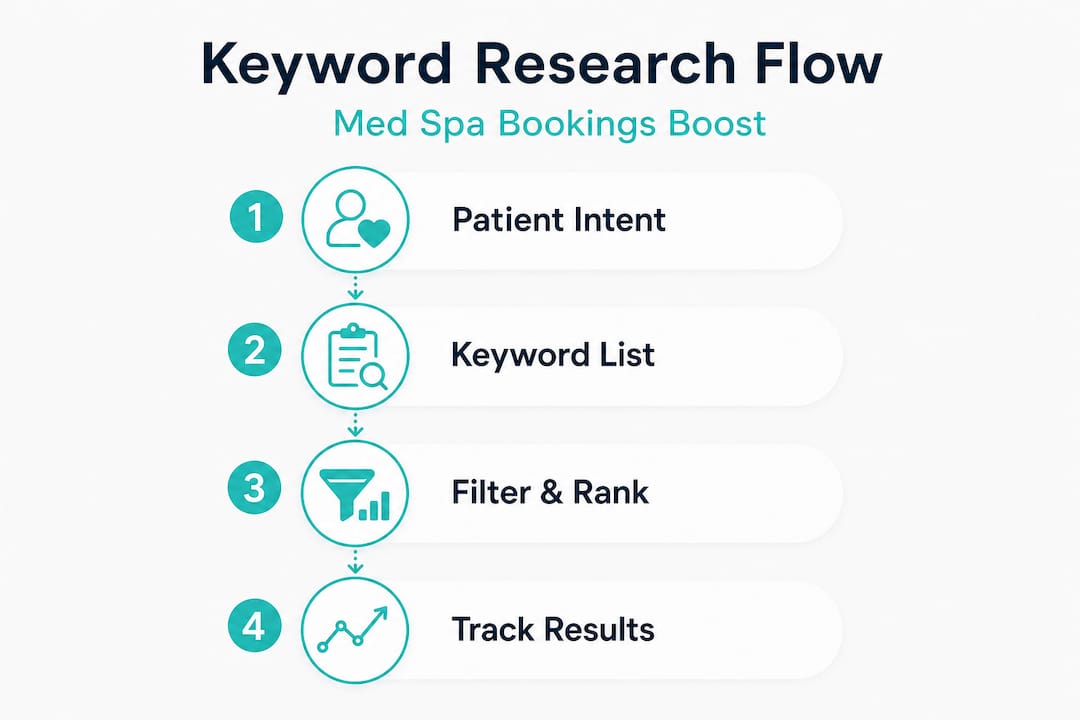
Finally, knowing how to measure and adapt your keyword efforts will turn your med spa’s strategy into an ongoing growth engine.
Setting up your keyword list and publishing content is not the end of the process. It’s the beginning. The med spas that consistently attract new clients treat keyword research as a continuous cycle, not a one-time project.
Here is a simple monthly monitoring routine:
- Check GSC weekly for new queries. GSC reveals content gaps that offer ongoing optimization opportunities. New searches appearing in your data often signal shifts in patient demand you can capitalize on quickly.
- Track keyword ranking positions monthly. Use a free or paid rank-tracking tool to monitor where your target keywords appear on Google. Positions above 10 are on page one. Positions 11 to 20 are page two opportunities.
- Measure actual business outcomes. Rankings and traffic are leading indicators. The metrics that truly matter are form submissions, phone calls, online bookings, and new patient consultations.
- Review and refresh content quarterly. Search trends shift. New treatments become popular. Seasonal demand for services like laser hair removal before summer or injectables before the holidays creates predictable keyword spikes you can prepare for in advance.
Key metrics to track every month:
- Impressions and clicks in GSC for target keywords
- Page-one keyword count for your core service terms
- Website conversion rate (visitors who book or inquire)
- New patient leads attributed to organic search
- Local map pack appearances for “near me” terms
Pairing keyword data with creative assets like video strategies for med spas can amplify the impact of your top-performing keywords. Videos that answer common patient questions rank in both YouTube and Google, doubling your visibility for the same topic.
Pro Tip: Create a simple keyword tracking spreadsheet with columns for keyword, current ranking, last month’s ranking, and notes. Review it at your monthly marketing meeting. Trends become obvious fast when you can see them visually over time.
Why effective med spa keyword research is about patient value, not just traffic
Let’s zoom out and address why so many med spa marketers get tripped up by keyword research. It is not about chasing search traffic.
The number most people obsess over is monthly search volume. Bigger number, better keyword. That logic sounds reasonable until you realize that a 10,000-search keyword filled with curious teenagers and DIY enthusiasts will never grow your business. We’ve seen med spas invest months of content creation into high-volume, low-intent keywords and then wonder why their phone isn’t ringing.
Here is the uncomfortable truth: most med spas don’t have a traffic problem. They have a relevance problem. Their websites attract the wrong audience because their keyword strategy was built around what sounds impressive rather than what actually converts.
A keyword workflow must check for relevance and intent, not just search volume. This isn’t a technical suggestion. It’s the single strategic decision that separates med spas with full calendars from those with great-looking dashboards and empty treatment chairs.
The med spas we’ve seen succeed long-term focus relentlessly on who their patient is and what that patient is searching for at the moment they’re ready to act. A 42-year-old professional searching “lip filler consultation [city]” is worth ten times the anonymous visitor reading a generic blog post about aging. Quality of traffic, not quantity, determines revenue.
When your keyword strategy is built around patient value, everything downstream improves. Your content is more relevant. Your conversion rate goes up. Your cost per acquisition drops. And the patients who do book are more likely to return and refer others. This is the sustainable path to growing your med spa client base over years, not just weeks.
Take your med spa keyword and marketing strategy to the next level
If you’re ready to apply these strategies and see measurable results, here’s how Aesthetic Rank Lab can help.
At Aesthetic Rank Lab, we work exclusively with med spas, which means every strategy we build is designed around the specific way aesthetic patients search, decide, and book. Our local SEO for med spas service targets the high-intent local searches that drive real appointments, not just traffic. If you want to scale faster, our med spa lead generation services are built to convert keyword rankings into a steady stream of new patient inquiries. And for practices ready to work smarter, our med spa automation tools help you follow up with leads instantly so you never lose a booking to slow response times. Let’s put your keyword strategy to work.
Frequently asked questions
Which tool gives the most accurate data for med spa keyword research?
Google Search Console provides actual query data from your existing traffic, capturing real patient intent specific to your med spa’s current visibility.
How often should I update my med spa’s keyword list?
Review and update your keyword list at least every quarter, or immediately after adding new services or noticing a shift in patient inquiries.
What are examples of “vanity traffic” in med spa SEO?
Searches like “anti-aging skincare” or “beauty tips for women” are classic examples because vanity traffic and irrelevant query matches inflate impression and click metrics without producing real bookings.
How do I find new keywords my competitors are using?
Browse top-ranking competitor websites and study their service page titles, blog topics, and header text. GSC can help identify content opportunities by showing what already brings visitors, and comparing that to competitors can reveal gaps you can fill.
Should I focus on local or national keywords for my med spa?
Focus primarily on local intent terms. Most bookings come from patients searching within your city, suburb, or specific service area rather than broad national queries.