
TL;DR:
- Pay per click advertising emphasizes relevance and strategy over budget, delivering better results for med spas. Most owners overlook the importance of post-click experience and proper targeting, which are crucial for converting clicks into booked consultations. Focusing on measurable outcomes like booked appointments and optimizing campaigns accordingly ensures a sustainable growth strategy.
Most med spa owners assume pay per click advertising is a numbers game: spend more money, get more clicks, fill more appointment slots. That assumption costs them thousands every year. The truth is that PPC advertising rewards relevance, intent, and strategy far more than raw budget. This guide breaks down exactly how PPC works, what drives real results for med spas, and how to build campaigns that bring in booked consultations rather than empty traffic that disappears without booking anything.
Table of Contents
- How pay per click advertising works
- Inside the PPC auction: What determines your ad’s position and cost
- Key PPC metrics and industry benchmarks
- How med spas win with PPC: Tactics and success strategies
- What most med spas get wrong about PPC—and how to get it right
- Supercharge your med spa’s growth with expert PPC support
- Frequently asked questions
Key Takeaways
| Point | Details |
|---|---|
| PPC is pay-per-click | You only pay when someone clicks your ad, not for every impression. |
| Auction system matters | Google Ads rewards relevance and intent, not just the highest bid. |
| Track the right metrics | Focus on conversion rates and bookings rather than vanity metrics. |
| Local targeting wins | Using local relevance and specific targeting boosts med spa ROI. |
| Strategy beats spend | A smart, tailored approach delivers results, not just a big ad budget. |
How pay per click advertising works
Pay per click advertising is exactly what it sounds like: you only pay when someone actually clicks your ad. You do not pay for impressions, views, or brand exposure. That model alone makes PPC fundamentally different from a billboard or a magazine ad, where you pay regardless of engagement.
Pay-per-click advertising is an online advertising model where advertisers pay when someone clicks their ad. That click-based pricing means your budget is tied directly to real user action, which is why it appeals to med spas that want accountability from every marketing dollar.
Here is a quick comparison between PPC and traditional digital advertising:
| Feature | PPC advertising | Traditional display ads |
|---|---|---|
| When you pay | Per click | Per impression (per 1,000 views) |
| Audience intent | High (they searched for it) | Low to medium |
| Budget control | Daily/campaign caps | Often minimum spend commitments |
| Speed to results | Days | Weeks to months |
| Measurability | Precise | Harder to attribute |
The main platforms where med spas run PPC campaigns include Google Ads, Microsoft (Bing) Ads, and paid social platforms like Meta. Google Ads dominates for search intent, meaning someone types “Botox near me” and your ad appears at the top of the results. That is the environment where your potential client is actively looking for exactly what you offer.
Here is how the setup works in practice for most med spas:
- You define a daily or monthly budget (for example, $500 per month)
- You select keywords like “Botox near me,” “laser hair removal [city],” or “lip filler consultation”
- You write ad copy that matches what those searchers want
- You set targeting parameters including location radius, device type, and time of day
- When someone clicks, the amount charged depends on the auction (explained in the next section)
Think of it this way: Every time someone searches for a service you offer, an instant auction fires off behind the scenes. Your ad either shows up or it does not, and the outcome depends on more than just your wallet.
The paid advertising basics behind PPC are learnable, but the execution requires attention to detail and ongoing refinement to avoid burning through budget on low-quality clicks.
Inside the PPC auction: What determines your ad’s position and cost
Here is where most med spa owners get confused. They assume that whoever bids the highest wins the top spot and pays the most. That is only partially true. Google and other platforms use a more sophisticated system.
PPC commonly operates through search-engine ad auctions that determine eligibility, ad order, and pricing in real time. Every single search triggers a fresh auction. Within milliseconds, the platform evaluates every advertiser competing for that search query and determines who shows up, in what order, and at what cost.
The factors that go into that decision include:
Your bid: The maximum amount you are willing to pay per click.
Ad relevance: How closely your ad copy matches what the user searched for.
Landing page experience: Whether the page your ad links to actually delivers on the promise the ad makes.
Expected click-through rate: The platform’s prediction of how likely your ad is to get clicked based on historical performance.
Ad extensions: Additional information like phone numbers, location, site links, and review ratings that make your ad more useful.
These factors combine into a score called Ad Rank. In Google Ads, bids and advertiser competition are considered together with relevance and intent, so more relevant ads can win and even cost less than competitors with higher bids.
Here is a practical comparison to make that concrete:
| Scenario | Med Spa A | Med Spa B |
|---|---|---|
| Keyword targeted | “Botox near me” | “Botox near me” |
| Max bid | $8.00 | $5.00 |
| Ad relevance score | Low (generic ad) | High (specific, local ad) |
| Landing page match | Homepage | Botox-specific service page |
| Ad Rank outcome | Lower position | Higher position |
| Actual cost per click | More | Less |
Med Spa B wins with a lower bid because its ad and landing page are a better match for the searcher’s intent. This is why your paid search strategy must prioritize relevance, not just competitive bidding.
Pro Tip: Create dedicated landing pages for each service you advertise. A Botox ad should land on a Botox-focused page with a booking button, testimonials, and pricing information. Sending all your PPC traffic to your homepage is one of the fastest ways to inflate your costs and kill your conversion rate.
Key PPC metrics and industry benchmarks
Once you know how your ads get shown and priced, the next step is knowing how to judge what “good” actually looks like in PPC. These are the numbers you need to track and understand:
CTR (click-through rate): The percentage of people who see your ad and click it. A 3% CTR means 3 out of every 100 people who see the ad click through.
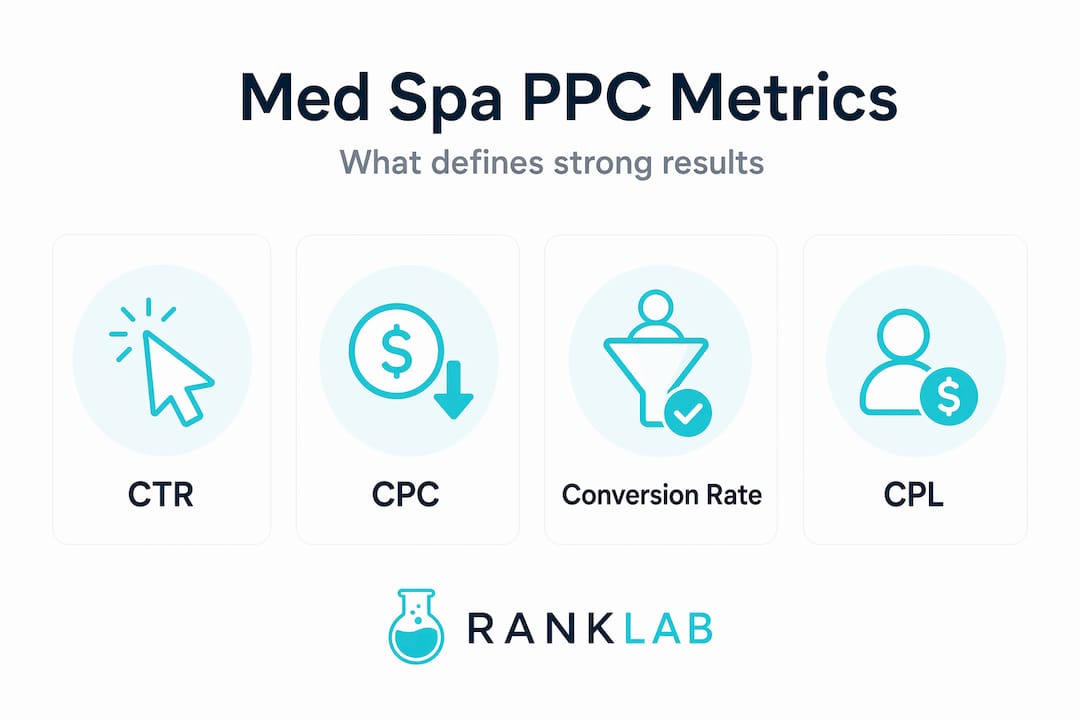
CPC (cost per click): What you pay for each click. This varies widely by keyword competitiveness and industry.
Conversion rate: The percentage of people who click your ad and then complete a desired action, such as booking a consultation or filling out a contact form.
Cost per lead (CPL): How much you spend in ad budget to generate one qualified lead or booked consultation. This is arguably the most important number for med spas.
PPC effectiveness is usually evaluated with funnel metrics like CTR and conversion rate, and industry benchmarking is commonly reported using averages across many accounts. Here is a realistic snapshot of what those numbers look like:
| Metric | Industry average (Google Ads) | Strong med spa benchmark |
|---|---|---|
| Click-through rate (CTR) | 3.17% | 4% or higher |
| Cost per click (CPC) | $2.69 to $8.00+ | $5 to $15 (aesthetics) |
| Conversion rate | 3.75% | 5% or higher |
| Cost per lead | $40 to $100+ | Under $80 per booked consult |
The beauty and wellness category tends to see higher CPCs than general retail because the lifetime value of a new client is substantial. A client who comes in for Botox can easily spend $1,500 to $3,000 annually at your practice. Spending $60 to acquire that client is a favorable return.
The most important things to track for your specific med spa:
- Number of form submissions or calls generated from ads
- Booked consultation requests (not just calls)
- Cost per booked consultation
- Return on ad spend (ROAS) once you know your average client value
These local PPC results are far more meaningful than chasing a generic industry CTR benchmark. Benchmarks inform your expectations, but your actual goal is booked appointments and paying clients. Check out these improving med spa leads strategies to complement your PPC with other proven approaches.
How med spas win with PPC: Tactics and success strategies
You now know what to measure. Here is how to actually achieve standout PPC results for your med spa, from initial setup through ongoing optimization.
Step 1: Define your campaign goals before you spend a dollar
Decide exactly what action you want a potential client to take. Is it booking an appointment online? Calling your front desk? Filling out a consult request form? Every element of your campaign, from keywords to landing pages, should point toward that one action.
Step 2: Build tightly themed ad groups
Do not lump all your services into a single campaign. Create separate ad groups for Botox, fillers, laser treatments, body contouring, and so on. Each ad group should have its own keywords, its own ad copy, and its own landing page. This structure keeps relevance high and costs low.
Step 3: Use negative keywords aggressively
Negative keywords prevent your ad from showing up for irrelevant searches. If you offer cosmetic Botox, you do not want to pay for clicks from people searching for “Botox for migraines covered by insurance” or “Botox training courses.” Building a robust negative keyword list is one of the fastest ways to stop wasting money.
Step 4: Write ad copy that speaks to intent
Your headline needs to answer the searcher’s question immediately. “Botox in [Your City] starting at $12 per unit” outperforms “Welcome to Our Medspa” every single time. Use the second headline to highlight a differentiator: board-certified injectors, same-week appointments, or a new client special.
Step 5: Optimize your landing pages
Benchmarks can help set expectations, but med spas should evaluate performance with their own conversion actions like booked consults, not only clicks. That means your landing page must do the heavy lifting. Include a prominent booking button, before-and-after photos, provider credentials, pricing transparency, and patient testimonials. Remove navigation menus that distract visitors from booking.

Step 6: Set up call tracking and conversion tracking
Without tracking, you are guessing. Use Google Ads conversion tracking to record form submissions and phone calls that come directly from your ads. This data tells you which keywords and ads actually generate bookings.
Step 7: Run A/B tests on headlines and CTAs
Write two versions of every ad and let them compete. Test different headlines, calls to action, and value propositions. Over time, winning ad copy becomes obvious from the data.
Pro Tip: Use geotargeting for med spas to limit your ad delivery to a specific radius around your location. Most clients will not drive more than 20 miles for aesthetic services. Tightening your targeting radius keeps your budget focused on the people most likely to actually book. Pair this with top med spa marketing trends to stay ahead of competitors in 2026.
Pitfalls to avoid at all costs:
- Obsessing over CTR while ignoring cost per booked consultation
- Sending all ad traffic to your homepage instead of specific service pages
- Ignoring search term reports (the actual phrases triggering your ads)
- Setting a campaign live and never checking on it
- Using only broad match keywords without negative keyword controls
What most med spas get wrong about PPC—and how to get it right
After years of working exclusively with med spas on their digital marketing, one pattern stands out above all others. Owners and managers focus almost entirely on cost-per-click as their primary health metric for a campaign. They see $7 per click and panic. They see $3 per click and celebrate. But neither number tells you whether the campaign is actually working.
The real question is: what happens after the click?
A $7 click that lands on a perfectly optimized Botox page, delivers a seamless booking experience, and converts into a $500 consultation is a spectacular investment. A $2 click that bounces off a cluttered homepage and leaves without any action is pure waste. The click itself is just the ticket through the door. Everything that happens inside your digital experience determines whether you built revenue or burned budget.
The med spas that consistently win with PPC focus on three things competitors overlook. First, they match search intent precisely. When someone types “lip filler natural results [city],” they want to see an ad that speaks directly to natural-looking results from a local provider, not a generic “Book Your Consultation Today” headline. Second, they invest in the post-click experience with the same seriousness as the ad itself. Clear service pages, fast load times, visible pricing, and easy booking are non-negotiable. Third, they treat PPC as one piece of an integrated strategy rather than a standalone tactic.
Pairing PPC with strong local SEO, compelling social proof, and smart follow-up sequences is how you boost med spa sales in a sustainable way rather than depending entirely on paid traffic that stops the moment you pause your budget.
The mindset shift that changes everything is this: stop asking “how do I get cheaper clicks?” and start asking “how do I make every click count more?”
Supercharge your med spa’s growth with expert PPC support
Ready to put these insights into practice? The next step is easier and more effective when you have the right expert partner. At Aesthetic Brink Lab, we build and manage PPC campaigns exclusively for med spas, which means we already understand the keywords, compliance nuances, seasonal trends, and conversion tactics specific to your industry. We combine paid advertising with automation for med spa marketing to follow up with leads automatically and maximize every dollar you spend. From lead generation ideas to full-funnel paid campaigns, we handle the complexity so you can focus on treating clients. Explore our complete approach to digital advertising for med spas and see how a niche-focused team can accelerate your bookings.
Frequently asked questions
How much should a med spa spend on PPC advertising?
Budgets vary, but many med spas start with $500 to $2,000 monthly and scale based on cost per booked consultation and overall client acquisition results.
What is a good click-through rate (CTR) for med spa PPC ads?
Most med spa campaigns should aim for a CTR between 3% and 5%, which is considered strong in both the beauty and wellness sectors based on industry CTR benchmarks.
Are Google Ads or Facebook Ads better for med spas?
Google Ads typically converts better for high-intent searchers actively looking for a specific service, while Facebook Ads excel at building awareness; combining both usually delivers the strongest overall results.
How long does it take to see results from PPC advertising?
Many med spas see clicks and phone calls within the first few days of launch, but refining campaigns for consistent booked consultations generally takes one to three months of data and testing.
What PPC metric matters most for med spas?
Booked appointments and consultation requests are the most valuable metrics because, as industry benchmarks confirm, clicks alone do not reflect whether a campaign is actually growing your practice.