
TL;DR:
- Programmatic advertising uses AI and real-time data for precise, targeting and automated ad buy.
- It offers med spas better targeting, budget control, and continuous optimization compared to traditional methods.
- Success depends on strategy, testing, and choosing verified platforms to avoid fraud and transparency issues.
If you’ve ever run Facebook or Google ads for your med spa and wondered why so many clicks turn into nothing, you’re not alone. Most med spa owners are spending real money on digital ads that reach the wrong people at the wrong time. Programmatic advertising changes that equation by using AI and real-time data to put your message in front of the exact people most likely to book an appointment, automatically. This guide walks you through what programmatic advertising is, how it works, the real benefits for med spas, the pitfalls to watch for, and the strategies that actually move the needle.
Table of Contents
- What is programmatic advertising?
- How programmatic advertising works: Core mechanics
- Benefits of programmatic advertising for med spas
- Challenges and nuances in programmatic advertising
- Our take: What most med spas miss about programmatic
- How Aesthetic Rank Lab can support your med spa growth
- Frequently asked questions
Key Takeaways
| Point | Details |
|---|---|
| Automated ad buying | Programmatic advertising uses AI and real-time bidding for targeted digital ads without manual negotiation. |
| Hyper-local targeting | Med spas can reach qualified local prospects based on geography, age, and interests instantly and efficiently. |
| Optimize budgets | AI-driven automation prevents wasted spend by optimizing placements and maximizing ROI. |
| Fraud and data management | Understanding and mitigating risks such as ad fraud and privacy compliance is key for high-performance campaigns. |
What is programmatic advertising?
Programmatic advertising is the automated buying/selling of digital ad inventory using AI and real-time auctions. Instead of calling a publisher, negotiating rates, and waiting days for a campaign to go live, programmatic technology handles all of that in milliseconds. You set your audience parameters, budget, and creative assets, and the system does the rest.
Three core technologies power this ecosystem:
- Demand-side platforms (DSPs): The software advertisers (like your med spa) use to bid on ad placements across thousands of websites and apps simultaneously.
- Supply-side platforms (SSPs): The tools publishers use to make their ad inventory available and maximize revenue.
- Ad exchanges: The digital marketplaces where DSPs and SSPs connect and auctions happen in real time.
Traditional ad buying looks nothing like this. With legacy media buys, you’d negotiate a flat rate for a banner on a local health website, run it for 30 days, and hope the right people saw it. You had little control over who saw the ad, and even less data on what happened afterward. Programmatic flips that model entirely.
For a med spa, this means instead of paying to reach everyone who visits a general wellness website, you’re bidding to reach women aged 30 to 55, with household incomes above $75,000, located within 15 miles of your clinic, who have recently searched for Botox or laser skin treatments. That’s not guesswork. That’s data-driven precision tied to your actual target client.
Here’s a quick comparison to make the difference crystal clear:
| Factor | Programmatic | Traditional |
|---|---|---|
| Buying process | Automated, real-time | Manual negotiation |
| Targeting | Data-driven, granular | Broad, demographic |
| Speed to launch | Minutes to hours | Days to weeks |
| Optimization | Continuous, AI-driven | Manual, periodic |
| Transparency | Detailed reporting | Limited visibility |
| Budget flexibility | Full control, real-time | Fixed contracts |
For med spas investing in med spa digital advertising, programmatic is a major upgrade over the spray-and-pray approach most clinics still rely on.
How programmatic advertising works: Core mechanics
Once you understand what programmatic advertising is, it helps to see how the technology works at lightning speed. Here’s exactly what happens every time a potential client loads a webpage that has programmatic ad space:
- User loads a page. A woman in Dallas searches for “skin tightening near me” and clicks through to a beauty editorial site.
- Ad request fires. The publisher’s SSP sends an ad request to the ad exchange, including user data like location, browsing history, and device type.
- DSPs evaluate the opportunity. Your DSP receives the request and evaluates whether this user matches your target audience profile.
- Bid is submitted. If she matches, your DSP submits a bid within the auction window, which completes in 40 to 120ms.
- Winning ad displays. The highest bidder wins. Your med spa’s ad appears on her screen before the page even finishes loading.
- Data is captured. Every impression, click, and conversion is recorded for optimization.
The whole process happens faster than a human blink. That speed is what makes programmatic so powerful for local service businesses like yours.
Not all programmatic inventory is bought the same way. The four main buying types are:
| Buying type | How it works | Best for |
|---|---|---|
| Open RTB | Open auction, highest bid wins | Broad prospecting, volume |
| Private Marketplace (PMP) | Invite-only auctions on premium sites | Brand safety, niche audiences |
| Preferred Deals | Fixed price, first-look access | Consistent placements |
| Programmatic Guaranteed | Reserved inventory, guaranteed impressions | High-value campaigns |
For a med spa running a Botox promotion, open RTB might work great for broad awareness. But if you want your ad on a trusted local lifestyle publication, a Private Marketplace deal gives you both the premium placement and the audience quality.
Pro Tip: Don’t default to open RTB for everything. Test a small budget across at least two buying types and measure cost per booked consultation. The results may surprise you.
Your paid advertising strategies should factor in which buying type aligns with your campaign goal before you allocate a single dollar.
Benefits of programmatic advertising for med spas
Understanding the technical process, med spa marketers naturally ask: why invest in programmatic, and what makes it powerful for driving real growth? Here’s the answer broken down.
Precise audience targeting is the headline benefit. Programmatic allows you to target by designated market area (DMA), zip code, age range, household income, interest categories, and even life events like recent home purchases or new parents. Hyper-local geo-targeting and demographic precision mean your budget goes toward people statistically more likely to become paying clients.
For a med spa, that targeting profile might look like this:
- Women aged 32 to 58
- Household income over $80,000
- Located within 10 miles of your clinic
- Interests: skincare, wellness, anti-aging
- Has visited competitor websites in the last 30 days
Budget optimization happens automatically. Programmatic systems continuously shift spend toward placements that are converting and away from those that aren’t. Unlike a static Google Display campaign you check once a week, programmatic is always learning and adjusting in real time.

Typical CPM costs for local med spa campaigns fall in the $3 to $8 range, which means your creative can reach thousands of qualified local prospects for a relatively modest daily budget. But the metric that actually matters isn’t reach, it’s cost per acquisition.
Pro Tip: Track cost per booked consultation from day one. A campaign with a $5 CPM that generates two bookings is less efficient than one with a $7 CPM that generates ten. Reach is vanity. Appointments are reality.
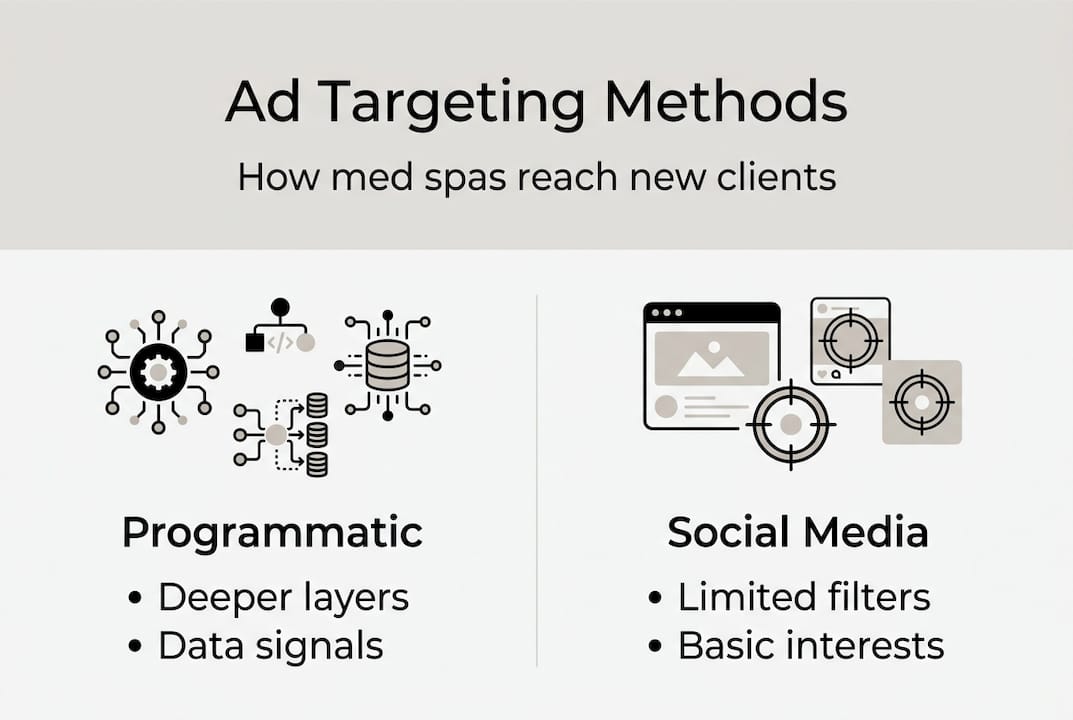
To learn how to target med spa clients more effectively, programmatic gives you the targeting depth that social platforms simply can’t match for local services. Pairing programmatic with strong lead generation for med spas creates a pipeline that keeps your appointment book full month after month.
Challenges and nuances in programmatic advertising
Programmatic isn’t magic. Before you dive in, it’s critical to recognize common pitfalls and the nuanced decisions med spa marketers face in this space.
Ad fraud, privacy regulations, transparency gaps, brand safety risks, and fragmented measurement are the ongoing challenges every programmatic advertiser faces. For med spas, the consequences of ignoring these aren’t just wasted budget. They can mean your ads appear on sites that damage your brand reputation or generate traffic that looks real but never converts.
Here’s what to watch for:
- Ad fraud: Bots inflate impression and click counts. In local campaigns targeting smaller audiences, inflated metrics are easier to miss. Require your platform to use third-party fraud verification tools.
- CCPA compliance: California’s privacy law and similar state regulations affect how you can use audience data. If you’re running campaigns in regulated states, confirm your DSP handles consent properly.
- Lack of transparency: Some platforms bundle fees and don’t reveal which specific sites your ads ran on. Always ask for domain-level reporting so you know exactly where your money went.
- Brand safety risks: Without blocklists or category exclusions, your med spa ad could appear next to controversial content. Set exclusions before you launch.
“Programmatic environments with poor fraud controls can waste 20 to 30 percent of a local advertiser’s display budget on non-human traffic. The fix isn’t avoiding programmatic. It’s choosing verified platforms and monitoring campaigns weekly.”
Auction mechanics add another layer of nuance. The shift from second-price to first-price auctions, header bidding adoption, and transparency standards have changed how bids are evaluated and won. In a first-price auction, you pay exactly what you bid, so overbidding directly costs you money. Bid shading tools help by estimating the lowest competitive bid needed to win.
Learning how to boost med spa sales through programmatic means mastering not just the opportunity but the guardrails that protect your investment.
Our take: What most med spas miss about programmatic
Most med spas that try programmatic advertising treat it like a light switch. They set up an open RTB campaign, upload one creative, and check back in six weeks wondering why it underperformed. That’s not a programmatic problem. That’s a strategy problem.
The med spas seeing real growth from programmatic are doing three things differently. First, they’re blending buying types. Open RTB for prospecting, PMPs for retargeting warm audiences on trusted lifestyle publications, and programmatic guaranteed for seasonal promotions. Second, they’re treating first-party data as a core asset. With third-party cookies disappearing, your email list, booking history, and CRM data are what fuel superior targeting. If you don’t have that data organized and connected to your DSP, you’re already behind. Third, they’re testing constantly. Creative fatigue in local markets happens fast. Running two to three creative variants and rotating based on performance is standard practice, not optional.
We’ve seen it firsthand in our med spa case studies: the clinics that commit to structured testing, clean data, and a mix of buying strategies outperform those chasing the lowest CPM every single time. Programmatic rewards smart operators, not passive ones.
How Aesthetic Rank Lab can support your med spa growth
Now that you know how programmatic works and where most competitors fall short, here’s how Aesthetic Rank Lab helps med spas turn these insights into real growth. Our team builds and manages paid advertising campaigns designed specifically for med spa audiences, from audience setup and creative strategy to bid management and fraud monitoring. We also connect programmatic campaigns to med spa automation workflows so that every lead is followed up instantly and tracked through to booking. Combined with our lead generation services, we build a full funnel that brings in the right clients and keeps them coming back. Ready to stop guessing and start growing? Reach out for a strategy consultation today.
Frequently asked questions
Is programmatic advertising suitable for small, local med spas?
Yes, programmatic fits small med spas well because hyper-local geo-targeting and budget optimization allow even modest budgets to reach the right local audience with precision.
What’s the typical cost to run programmatic ads for a med spa?
U.S. display CPMs typically range from $3 to $8 for local campaigns, though cost benchmarks vary by service type and targeting depth, making cost per acquisition the better performance metric.
How do I keep my med spa’s programmatic ads safe from fraud?
Work with platforms that include third-party verification and review ad fraud risks weekly by monitoring for abnormal click patterns or traffic spikes that don’t match conversion data.
What’s the difference between real-time bidding and private marketplace in programmatic?
Open RTB vs PMP comes down to scale versus quality: RTB is an open auction focused on reach, while private marketplaces offer premium, invite-only placements better suited for brand-safe retargeting.