
TL;DR:
- A visually appealing med spa website may remain invisible in search results without proper SEO infrastructure.
- Conducting a comprehensive SEO audit identifies technical, content, authority, and UX issues, enabling targeted improvements.
Your med spa website looks incredible. Professional photography, elegant fonts, a smooth booking flow. But here’s the uncomfortable reality: a visually stunning website can sit completely invisible in search results, pulling in zero new clients every month while competitors with simpler sites dominate the first page of Google. The difference isn’t design talent. It’s SEO infrastructure, and only a proper audit can reveal what’s broken, what’s missing, and what opportunities you’re leaving on the table. For med spa owners serious about growing their client base, understanding SEO audits is one of the most practical investments you can make.
Table of Contents
- What is an SEO audit?
- Core phases of an SEO audit for med spas
- Technical SEO: The foundation of visibility
- Prioritizing audit recommendations for maximum impact
- From audit to action: Applying the findings
- Why most med spas overlook game-changing audit insights
- Take your med spa’s SEO further with expert help
- Frequently asked questions
Key Takeaways
| Point | Details |
|---|---|
| SEO audits go beyond appearance | A beautiful website still needs regular audits to ensure new clients can find you online. |
| Technical fixes come first | Resolving crawl and indexing issues always takes priority over content or link building. |
| Prioritization drives real results | Focus on high-impact issues rather than tackling a long checklist. |
| Regular audits mean growth | Ongoing SEO audits help med spas adapt, improve visibility, and win more bookings. |
What is an SEO audit?
Many med spa owners think SEO is just about keywords or getting backlinks. The reality is more structured. An SEO audit is a structured review of how well a website is positioned to rank and earn organic traffic, typically checking technical health, on-page relevance, content quality, intent fit, and authority including backlinks, then turning findings into prioritized fixes.
Think of it like a full health checkup for your website. A doctor doesn’t just check your blood pressure. They run panels, look at your chart history, and compare results against baselines. An SEO audit does the same for your online presence.
For a med spa, an audit typically reviews these core areas:
- Technical health: Can Google actually crawl and index your pages?
- On-page relevance: Are your pages targeting the right search terms?
- Content quality: Does your content answer what prospective clients are searching for?
- Authority signals: Do credible websites link to yours?
- User experience: Do visitors stay, engage, and book?
The goal of an audit is not to produce a 100-point checklist. It’s to identify the specific blockers and opportunities that move your business forward. Prioritizing fixes matters far more than ticking every box.
That distinction is critical. A lot of agencies hand over a bloated spreadsheet of 200 “issues” with no guidance on what actually matters. A real audit tells you what to fix first and why.
Core phases of an SEO audit for med spas
Now that you know what an SEO audit is, let’s explore its main focus areas and how each plays out for med spa websites specifically.
Common audit phases include technical, content, backlink/authority, and UX/engagement as part of the overall audit workflow. Here’s how each phase applies to your med spa:
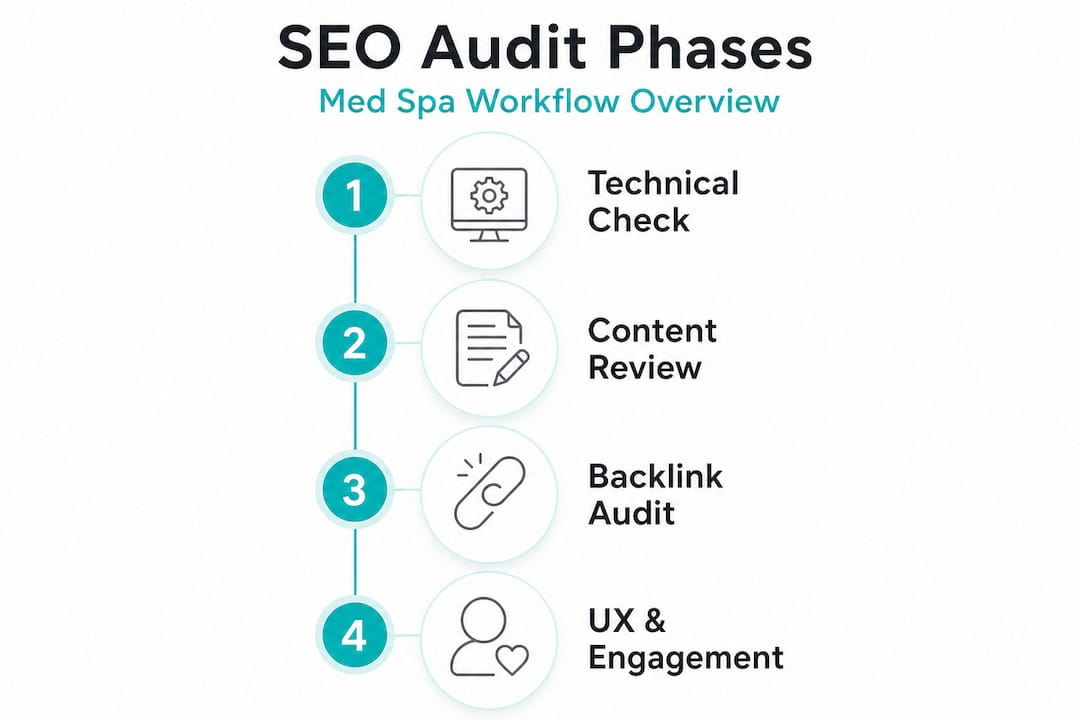
| Audit phase | What it checks | Med spa example |
|---|---|---|
| Technical | Crawlability, indexation, site speed | Botox service page blocked by robots.txt |
| Content | Keyword targeting, relevance, intent match | “Laser hair removal” page missing local intent |
| Authority | Backlinks, domain reputation, citations | No links from local beauty or health directories |
| UX/Engagement | Bounce rate, conversions, mobile usability | Mobile booking form not loading properly |
Here’s the recommended order for working through audit phases:
- Fix technical issues first. If Google can’t crawl your pages, nothing else matters. Blocked pages, crawl errors, and slow load times need to be addressed before any content work.
- Audit content and keyword alignment. Once Google can access your pages, make sure they target what real prospects search. Local SEO for med spas is especially important here because most clients search with location modifiers like “med spa near me” or “Botox in Austin.”
- Review authority and backlinks. Identify whether credible local sources, beauty publications, or health directories link back to your site.
- Assess UX and engagement. Even if you rank well, a confusing booking flow or slow mobile experience will kill conversions.
Pro Tip: Run a quick check on improving local search visibility before you start an audit. Understanding where you currently stand in local results gives you a benchmark to measure every fix against.
The phases are interconnected. A site with strong content but broken technical foundations will still underperform. You need all four working together.
Technical SEO: The foundation of visibility
With the core phases mapped out, let’s dive deeper into the foundation every med spa site must get right: technical SEO.

Technical SEO audits typically include crawlability and indexation checks such as robots.txt, crawl errors, and canonical or noindex issues, using tools like Google Search Console’s URL Inspection and Coverage reports to verify what Google can fetch and index.
Here are the most common technical issues found on med spa websites:
| Technical issue | What it means | Impact level |
|---|---|---|
| Pages blocked by robots.txt | Google is told not to visit those pages | Critical |
| Noindex tags on live pages | Page won’t appear in search results | Critical |
| Duplicate content | Multiple URLs with identical content | High |
| Incorrect canonical tags | Wrong URL is treated as the main version | High |
| Slow page speed | Pages take more than 3 seconds to load | High |
| Broken internal links | Visitors and bots hit dead ends | Medium |
Here’s a real scenario we see regularly. A med spa builds a new website and moves service pages to a different URL structure. The old pages get redirected, but somewhere in the build, a “noindex” tag gets left on three or four key service pages. Google visits those pages, sees the noindex instruction, and simply excludes them from search results entirely.
If a page is not indexable due to noindex, robots restrictions, access or login constraints, or a failed fetch, optimizing on-page copy and links won’t fix visibility. URL Inspection is meant for diagnosing this per-page indexing problem exactly.
In plain terms: you could spend weeks perfecting your content and building backlinks, but if Google can’t index the page, that work is completely wasted.
Pro Tip: Open Google Search Console, go to the URL Inspection tool, and paste in your most important service pages one by one. Check whether Google has indexed them and when it last crawled them. This single check can reveal problems that have been silently blocking your traffic for months.
Your website design for med spas has to be built with technical SEO in mind from day one. Aesthetics and performance should never compete with each other.
Prioritizing audit recommendations for maximum impact
Fixing technical health is essential, but making meaningful improvements depends on knowing what to fix first. Here’s how to prioritize for results.
A good audit methodology prioritizes fixes by impact and order of operations, for example crawl and index issues first, then on-page and content work, then authority building, rather than producing a long unprioritized checklist.
Not every issue on your audit report deserves the same urgency. Some problems block all organic traffic entirely. Others are minor quality improvements that help at the margins. Here’s a practical framework for deciding what to address:
- Blockers first: Any technical issue preventing Google from indexing your key pages must be resolved before anything else. This includes noindex errors, crawl blocks, and server-side issues.
- High-traffic, high-conversion pages second: Once Google can access your pages, focus on service pages that drive the most bookings. A Botox page or laser treatment page will deliver more return than a general blog post.
- Content gaps third: After fixing existing pages, identify which services you offer but haven’t created dedicated pages for. Missing content means missing search demand.
- Authority building fourth: Once your technical foundation and content are solid, earning backlinks from beauty publications, local blogs, or directories compounds your results over time. Strategies for improving online reputation also contribute to your authority signals.
For local SEO audit strategies specifically, prioritization should account for your Google Business Profile completeness, local citation consistency, and whether your site content includes city or neighborhood-specific language.
If you own multiple med spa locations or operate a franchise model, prioritization gets more nuanced. Enterprise-level audits need to account for duplicate content across location pages, consistent NAP (name, address, phone number) data, and whether each location has its own indexed landing page with unique local content.
Pro Tip: Before your next audit, review what services make you the most revenue. Those pages should be your first priority for technical fixes and content improvements. Connecting SEO work directly to revenue outcomes keeps your team focused on what actually matters.
Understanding the role of content for beauty brands also helps frame which topics your audience actively searches for when deciding between professional and at-home options.
From audit to action: Applying the findings
Once priorities are clear, the final step is making audit insights drive real results for your business.
The audit’s purpose is identifying both problems and opportunities, then focusing on the factors that most influence organic search performance. But findings sitting in a report do nothing. You need a clear action plan.
Here’s a practical process for turning audit results into measurable growth:
- Translate every finding into a specific action item. “Fix technical SEO” isn’t actionable. “Remove noindex tag from /services/botox page” is. Every recommendation needs a concrete next step.
- Assign ownership and a realistic deadline. Whether that’s your web developer, content writer, or marketing agency, someone needs to be accountable for each item. Set a deadline and check in on it.
- Start with the highest-impact items. Use the prioritization framework from the previous section. Don’t get distracted by 50 small fixes when three big ones are blocking your growth.
- Measure what changes after each fix. Track rankings, organic traffic, and bookings week over week. Google Search Console and Google Analytics give you the data. You should see movement within four to eight weeks for technical fixes, and within two to three months for content improvements.
- Schedule your next audit. SEO is not a one-time project. Algorithm updates, site changes, new competitors, and evolving search behavior all shift the landscape. Build recurring audits into your marketing calendar.
For concrete tactics tied to boosting med spa sales, align your SEO action plan with seasonal promotions and new service launches. If you’re adding a new treatment to your menu, create an optimized service page at the same time, not six months later.
Also consider whether your med spa UX practices support conversion once you start driving more traffic. Ranking on page one means nothing if your booking flow frustrates visitors or your site loads slowly on mobile. The question of whether home treatments compare to professional services is one your content should answer clearly to capture clients who are still weighing their options.
Pro Tip: Create a simple tracking spreadsheet with three columns: the audit finding, the action taken, and the result measured. Review it monthly. This makes the ROI of your SEO work visible and helps you justify continued investment.
Why most med spas overlook game-changing audit insights
Here’s something we’ve seen consistently across dozens of med spa projects: owners invest heavily in beautiful websites and social media content, then wonder why their calendar isn’t full. The answer is almost always hiding in technical and content issues that a proper audit would surface in under an hour.
The most common mistake is treating an audit as a one-time task. A med spa gets an audit done, fixes a few issues, and considers it closed. But their site keeps evolving. New pages get added without proper optimization. A site migration breaks redirects. A plugin update accidentally adds noindex tags to key service pages. Without regular audits, these problems compound silently for months.
One-size-fits-all audits are another problem. A generic SEO report doesn’t account for the specific dynamics of the med spa industry: strong local intent in searches, the importance of trust signals in healthcare-adjacent businesses, or the way clients compare specific treatments before booking. Your audit needs to reflect your actual service area, your competitive landscape, and your specific business goals.
The fastest results we’ve seen come from focusing on what we call “high-leverage fixes.” These are the three to five issues that, once resolved, immediately impact crawlability or rankings for your most valuable pages. Not every audit item moves the needle equally, and spending time on low-impact recommendations while blockers remain is a common trap.
The mindset shift that changes everything is treating designing for conversion and SEO as connected disciplines rather than separate projects. Technical health, content relevance, and user experience all feed each other. When you fix your indexation issues, your content improvements gain traction faster. When your UX improves, engagement signals strengthen your rankings. An audit is the starting point, but ongoing optimization is the engine.
Take your med spa’s SEO further with expert help
Understanding your audit findings is just the beginning. If you want to put these insights to work faster and with greater precision, professional support makes a measurable difference. Aesthetic Brink Lab specializes exclusively in med spa marketing, combining technical SEO services for med spas with a Smart Website ecosystem built to perform in competitive local markets. From resolving indexation issues to developing content that converts searchers into booked clients, we handle the full workflow. Explore our lead generation for med spas strategies and marketing automation for med spas to see how audit-driven improvements connect to long-term business growth.
Frequently asked questions
How often should a med spa perform an SEO audit?
Med spas should perform comprehensive SEO audits at least twice a year to catch new issues quickly and stay ahead of algorithm changes. More frequent lightweight checks every quarter are ideal for active websites adding new service pages regularly.
What tools help med spa owners check their website’s SEO technical health?
Google Search Console provides a URL Inspection tool to test a page against requirements for appearing in Google search results, making it one of the most accessible and reliable tools for diagnosing crawl and indexing problems at no cost.
Can I do a basic SEO audit myself or do I need an expert?
You can handle basic checks using free tools like Google Search Console, which surfaces crawl errors and coverage issues without technical training. However, deeper audits covering content strategy, backlink analysis, and prioritized action plans benefit significantly from professional expertise, especially in a competitive local market.
What’s the first SEO issue to check if my site isn’t getting traffic?
Check whether your key service pages are actually indexed by Google using the URL Inspection tool, since non-indexed pages cannot rank or receive organic traffic regardless of how well-optimized the content is. This single diagnostic step often reveals the most critical and immediately fixable problem on underperforming sites.