
TL;DR:
- Most med spa owners mistakenly believe that frequent emails and promotions are sufficient for patient retention. Effective retention marketing involves personalized, systematic communication that nurtures relationships, saves costs, and encourages loyalty. Tracking actual patient behaviors, not vanity metrics, ensures a meaningful approach to sustaining long-term growth.
Most med spa owners think patient retention marketing means sending more emails. More texts. More promotions. That thinking is costing them patients they already earned. Patient retention marketing is the deliberate, systematic practice of nurturing relationships with existing patients so they return, stay engaged, and eventually become advocates for your practice. For a med spa, this is not a nice-to-have. It is the difference between a practice that grows predictably and one that constantly scrambles for new faces to fill the schedule.
Table of Contents
- Key takeaways
- What patient retention marketing actually means
- Why retention marketing pays off financially
- Practical strategies that improve patient retention
- Measuring patient retention marketing success
- Common pitfalls that undermine retention efforts
- My take on building retention that actually lasts
- How Aestheticranklab helps you retain more patients
- FAQ
Key takeaways
| Point | Details |
|---|---|
| Retention beats acquisition economics | Keeping existing patients costs far less than finding new ones, protecting your revenue margin. |
| It’s a system, not a campaign | Patient retention marketing reflects your entire patient experience, not just how often you communicate. |
| Personalization drives rebooking | Multi-channel, personalized outreach tied to treatment schedules produces the highest return rates. |
| Measure behavior, not clicks | Track actual rebooking and visit completion rates, not vanity metrics like email opens. |
| Avoid overcommunication | More messages do not equal more loyalty. Relevance and timing matter far more than volume. |
What patient retention marketing actually means
Let’s start with the definition, because it matters more than most people realize. Patient retention is a measure of how many patients keep returning to your practice over a given period. Retention marketing is the systematic set of communications, tools, and experiences designed to make that return more likely.
That definition matters because it draws a clear line. Retention marketing is not the same as a monthly email newsletter or a “we miss you” text. Those are tactics. True retention marketing is the full architecture of how you stay in relationship with a patient between visits.
Here is what it includes, and what it is not:
- What it includes: Personalized follow-up messages after appointments, milestone-triggered reminders tied to treatment cycles, loyalty recognition, patient education content, and proactive re-engagement before a patient goes cold
- What it is not: Blasting your entire list with a promotion when bookings are slow, sending generic appointment reminders with no context, or hoping patients will return on their own
The core concept behind retention as a system is continuity. Patients return to practices where they feel remembered, where the next step is clear, and where the communication feels personal rather than automated. For med spas specifically, this is critical. Many aesthetic treatments require multiple sessions or seasonal maintenance. The patient journey does not end at checkout. Retention marketing picks up exactly there.
Why retention marketing pays off financially
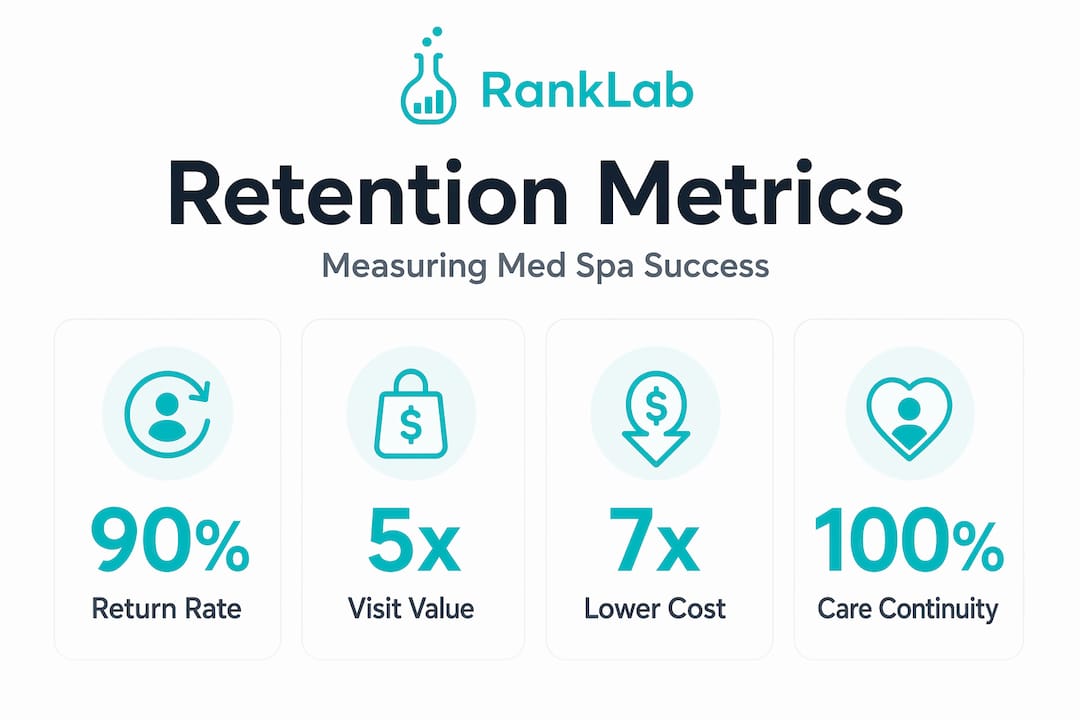
The economics of patient retention are not subtle. Acquiring new patients costs five to seven times more than retaining existing ones. For a med spa spending $80 to $120 per lead on paid advertising, that gap is impossible to ignore.
But the financial case goes deeper than acquisition cost. Returning patients spend more per visit because they trust your team’s recommendations. They require less consultation time, which improves operational efficiency. They refer friends and family, which generates zero-cost acquisition. And when you build a base of loyal patients, your monthly revenue becomes far more predictable because you are not starting from zero every time.
Pro Tip: Calculate your current patient retention rate before spending another dollar on ads. Divide the number of returning patients by total active patients over a 12-month period. If your rate is below 60%, no acquisition budget will fix a retention problem.
The benefits of patient retention also extend to patient outcomes. Continuity of care means your team tracks how patients respond to treatments over time, which leads to better results and higher satisfaction. Happy patients with great results do not need to be convinced to rebook. They want to.

Practical strategies that improve patient retention
The med spas that retain patients most effectively share one trait: they treat post-visit engagement as seriously as pre-visit marketing. Here is a proven framework for how to improve patient retention using tactics that actually move the needle.
- Send a structured follow-up within 48 hours. A simple message checking in after a procedure, explaining what to expect during recovery, and naming the recommended next appointment time tells the patient you are paying attention. Proactive engagement over 60 to 90 days can boost patient retention by up to 40%.
- Use milestone-triggered communications. Post-visit and milestone-triggered messages drive the highest retention impact because they align with how the patient’s treatment actually works. A Botox patient who sees you every three to four months should receive an automatic outreach at week ten, not week sixteen when they have already booked somewhere else.
- Build a real multi-channel strategy. Personalized, multi-channel engagement shaped by patient preferences performs better than any single channel. Some patients respond to SMS, others open every email, and some prefer a quick message through your patient portal. Know your segments and tailor accordingly. Aestheticranklab’s guide on audience targeting for med spas breaks down how to profile patients for more effective outreach.
- Invest in convenient booking and flexible payment. Friction kills retention. If rebooking requires a phone call during business hours, many patients simply will not do it. Online scheduling, flexible financing options, and fast checkout all reduce the barriers between a patient’s intention to return and their actual appointment.
- Use educational content to stay top of mind. Between visits, patients are making decisions about their aesthetic treatments. If your practice provides relevant patient education on results, aftercare, and treatment options, you become the authority they trust. That trust converts directly into rebooking.
Pro Tip: A CRM designed for med spas changes everything about retention. It tracks patient activity, automates triggers based on treatment dates, and flags patients who are overdue for a visit. Without it, you are managing retention manually, which means gaps. Explore what a med spa CRM can do for your rebooking numbers.
Measuring patient retention marketing success
You cannot fix what you do not measure. Measuring patient retention success starts with getting honest about what the right metrics actually are.
| Metric | What it measures | Why it matters |
|---|---|---|
| Retention rate | Percentage of patients who return within 12 months | Core indicator of loyalty and practice health |
| Rebooking rate | Patients who schedule next visit before leaving | Immediate retention signal at point of service |
| NPS (Net Promoter Score) | Likelihood of patient referral | Predicts organic growth and deeper loyalty |
| Reactivation rate | Lapsed patients who return after outreach | Measures effectiveness of win-back campaigns |
The most common mistake med spa owners make in this area is confusing engagement with retention. Your email open rate is not a retention metric. A patient can open every email you send and still book their next Hydrafacial somewhere else. True retention measurement tracks what patients actually do, not how they interact with your content.
Use these measurements alongside patient feedback:
- Collect post-visit surveys and track satisfaction scores over time
- Monitor how long it takes for patients to return after each visit type
- Identify your highest-churn treatment categories and investigate the experience around them
- Run quarterly reviews comparing retention rates across patient acquisition sources
Data-driven patient retention requires treating your retention performance with the same rigor you apply to paid advertising. Set benchmarks, track trends, and make decisions based on behavior, not assumptions.
Common pitfalls that undermine retention efforts
Even med spas with strong services and solid marketing can undermine their retention through predictable, avoidable mistakes.
The biggest one is treating retention as a volume problem. More messages are not the answer. Overcommunication causes friction and reduces trust. When patients feel like they are being blasted with promotions, they unsubscribe and eventually disengage entirely. Relevance and timing outperform frequency every time.
Other pitfalls to watch for:
- Treating the patient journey as linear. In reality, patients move at different paces. A retention system that sends the same message to every patient on the same schedule will miss the mark for most of them.
- Siloing marketing from operations. If your front desk team is not aligned with your retention messaging, patients will experience a disconnect. Retention marketing is a whole-practice effort, not just a marketing department task.
- Relying on vanity metrics. Clicks, opens, and social likes feel productive. They are not retention metrics. Focus on what patients book and when they return.
- Ignoring lapsed patients. Patients who have not visited in six months are not gone. A well-timed, personalized re-engagement message can recover a meaningful percentage of them.
Pro Tip: Set a 90-day “at-risk” flag in your CRM. Any patient who has not booked within 90 days of their typical treatment cycle should trigger an automated personal outreach from your team. Early reactivation is far easier than winning back someone who has moved on.
My take on building retention that actually lasts
I’ve worked with enough med spas to say this plainly: most of them underestimate retention, and most of them know it. The data is clear, the logic is obvious, and yet the default behavior is to spend more on ads while hoping existing patients come back on their own.
What I’ve seen work is not complicated. The med spas with the strongest retention do two things consistently. First, they treat every post-visit interaction as a scheduled marketing event, not an afterthought. Second, they build their patient experience around clarity. Patients always know what comes next, when to expect communication, and who to contact. That clarity creates trust. That trust creates loyalty.
Retention marketing is not about gimmicks or effective patient loyalty programs built on discounts. It is about respect. Respecting the patient’s time by making rebooking easy. Respecting their intelligence by communicating relevantly. Respecting their investment by providing consistent, high-quality follow-through between visits.
I’ve watched practices with mediocre acquisition budgets outperform high-spending competitors simply because they kept more of the patients they already had. That is the argument for making retention your core strategy, not an afterthought.
— Keith
How Aestheticranklab helps you retain more patients
At Aestheticranklab, we built our entire approach around the reality that acquiring a patient once is not enough. Our med spa marketing automation services are designed specifically to do what most generic marketing agencies cannot: automate the kind of personalized, timely outreach that keeps patients coming back. From CRM setup and milestone-triggered campaigns to full social media management for med spas, every service we offer is built for the aesthetics industry. We understand patient journey timing, treatment cycles, and the importance of patient relationship management at every touchpoint. If you are ready to make retention a real growth engine for your practice, our team is ready to help you build it.
FAQ
What is patient retention marketing in a med spa?
Patient retention marketing is the systematic use of personalized communication, post-visit follow-ups, and technology to keep existing patients engaged and returning. It goes beyond messaging volume to include the full patient experience from checkout to rebooking.
How do you calculate patient retention rate?
Divide the number of patients who returned within a set period by your total active patient count for that same period, then multiply by 100. A healthy med spa retention rate typically falls between 60% and 80%.
Why is retention more cost-effective than patient acquisition?
Retaining an existing patient costs five to seven times less than acquiring a new one, according to healthcare industry benchmarks. Returning patients also spend more per visit and generate referrals, which multiplies the financial benefit.
What are the most effective patient retention techniques for med spas?
The most effective techniques include structured 48-hour post-visit follow-ups, milestone-triggered rebooking reminders aligned to treatment cycles, multi-channel personalized outreach, and CRM automation that flags at-risk patients before they lapse.
What metrics should I track to measure retention marketing success?
Focus on patient retention rate, rebooking rate, reactivation rate, and Net Promoter Score. Avoid relying on email opens or clicks, which measure engagement but not actual patient return behavior.