
TL;DR:
- Personalized marketing significantly improves client engagement and retention by tailoring messages to individual preferences and behaviors. It relies on data collection, unified profiles, and real-time automation to create relevant, timely interactions. Successful implementation requires ongoing testing, privacy respect, and a mindset of continuous improvement.
Sending the same promotional email to every client on your list might feel efficient, but it often has the opposite of the intended effect. Clients tune out, unsubscribe, or simply stop showing up. Personalized marketing drives far higher engagement than generic campaigns precisely because it treats each person as an individual, not a number. This guide walks you through what personalized marketing is, how it works in a real med spa context, and the practical steps you can take right now to build stronger client relationships and improve long-term retention.
Table of Contents
- What is personalized marketing?
- How does personalized marketing actually work?
- Personalized marketing versus segmentation: What’s the difference?
- Tangible results: Does personalized marketing actually move the needle?
- Practical tips for med spas: How to personalize marketing the right way
- A med spa marketer’s truth: Personalization is a program, not a quick fix
- Next steps: Tools and expertise for med spa personalized marketing success
- Frequently asked questions
Key Takeaways
| Point | Details |
|---|---|
| Personalization defined | Personalized marketing means communicating based on each client’s real preferences and behaviors, not just generic segments. |
| Real ROI impact | In 2026, personalized campaigns can increase conversions 37 times compared to generic campaigns. |
| Med spa best practices | Effective personalization in med spas blends automation, behavioral triggers, and privacy-safe data management. |
| Beyond automation | Continuous testing and learning are essential for personalization success—rules alone are not enough. |
What is personalized marketing?
Personalized marketing is the practice of customizing your communications based on each client’s preferences, past behaviors, treatment history, and where they are in their relationship with your business. It is not a gimmick. It is a fundamental shift in how you think about reaching people.
At its core, personalized marketing tailors messages, offers, and experiences using customer data collected across every interaction. Rather than sending a generic “20% off this month” email to your entire list, you send a post-treatment follow-up to someone who just had their first HydraFacial and a loyalty reward to someone celebrating their tenth Botox session. Same promotion, different framing. Completely different impact.
For med spas, personalization addresses a real business problem: clients are busy, their inboxes are crowded, and they expect relevance. When your message matches their moment, they pay attention. When it does not, they ignore it or, worse, click unsubscribe.
The key components of a working personalization framework include:
- Data collection: gathering appointment data, service preferences, communication history, and website behavior
- Unified client profiles: combining all of that data into a single view of each person
- Behavioral triggers: using actions (like booking or skipping a scheduled appointment) as signals for what message to send next
- Channel alignment: delivering the message through the channel each client actually uses, whether that is email, SMS, or social media
Explore med spa content ideas to see how content strategy fits naturally into a personalized approach.
“Personalized marketing is not about using a client’s first name in a subject line. It is about understanding what that person actually wants next and showing up for them at exactly the right moment.”
How does personalized marketing actually work?
Understanding what personalization is and knowing how to execute it are two very different things. The mechanics matter because med spa teams are often small and stretched thin. You need a process that is repeatable and manageable, not a system that requires a full-time data scientist.
Personalization is enabled by collecting, unifying, and analyzing data across every client touchpoint, then using that data to deliver content in real time. Here is how it plays out step by step for a typical med spa:
-
Capture data at every touchpoint. Your booking software, front desk interactions, post-treatment surveys, and website visits all generate data. Most med spas are sitting on a goldmine of information they are not using. Start logging treatment history, preferred appointment times, service frequency, and how clients respond to different types of messages.
-
Build unified client profiles. Consolidate that data so that every team member, and every automated system, is working from the same picture of each client. A client profile should show at a glance what services they love, how recently they visited, and what offers have resonated with them in the past.
-
Use analytics to infer future needs. If a client comes in for laser hair removal every six weeks, your system should automatically flag when they are approaching their next likely appointment window. If a client purchased a package but has not used all sessions, that is another trigger for personalized outreach.
-
Build lifecycle-based automations. New inquiry? Send a warm welcome series that explains your most popular services and includes a first-visit offer. Post-treatment? Send a check-in message 48 hours later. Lapsed client? Send a “we miss you” message with a relevant offer tied to their last treatment.
-
Deliver in real time. Timing is everything. A follow-up message sent one week after a treatment is far less effective than one sent 48 hours later. Automation tools allow you to set these triggers once and let them run.
Pro Tip: Review your audience segments for med spas before building automation rules. Knowing your distinct client types, such as the first-timer, the loyal regular, and the lapsed client, will help you write messages that feel genuinely personal rather than mass-produced.
The real advantage here is speed combined with precision. When a client takes an action, your system responds within hours instead of waiting for your next scheduled blast. That responsiveness builds trust and keeps your brand top of mind throughout the client journey.
Personalized marketing versus segmentation: What’s the difference?
A lot of med spa marketers think they are doing personalization when they are actually just doing segmentation. Both are useful, but they are not the same thing, and confusing them can lead to missed opportunities.
Segmentation divides your client list into groups based on shared characteristics. For example, you might create a group of clients who have not visited in 90 days and send them all a reactivation offer. That is a smart move. But every person in that group gets the same message regardless of which service they last booked, how much they typically spend, or how they prefer to be communicated with.
Personalized marketing tailors each message and offer to the individual, not just the group. Instead of one reactivation email for all lapsed clients, you might send different messages to the lapsed Botox client versus the lapsed chemical peel client, each highlighting the treatment they actually love.
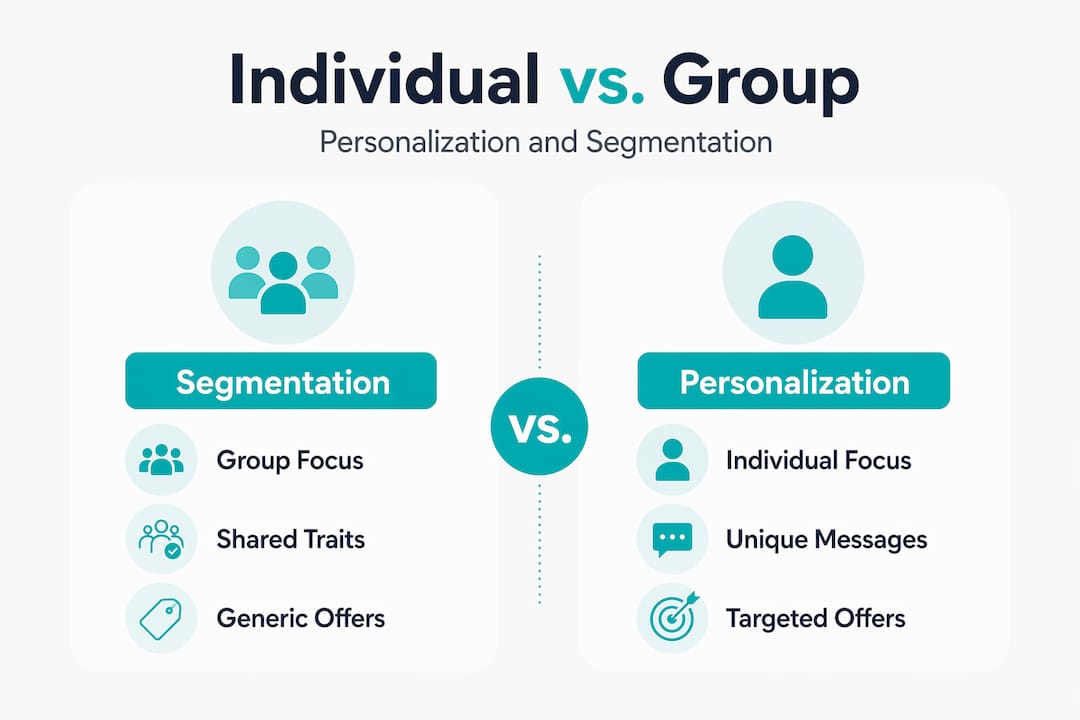
Here is a quick comparison:
| Feature | Segmentation | Personalization |
|---|---|---|
| Targeting level | Group | Individual |
| Message type | Shared across a segment | Tailored to each person |
| Data required | Basic demographics or behavior | Full profile with history |
| Typical output | One message per segment | Dynamic content per recipient |
| Impact on loyalty | Moderate | Significantly higher |
The difference in outcomes is not subtle. When you personalize, clients feel understood. That feeling translates directly into stronger loyalty and more repeat bookings. For med spas where client lifetime value is everything, that distinction is worth investing in.
Strong boosting med spa client engagement strategies start with segmentation but evolve into true personalization as your data matures. Pairing personalized messaging with compelling visual content for engagement amplifies the effect further, especially on social platforms where first impressions happen in seconds.
Tangible results: Does personalized marketing actually move the needle?
If you want hard numbers, the evidence is striking. The most recent 2026 benchmarks show a lift from 2.4 times better conversion rates in 2024 all the way to 37.6 times better conversion rates in 2026 for personalized versus generic messages. That is not a marginal improvement. That is a category-level difference in performance.

What is driving that jump? A few things are working together. First, personalization technology has become more accessible, so more businesses are deploying it well rather than awkwardly. Second, clients have become far more sensitive to irrelevant messaging. A poorly targeted offer is not just ineffective, it actively damages trust.
For med spas specifically, the results show up in a few key areas:
- Repeat bookings: Clients who receive relevant, timely follow-ups after a treatment are significantly more likely to rebook within 60 days.
- Package upsells: When an offer is tied to a client’s known service preferences, package conversion rates improve substantially compared to generic promotions.
- Retention rates: Med spas that consistently use behavior-triggered messaging report lower client churn and higher average visit frequency per year.
- Referral behavior: Clients who feel genuinely recognized by a brand are more likely to recommend it to friends and family.
“The data is clear: generic campaigns are no longer competitive. The med spas winning at retention are the ones treating each client message as a one-to-one conversation, not a broadcast.”
Behavior-triggered messaging, such as a post-visit offer sent 48 hours after a client’s appointment, consistently outperforms generic promotional blasts regardless of the industry. Explore proven med spa sales strategies to see how personalization fits into a broader revenue growth framework.
Practical tips for med spas: How to personalize marketing the right way
Knowing the benefits is one thing. Building a sustainable personalization system for your med spa is another. Here is a practical roadmap that accounts for both results and the very real risks of doing this poorly.
Getting started:
-
Map your client journey first. Before you write a single email, document the key moments in your client lifecycle: first inquiry, first visit, post-treatment, rebooking window, milestone (like a birthday or anniversary), and lapse. Each moment is an opportunity for a personalized touchpoint.
-
Install automation for lifecycle triggers. Birthday messages, post-treatment check-ins, and rebooking reminders should be automated from day one. These are low-effort, high-impact touchpoints that require minimal ongoing maintenance once set up properly.
-
Start with behavioral segmentation, then refine. You do not need a perfect dataset to begin. Start by segmenting clients by recent activity and treatment type. As your data grows richer, you can layer in individual-level personalization. Lifecycle triggers, AI-driven segmentation, and omnichannel follow-up are the building blocks of a mature personalization system.
-
Respect privacy rigorously. This is non-negotiable. Personalization creates real privacy risks when data is collected without proper consent or used in ways clients do not expect. Always use opt-in consent for marketing communications, be transparent about how you use client data, and give clients a clear way to update their preferences or opt out entirely.
Pro Tip: A simple “communication preferences” section in your intake form goes a long way. Ask clients whether they prefer email or SMS, how often they want to hear from you, and what types of offers interest them. You will get better data and clients will feel respected from the start.
Ongoing best practices:
- Test subject lines, message timing, and offer types across different client segments
- Review your automation results monthly and adjust triggers or message copy that underperforms
- Never use personalization to pressure clients. Relevant is helpful. Pushy is damaging.
- Keep your client database clean. Outdated information produces irrelevant messages, which defeats the entire purpose.
Investigate unique med spa marketing angles to identify fresh personalization hooks that go beyond basic promotions. And if you serve clients across a defined geographic area, geotargeting for med spas can add another powerful personalization layer by tailoring messages based on local events or proximity-based triggers.
A med spa marketer’s truth: Personalization is a program, not a quick fix
Here is a perspective many marketing vendors will not tell you: installing a personalization tool is not the same as running a personalization program. Plenty of med spas set up automated workflows, declare victory, and then wonder six months later why retention numbers have barely moved.
The truth is that successful personalization requires a mindset shift. It is not a one-time project with a defined end date. It is a continuous cycle of testing, measuring, and improving. Personalization should be managed as a test-and-learn program, not just a static set of rules you configure once.
What does that look like in practice? It means treating every campaign as a live experiment. When your post-treatment follow-up gets a 40% open rate in month one but drops to 18% by month four, that is not a failure. That is information. The message has lost novelty. Time to refresh the copy, adjust the timing, or introduce a new offer type.
It also means staying curious about what your clients actually respond to, not just what you assume they want. A med spa that surveys clients annually and uses those results to update their personalization rules will consistently outperform one that relies on gut instinct alone.
The med spa marketing trends in 2026 point strongly toward AI-assisted personalization, where machine learning tools identify patterns in client behavior that a human analyst would likely miss. But even the best AI cannot replace the ongoing human judgment that decides what feels authentic to your brand and what crosses into intrusive territory.
Build a rhythm of monthly reviews. What is working? What is not? Which client segments are engaging and which are going cold? Answering those questions consistently is what separates med spas that use personalization as a genuine competitive advantage from those that just have it set up and running.
Next steps: Tools and expertise for med spa personalized marketing success
Reading about personalization is the easy part. Implementing it well, across email, SMS, social media, and your website, requires systems, strategy, and often a partner who has done it before. At Aesthetic Brink Lab, we build med spa marketing automation frameworks that turn client data into consistent, relevant touchpoints without adding hours of manual work to your team’s plate. Our Smart Website ecosystem, purpose-built for med spas, supports the UX design that turns website visitors into booked clients. And our med spa social media services ensure that your personalized brand voice carries across every platform your clients use. If you are ready to move from strategy to execution, we are built for exactly that.
Frequently asked questions
What is the main goal of personalized marketing in a med spa?
The main goal is to boost engagement and retention by delivering messages and offers that match each client’s unique preferences and behaviors, making every communication feel relevant rather than generic.
What types of data are most useful for med spa marketing personalization?
Lifecycle stage, treatment history, channel preferences, and recent behavioral signals are the most actionable data types for creating personalized experiences that drive repeat bookings.
How does personalized marketing impact conversion rates?
According to 2026 benchmarks, conversions lift up to 37.6 times compared to generic marketing messages, a dramatic increase from the 2.4 times improvement reported just two years earlier.
Are there privacy risks with marketing personalization?
Yes. Without proper consent practices and transparency, personalization risks damaging trust and can create legal and ethical exposure, so always use opt-in consent and clear data policies.
Should med spas automate all parts of personalization?
Automation is essential for consistency, but personalization needs ongoing testing and optimization to stay effective. Setting it up and walking away is one of the most common and costly mistakes med spa marketers make.