
TL;DR:
- Med spas must continuously monitor their SEO performance to detect issues early and prevent lost bookings. Tracking key metrics like clicks, impressions, CTR, and position helps assess visibility and user engagement for targeted pages. Regular, structured reviews of SEO data enable strategic adjustments that directly support business growth and revenue.
You built a beautiful med spa website, maybe even invested in SEO a year ago, and now you assume it’s working. That assumption is quietly costing you bookings. Understanding why monitor SEO performance matters is not about obsessing over data; it’s about knowing when something is broken before your appointment calendar feels it. For med spas competing in crowded local markets, a two-week blind spot in your organic traffic can mean dozens of lost consultations. This guide cuts through the noise and gives you a clear, practical framework for tracking what matters and acting on it fast.
Table of Contents
- Why continuous SEO monitoring is vital for med spas
- Core SEO metrics med spas should monitor
- Connecting SEO performance to business outcomes for med spas
- How to interpret SEO data to make smart decisions
- Implementing effective SEO monitoring routines for your med spa
- The part most med spa owners get wrong about SEO monitoring
- Ready to stop guessing and start growing?
- Frequently asked questions
Key Takeaways
| Point | Details |
|---|---|
| Continuous monitoring | SEO performance should be monitored regularly, not just once a month, to catch issues early and protect revenue. |
| Core metrics to watch | Clicks, impressions, CTR, and average position provide key insights into SEO visibility and engagement. |
| Business outcome focus | Converting SEO traffic into leads and revenue is more important than chasing rankings alone. |
| Smart data interpretation | Use conversion data to guide decisions and treat other SEO metrics as diagnostic signals. |
| Routine and tools | Establish daily, weekly, and monthly monitoring rhythms using tools like Google Search Console and GA4 for best results. |
Why continuous SEO monitoring is vital for med spas
Most med spa owners treat SEO like a one-time project. Hire someone, get it done, move on. The reality is that search rankings are not a locked-in result. They shift constantly based on competitor moves, Google algorithm updates, and changes to your own website. A page that ranked third for “botox near me” in January can slip to page two by March with no obvious cause and no warning.
The importance of SEO tracking becomes obvious the moment you experience an unexplained drop in new patient inquiries. By then, the damage is already compounding. Monitoring SEO performance lets med spas catch issues early before they snowball into larger revenue problems. A small CTR dip caught in week one is a ten-minute fix. That same dip ignored for two months becomes a serious gap in your new client pipeline.
Here is what continuous monitoring actually catches before you feel the pain:
- Keyword ranking slips on your highest-value service pages (think Morpheus8, laser hair removal, HydraFacial)
- Sudden drops in organic traffic caused by crawl errors or accidental page de-indexing
- Rising competitor rankings on terms you previously owned
- Click-through rate declines that signal your title tags or meta descriptions need refreshing
- Mobile usability issues that Google is penalizing you for silently
“The practices most likely to protect your med spa’s visibility are the boring ones: regular check-ins, documented baselines, and a clear process for diagnosing drops before they compound.”
Pro Tip: Set Google Search Console to email you alerts for manual actions and coverage issues. These take five minutes to configure and can flag a serious technical problem the same day it appears, saving you weeks of lost traffic.
Running SEO audits for med spas at regular intervals gives you a structured snapshot you can compare over time, making it far easier to spot what changed and why.
Understanding why SEO monitoring can’t be a once-a-month task leads us to the key metrics to track.
Core SEO metrics med spas should monitor
You do not need a dashboard full of 40 numbers. You need four core signals that tell you whether your med spa is visible, compelling, and ranking where it counts. Google Search Console’s four core metrics are clicks, impressions, average CTR, and average position, and together they give you a complete picture of visibility and user engagement.
Here is what each one actually means for your business:
| Metric | What it measures | Med spa example |
|---|---|---|
| Clicks | Visitors coming from organic search | How many people clicked to your Botox page from Google |
| Impressions | How often your pages appear in search results | Your HydraFacial page shown 1,200 times in a week |
| Average CTR | Percentage who click after seeing your listing | 3% CTR means 36 visits out of 1,200 impressions |
| Average position | Your average ranking for a given query | Position 4.2 for “med spa [your city]” |
These four numbers interact in ways that tell a story. High impressions with low CTR means your page shows up but does not convince people to click. That points to a title tag or meta description problem, not a ranking problem. Low impressions with decent position usually signals a narrow keyword footprint, meaning you need broader keyword research for med spas to expand the queries you appear for.
- Track by page: Which service pages are pulling traffic and which are invisible?
- Track by query: Are branded searches (your spa name) growing? Are local intent queries (“near me”) improving?
- Track by device: Mobile users behave differently and often convert at different rates
Pair Google Search Console data with local search optimization signals like Google Business Profile views and direction requests to get the full local SEO picture.
Knowing which metrics to watch, next we explore how these indicators tie into your med spa’s overall business growth.
Connecting SEO performance to business outcomes for med spas
Rankings and impressions feel good, but they do not pay staff salaries. The real benefits of SEO analysis only show up when you connect those metrics to the things that actually grow your business. Think of your SEO data in three layers:
- Visibility layer: Are the right people finding you? Impressions and average position tell you whether you are appearing in front of people searching for lip fillers, coolsculpting, or whatever treatments drive your revenue.
- Experience layer: Once people land on your site, does the page deliver? Bounce rate, time on page, and pages per session reveal whether your content answers what users came looking for.
- Conversion layer: Do visitors book? Form submissions, phone calls, and online appointment bookings are the bottom-line metrics that tie all of your SEO work to actual revenue.
| Funnel stage | Key signals | Business question it answers |
|---|---|---|
| Visibility | Impressions, average position | Are we showing up for the right searches? |
| Experience | Bounce rate, session duration | Are visitors staying and engaging? |
| Conversion | Bookings, form fills, calls | Is organic traffic turning into clients? |
Pro Tip: If your conversion metrics are healthy but rankings slip, do not panic and overhaul your site. Conversion stability is a strong indicator that your core audience is still finding you and trusting your pages.
Good SEO measurement is not just rankings; it is a system that links technical signals, user experience, and conversion performance to real business decisions. Chasing a position-one ranking for a keyword that never converts is exactly the kind of activity that eats your marketing budget without growing revenue.
The clearest way to track med spa ROI from SEO is to assign a dollar value to each booked consultation and then count how many of those came through organic search. Even a rough estimate makes your SEO investment tangible and defensible.
With these KPI layers clear, we can now interpret SEO data wisely to avoid false alarms and focus on what truly matters.
How to interpret SEO data to make smart decisions
Data without context creates panic. A 15% traffic drop over two weeks can mean a serious algorithmic hit or it can mean the school holiday period shifted search behavior in your area. Knowing which is which determines whether you spend the next month reworking your entire site or simply wait it out.
Clicks, impressions, and rankings are diagnostic signals; the anchor point for every SEO review should be conversion and revenue, not vanity metrics. Here is a practical sequence for reading your data:
- Start with conversions and revenue. If bookings are stable or growing, there is no emergency.
- Check impressions next. A drop there usually means Google reduced how often your pages appear, which points to content quality or algorithm changes.
- Look at CTR. If impressions hold but clicks fall, your listing became less compelling. Update titles and descriptions.
- Check position. A position drop combined with impression drop often signals a ranking issue that needs content or link-building attention.
- Segment by page, query, device, and location. A sitewide drop is rare. Usually one or two pages or keyword clusters are the culprit.
Pro Tip: Compare current data to the same period last year, not just last month. Aesthetic treatments have strong seasonal patterns. A January dip after December’s holiday promotions is normal, not alarming.
Good local SEO services for med spas will already have this diagnostic process built into their reporting. If your current agency just sends you a ranking spreadsheet with no conversion context, that is a gap worth addressing. Pair regular med spa SEO audits with monthly data reviews to keep your interpretation grounded in the full picture.
Knowing how to interpret data leads us to practical monitoring routines for med spas to keep SEO on track.
Implementing effective SEO monitoring routines for your med spa
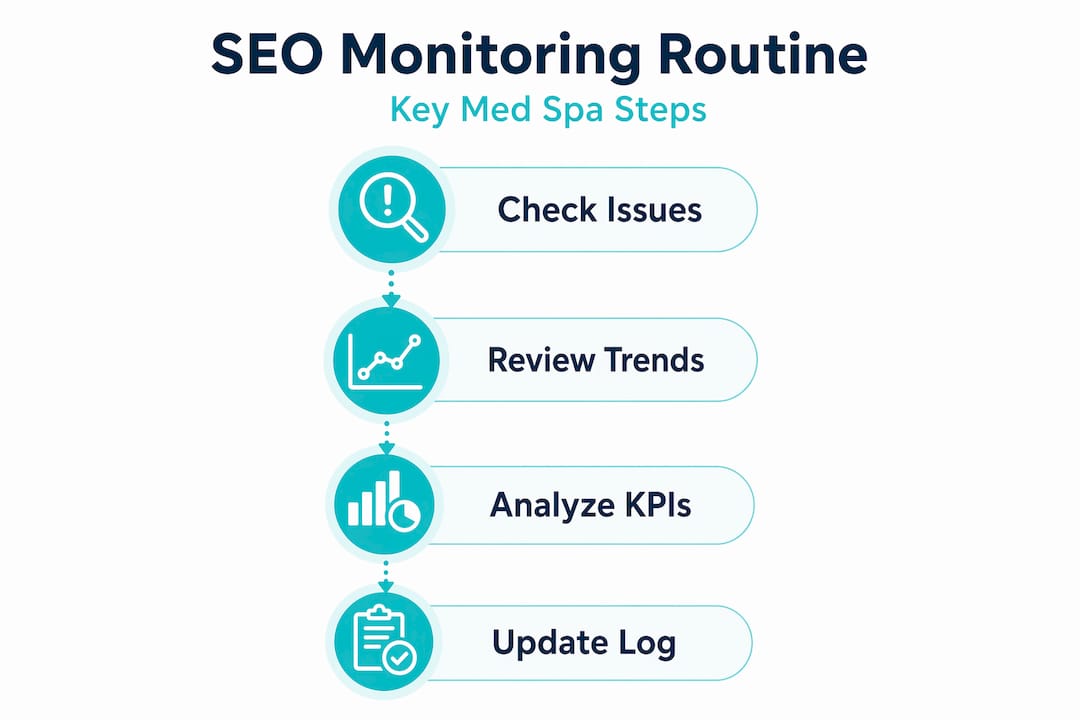
You do not need to spend three hours a day in analytics. You need a structured cadence that matches the urgency of what you are checking. Using metric-specific rhythms where daily checks focus on anomalies, weekly reviews cover trends, and monthly sessions go deep into funnel health gives you coverage without consuming your time.
Daily checks (5-10 minutes):
- Scan for Google Search Console coverage errors or manual action alerts
- Check for dramatic traffic drops via GA4 real-time overview
- Review any automated alerts from your SEO platform
Weekly reviews (20-30 minutes):
- Compare keyword cluster performance week over week
- Review CTR shifts on your top 10 service pages
- Check engagement metrics: time on page, bounce rate, session depth
- Flag any pages that dropped more than two positions on priority keywords
Monthly deep dives (1-2 hours):
- Full conversion funnel analysis: organic sessions to bookings
- Backlink profile review: new links gained, any toxic links to disavow
- Competitor ranking comparison on your core service terms
- Comprehensive site health check using your preferred tools for SEO monitoring
The best tools for SEO monitoring at the med spa level include Google Search Console (free and essential), GA4 for behavior and conversion data, and third-party platforms like Ahrefs, SEMrush, or AgencyAnalytics for automated rank tracking and alerts. Set up weekly automated reports so the data comes to you rather than requiring you to log in proactively.
Pro Tip: Create a simple shared document where your team logs any website changes: new pages, redirects, updated service descriptions. Cross-reference that log with your SEO data whenever you see a performance shift. Most unexplained drops trace back to a site change no one remembered making.
Combine your routine with local SEO checklists and structured SEO audits for med spas to ensure you are covering both the tactical and the strategic dimensions of your organic visibility.
The part most med spa owners get wrong about SEO monitoring
Here is the uncomfortable truth: most med spa owners either never look at their SEO data or they look at it obsessively and misread it. Neither extreme serves the business.
The obsessive checker sees a three-position ranking drop on a Tuesday and immediately wants to rewrite the entire page. That impulse almost always makes things worse. Google’s algorithm fluctuates naturally, and responding to noise with content changes creates instability that the algorithm actually penalizes over time.
The other group, the ones who check rankings quarterly or only when a consultant sends a report, are flying completely blind. By the time a problem surfaces in their revenue numbers, it has been building for eight to twelve weeks. The fix at that point is not a small tweak; it is a recovery campaign.
The answer is a middle path with a clear decision rule: monitor frequently, act only when conversion data confirms a real problem, and make one change at a time so you can measure its effect. That discipline is rarer than it sounds, and it is what separates med spas that grow their organic channel consistently from those that treat SEO as a mystery they threw money at once.
The other insight worth naming: your SEO data is a competitive intelligence tool, not just a self-assessment. When a competitor suddenly appears above you for your core local terms, that is information you can act on before it dents your revenue. Monitoring gives you that lead time.
Ready to stop guessing and start growing?
At Aesthetic Brink Lab, we work exclusively with med spas, which means we understand exactly which SEO signals matter for your business and which ones are noise. Our team combines full-service SEO management with a Smart Website ecosystem built specifically for med spas, so your site and your rankings work together from day one. If you want a team that monitors your performance, interprets your data, and translates it into more booked consultations, we are ready to talk. Reach out to us at Aesthetic Brink Lab to see what consistent, strategic SEO monitoring looks like in practice.
Frequently asked questions
Why is monitoring SEO performance important for med spas?
Monitoring SEO helps med spas catch small issues early, preventing drops in visibility and ensuring organic traffic leads to actual bookings and revenue. Early detection of ranking slips, CTR dips, or disappearing traffic stops small problems from becoming expensive recovery projects.
Which SEO metrics should med spas focus on?
Med spas should track clicks, impressions, CTR, and average position in Google Search Console, alongside conversion metrics like appointment bookings. These four signals together show both how visible your site is and how well it’s turning searchers into visitors.
How often should med spas monitor their SEO performance?
Med spas should check for urgent issues daily, review trends weekly, and do deep conversion and site health analysis monthly. This cadence balances vigilance with efficiency so monitoring stays sustainable for a small team.
Can drops in keyword rankings always mean a problem?
Not always. If conversions remain stable or increase, ranking drops may reflect seasonal patterns or SERP layout changes rather than a true performance issue. Stable conversions signal that your core audience is still finding and trusting your pages, so panic-driven changes are rarely warranted.
What tools are recommended for monitoring SEO performance?
Google Search Console and GA4 are essential starting points, with third-party platforms adding automated rank tracking and alerts. These tools together give med spas both real-time anomaly detection and the deeper trend analysis needed for smart monthly reviews.