
TL;DR:
- Client experience consistency is key to long-term loyalty in med spas.
- Mapping every stage of the client journey helps build trust and reduces client loss.
- Focus on moments of truth like arrival, check-in, and follow-up to enhance satisfaction.
Most med spa owners believe they lose clients because of price or competition. The real reason is far more common: a confusing, inconsistent client experience that leaves people feeling like strangers every visit. Research shows that clients who feel emotionally connected to a brand have a lifetime value three times higher than satisfied but unattached ones. That gap is not closed with discounts or new promotions. It is closed by defining and refining your med spa client journey from the very first touchpoint. This article walks you through every stage, the moments that matter most, and a practical framework to build loyalty that compounds over time.
Table of Contents
- What is the med spa client journey?
- Mapping the med spa client journey: Key stages
- Client experience moments that matter most
- Optimizing each stage for retention and referrals
- Common pitfalls when defining the med spa client journey
- Our perspective: The overlooked secret to med spa success
- Ready to optimize your med spa client journey?
- Frequently asked questions
Key Takeaways
| Point | Details |
|---|---|
| Map every stage | Visualize the client experience from first contact to advocacy to uncover gaps and opportunities. |
| Prioritize key moments | Focus on optimizing critical interactions like check-in and post-treatment follow-up for higher retention. |
| Review and refine regularly | Continuously update your client journey using staff and client feedback to stay ahead. |
| Small touches add up | Personal gestures and thoughtful technology use make your med spa memorable and boost referrals. |
What is the med spa client journey?
The client journey is the full sequence of experiences a person has with your med spa, from the moment they first hear your name to the point where they are actively recommending you to friends. It is not just about the treatment room. Every Instagram scroll, every phone call, every text reminder, and every follow-up email is part of that journey.
In med spas, this journey is more nuanced than a standard retail or restaurant experience. Clients are making decisions that involve their appearance, their self-confidence, and often, a significant financial investment. There is an emotional layer that most general customer journey frameworks miss entirely. Trust and privacy are not optional extras here. They are the foundation.
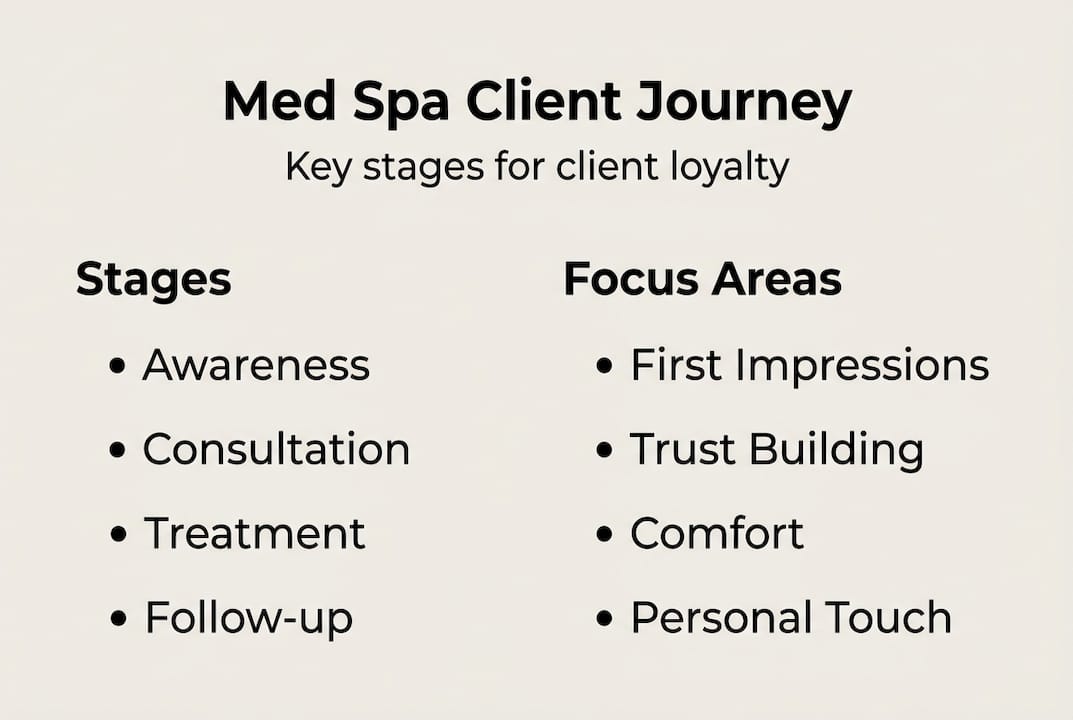
The consumer decision journey in aesthetics typically moves through these core stages:
- Awareness: The client discovers your med spa through an ad, referral, or search result
- Consideration: They research your services, read reviews, and compare you to competitors
- Booking: They take the step to schedule a consultation or treatment
- In-spa experience: Everything that happens from arrival to checkout
- Post-treatment: Follow-up communications, results tracking, and next-step recommendations
- Retention: Rebooking, membership offers, and ongoing relationship management
- Advocacy: The client refers others, leaves reviews, and becomes a vocal supporter
Each stage is a chance to earn more trust or lose it. As outlined in reputation management for med spas, the client journey has distinct stages from awareness to advocacy, and neglecting any one of them creates a gap your competitors can exploit.
A single referred client costs 5x less to acquire than a cold lead, and they convert at a higher rate. Advocacy is not a bonus outcome. It is the goal.
Mapping the med spa client journey: Key stages
Now that you understand the broad structure of the med spa client journey, let us break down each critical stage and see how to map your own process.
Successful med spas meticulously chart each stage of the customer journey so every team member knows their role and every client feels guided, not lost. A simple mapping table makes this concrete.
| Journey stage | Key touchpoints | Staff involved |
|---|---|---|
| Awareness | Social ads, SEO, referrals | Marketing team |
| Consideration | Website, reviews, DMs | Front desk, marketing |
| Booking | Online scheduler, phone call | Front desk |
| In-spa experience | Check-in, consultation, treatment | All clinical and front desk staff |
| Post-treatment | Follow-up texts, email sequences | Front desk, providers |
| Retention | Loyalty programs, rebooking prompts | Front desk, management |
| Advocacy | Review requests, referral programs | All staff |
Once you have this mapped using a customer journey mapping approach, you can assign ownership and standard operating procedures at every level.
Here are actions to take at each stage:
- Awareness: Run geotargeting campaigns tailored to your local zip codes
- Consideration: Build a resource-rich website with clear service pages and real before-and-after results
- Booking: Use automated scheduling with personalized confirmation messages
- In-spa experience: Implement a structured welcome protocol every provider follows
- Post-treatment: Send a personal check-in 48 to 72 hours after every treatment
- Retention: Offer tiered memberships with escalating benefits
- Advocacy: Ask for reviews within 24 hours of a positive visit and make it easy
Pair these tactics with visual client engagement methods to reinforce your brand identity at every stage.
Pro Tip: Map your most profitable client archetype’s journey first. Once you perfect that experience, expand it to other client profiles.
Client experience moments that matter most
After mapping out each stage, it is critical to focus on the specific moments that dramatically influence client satisfaction.
Not all touchpoints carry equal weight. A few specific interactions, often called moments of truth, have an outsized effect on whether a client stays or walks. Key moments like first impression and follow-up have a direct impact on repeat visits and long-term loyalty.
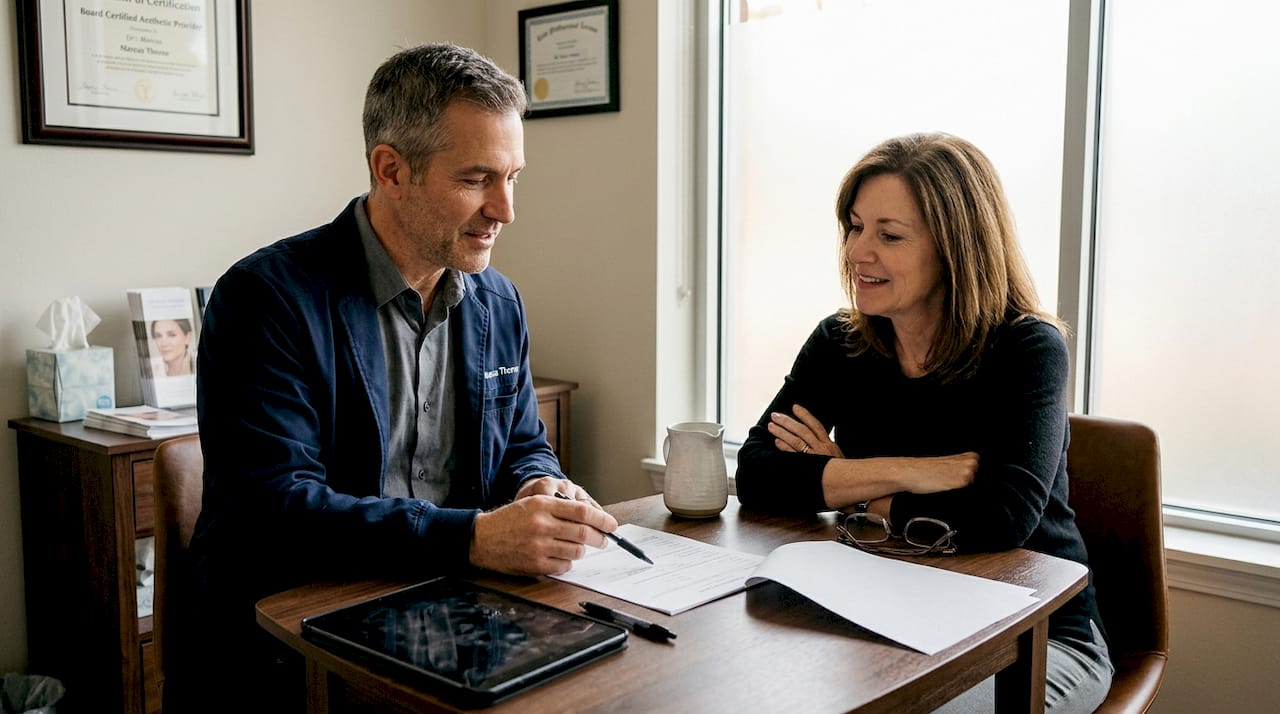
According to a report on enhancing customer experience, over 60% of customers will stop doing business with a company after just one bad experience. In a high-trust environment like med spas, that number may be even higher because clients have personal stakes involved.
The four moments that matter most are:
- Arrival: Does the space feel welcoming? Is the client greeted by name?
- Check-in and intake: Is paperwork easy? Are digital consent forms ready in advance?
- Provider introduction: Does the provider review notes before walking in, or does the client have to re-explain everything?
- Post-treatment follow-up: Does someone check in 48 to 72 hours later with genuine interest?
Tactics to raise the quality of each moment:
- Send digital intake and consent forms before arrival so the visit starts smoothly
- Train front desk staff to greet every client by first name
- Build a client notes system so providers always review history before entry
- Write personalized follow-up texts, not templated ones
- Send a handwritten thank-you card after a client’s first treatment
These small details are not just nice gestures. They shape your digital branding for med spas and translate directly into 5-star reviews and word-of-mouth referrals. Small investments here create compounding returns.
Optimizing each stage for retention and referrals
Understanding where you can have the most impact, here is how med spas can strategically optimize each stage for maximum retention and referral.
Effective reputation management and content engagement strategies enhance the client journey at every level, not just the clinical one. The goal is to build a system where every stage feeds the next.
| Journey stage | Optimization tactic | Business benefit |
|---|---|---|
| Awareness | Geo-targeted social ads | Lower cost per acquisition |
| Booking | Automated text reminders | Fewer no-shows |
| In-spa | Personalized welcome protocol | Higher satisfaction scores |
| Post-treatment | 48-hour check-in text | Increased rebooking rate |
| Retention | Membership tiers | Higher lifetime client value |
| Advocacy | Timed review requests | More 5-star reviews |
Quick wins to boost satisfaction right now:
- Automate appointment reminders via text and email
- Add a post-visit survey to collect feedback within 24 hours
- Create a simple referral program with a tangible reward
- Share client engagement content ideas on your social channels to stay top of mind between visits
Pro Tip: Automate the logistics like reminders and surveys, but keep the personal touches manual. A human-written follow-up text outperforms a templated one every single time.
Feedback loops are essential. If you are not collecting data after each visit and reviewing it monthly, you are flying blind. Building your med spa’s reputation depends on iterating your journey based on what clients actually tell you, not what you assume they want. The best med spas treat their journey map as a living document, not a one-time exercise.
Common pitfalls when defining the med spa client journey
As you refine your client journey, steer clear of these common pitfalls that can undermine your efforts.
Many med spas put serious effort into mapping their journey, then watch results plateau. The reason is almost always one of these five mistakes. Neglecting ongoing analysis and staff alignment weakens the client journey faster than any competitor ever could.
- Inconsistent staff training: When providers and front desk staff follow different protocols, the client experience becomes unpredictable. Solution: Create a written SOP (standard operating procedure) and train on it quarterly.
- Ignoring data: If you are not tracking rebooking rates, review counts, and no-show rates by stage, you cannot know where clients are dropping off. Solution: Review key metrics monthly as a team.
- Over-rigidity: A journey map is not a script. When clients need flexibility, forcing them into a rigid process feels cold. Solution: Build decision points into your map where staff can personalize.
- One-size-fits-all messaging: A first-time client needs different communication than a loyal member. Solution: Segment your client list and tailor follow-ups accordingly.
- Set-and-forget mentality: The biggest mistake. A journey map designed in 2024 may not reflect client expectations in 2026. Solution: Schedule a formal review every quarter.
Pro Tip: Hold a monthly 30-minute team meeting specifically to review one stage of the client journey. Rotate through all seven stages over the course of a few months and collect frontline staff input. They see what you do not.
Pair journey refinement with proven med spa sales strategies to ensure your operational improvements translate into actual revenue growth. Check out engaging content ideas to keep clients connected between visits and reduce the chance of losing them to a competitor.
Our perspective: The overlooked secret to med spa success
Here is a perspective most med spa owners miss entirely when thinking about the client journey.
The industry conversation is dominated by talk of TikTok ads, Google rankings, and new treatment menus. All of that matters. But the operators who build durable, profitable practices all have one thing in common: they obsess over the experience between the ads. Not the creative. Not the targeting. The actual moment a client walks through the door and every interaction after.
Here is the uncomfortable truth: your competitor can copy your promotions overnight. They can mirror your pricing and match your service menu. What they cannot replicate is a finely tuned client experience that has been built, tested, and refined over months. That consistency is your real competitive moat.
Most med spas spend the majority of their marketing budget acquiring new clients while the back door stays wide open. Existing clients leave because nobody followed up, nobody remembered their preferences, and nobody made them feel like more than a transaction. The med spa ecosystem perspective makes this clear: sustainable growth starts with mastering the fundamentals, not chasing the next shiny tactic. Invest in your journey first. The marketing ROI follows naturally.
Ready to optimize your med spa client journey?
A clearly defined client journey is not a luxury for large med spas. It is the foundation that separates practices with strong retention from those constantly chasing new clients to make up for lost ones. When every stage is intentional, your team performs better, your clients feel the difference, and your referrals grow without spending more on ads.
At Aesthetic Rank Lab, we build systems that support this from the ground up. From lead generation ideas that attract the right clients to reputation management help that keeps your online presence strong, everything we do is designed for med spas specifically. If you are ready to put a real system behind your client experience, we are ready to help.
Frequently asked questions
What are the main stages of the med spa client journey?
The main stages are awareness, consideration, booking, in-spa experience, post-treatment, retention, and advocacy. Each stage represents a distinct opportunity to build trust and deepen the client relationship with your med spa.
How can I map my med spa’s client journey?
List every touchpoint from first contact to follow-up, then visualize each stage and identify the key staff and tools involved at each step. Med spas that visually map the experience find it far easier to assign ownership and close gaps.
Which steps have the greatest impact on retention?
Check-in, provider introduction, and post-treatment follow-up are the three interactions that drive ongoing loyalty most consistently, because they directly affect how seen and valued the client feels.
What’s the most common mistake when defining the client journey?
The most common mistake is creating a journey map once and never revisiting it. Ongoing analysis and regular updates based on real client feedback are what keep the map useful and your retention numbers climbing.