
TL;DR:
- Med spa blogs succeed when they connect each post to a specific patient journey stage and treatment page. Effective strategies include detailed planning, compliance with E-E-A-T guidelines, and active promotion across channels. Regular measurement and system integration ensure content converts traffic into consultations and bookings.
Most med spas publish blogs occasionally, cross their fingers, and wonder why the phone isn’t ringing. The blog writing process med spa owners actually need isn’t about posting more frequently. It’s about building a system where each post serves a clear purpose, speaks to a specific stage in the patient journey, and connects readers to a real next step. Done right, your blog becomes one of the most reliable lead generation tools you have. Done wrong, it’s just content no one reads.
Table of Contents
- Key takeaways
- The blog writing process for med spas: planning first
- Executing the blog writing process step by step
- Publishing and promoting med spa blog content
- Measuring success and improving over time
- My honest take on med spa blogging
- How Aestheticranklab helps med spas build better blogs
- FAQ
Key takeaways
| Point | Details |
|---|---|
| Plan before you write | Build a content calendar 3-6 months ahead, tied to patient questions and local SEO priorities. |
| E-E-A-T compliance matters | Include author credentials, citations, and medical team review or your content won’t rank or convert. |
| Blog to treatment page linking | Connect every blog post to a relevant treatment page to create a working conversion path. |
| Measure what actually matters | Track consultation bookings and CTA clicks, not just page views, to know if your blog works. |
| Publishing is not the finish line | Repurpose content across email and social, then update posts regularly to maintain SEO value. |
The blog writing process for med spas: planning first
You cannot write your way out of a bad strategy. Before anyone types a single word, your med spa content strategy needs a solid foundation. That means knowing who you’re writing for, what stage of their decision they’re in, and what you want them to do next.
Start by mapping your patient journey. Someone researching “what is microneedling” is in a very different headspace than someone searching “best microneedling near me.” Your blog needs content for both, but the tone, depth, and call to action will be completely different. Educational posts at the top of the funnel build awareness. Treatment comparison posts move readers closer to booking. FAQ posts handle objections right before conversion.
From there, set a publishing cadence you can actually sustain. Top-ranking med spas publish two to four quality posts per month, typically two to three educational pieces between 800 and 1,200 words, plus one longer treatment guide at 1,500 words or more. That’s a reasonable starting point for most practices.
Build your content calendar three to six months out so your team isn’t scrambling each week. Editorial calendars planned ahead give you space for medical review, seasonal timing, and strategic alignment with promotions or new service launches.
Here’s what you need in place before you start writing:
- Keyword research tool (Google Search Console, Ubersuggest, or similar) to identify what your patients are actually searching
- Content calendar mapping topics to publishing dates, treatment pages, and patient journey stages
- Medical review workflow with a designated provider who approves clinical claims before publication
- Author profile system so credentials are visible on every post
- Analytics setup to track page performance, CTA clicks, and consultation conversions from day one
| Tool | Purpose | Priority |
|---|---|---|
| Keyword research tool | Find patient-intent search terms | High |
| Content calendar | Organize topics and publishing schedule | High |
| Medical review workflow | Ensure compliance and accuracy | High |
| Author credential display | Build E-E-A-T trust signals | High |
| Analytics dashboard | Track performance and conversions | Medium |
Pro Tip: Use keyword research insights to prioritize blog topics that directly support your highest-revenue treatment pages. If Botox brings in 40% of your bookings, your blog should have proportional coverage of Botox-related questions.
Executing the blog writing process step by step
Planning tells you what to write. Execution determines whether anyone reads it, trusts it, or books because of it. Here’s how to move from blank page to published post in a way that actually works.

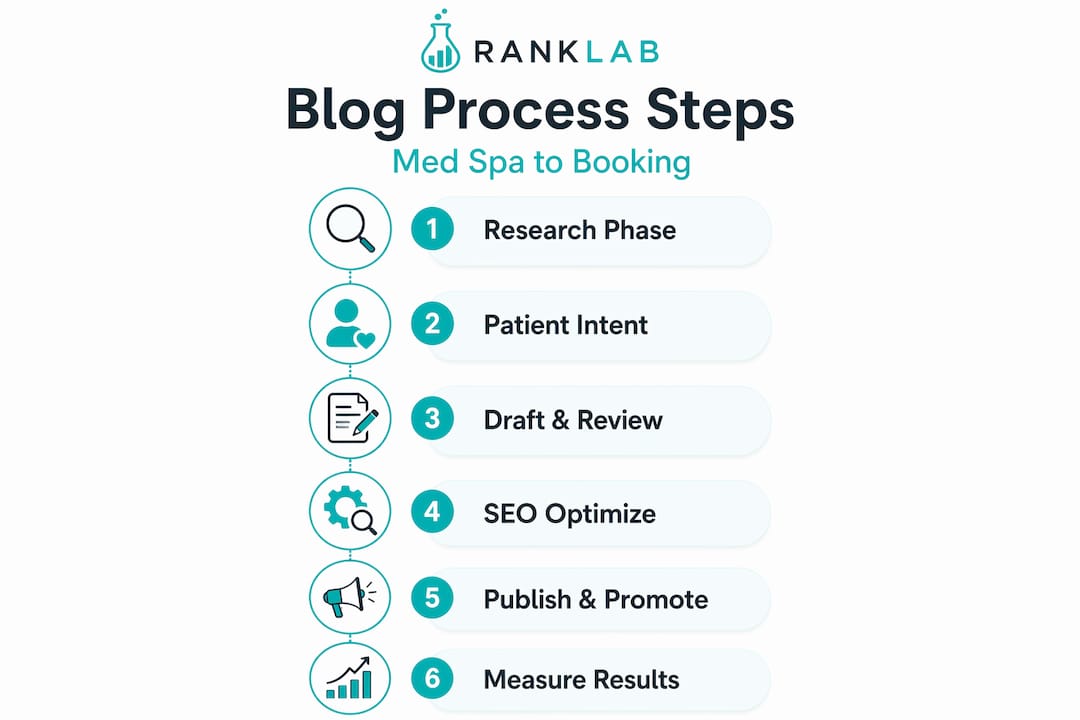
1. Research with patient intent in mind. Pull questions directly from Google’s “People Also Ask” section, your front desk’s most common inquiries, and patient consultation notes. These are real questions your readers have. Answer them specifically.
2. Draft with E-E-A-T built in from the start. Google treats healthcare content as YMYL (Your Money or Your Life), which means trust signals are non-negotiable for both rankings and patient conversion. Every post needs a visible author with credentials, citations to peer-reviewed or reputable medical sources, and language that’s both accurate and accessible to a non-clinical reader.
3. Structure for skimmability and SEO. Use H2 and H3 headings that mirror the questions patients ask. Break up content with short paragraphs. Include a clear introduction, a body that delivers on your headline’s promise, and a CTA that points to a treatment page or booking form.
4. Run your medical team review. A reliable content pipeline includes a draft phase, a provider review for clinical accuracy, evidence verification, and a final language check for patient accessibility. This step protects your practice legally and builds patient trust simultaneously.
5. Optimize before publishing. Add your target keyword in the title, first paragraph, one H2 heading, and the meta description. Include at least two internal links to relevant treatment pages. Internal linking to treatment pages builds topical authority and creates a direct path from educational content to conversion.
6. Add visuals and schema. Before/after images with proper consent labeling, infographics, and FAQ schema markup all contribute to both engagement and search visibility.
Pro Tip: Clinical experience makes for the most compelling content, but distance improves the narrative. If a provider recently handled an interesting patient scenario, wait four to eight weeks before writing about it. The perspective you gain turns a basic case summary into genuinely useful content.
A rotating content mix also prevents your blog from feeling repetitive. Covering education, trust building, objection handling, and decision support across your monthly calendar keeps different patient types engaged at different stages.
Publishing and promoting med spa blog content
Publishing without promotion is one of the most common mistakes in med spa content marketing. The moment you hit “publish” is the beginning of the work, not the end.
Your blog post has multiple lives beyond your website. Repurpose each post into:
- Social media content: Pull two or three key takeaways and turn them into Instagram carousels or short-form video scripts
- Email newsletters: Summarize the post with a single link back to the full article, driving warm traffic back to your site
- Google Business Profile posts: Share your blog content as a post update to boost local signals
- Local community forums or groups: Share genuinely helpful content where your patients spend time online
Timing matters more than most med spa owners realize. A post about summer skin prep should go live in March, not June. A “holiday party skin” piece should publish in early November. Aligning your schedule with seasonal patient demand captures search intent at peak volume.
Internal linking is where blogs either become part of a conversion system or stay as standalone content that never converts. Every blog post should link to at least one treatment page, your booking form, or a related service. Treatment pages that combine SEO structure with conversion elements are what turn curious readers into booked consultations.
| Distribution channel | Best content format | Patient engagement goal |
|---|---|---|
| Instagram/Facebook | Short tips, carousels, before/after posts | Awareness and trust building |
| Email newsletter | Post summaries with CTA links | Warm lead nurturing |
| Google Business Profile | Short updates linking to blog | Local SEO and visibility |
| Website blog | Long-form, SEO-optimized posts | Search ranking and conversion |
| YouTube/Reels | Video summaries of blog topics | Reach and brand credibility |
For social media strategy tied to your blog content, the med spa social media guide from Aestheticranklab offers specific tactics worth reading.
Measuring success and improving over time
Publishing consistently without measuring results is just hope as a strategy. Your blog needs a performance loop: publish, measure, adjust, repeat.
The metrics that actually matter for a med spa blog are:
- Consultation bookings from blog traffic: Set up goal tracking in Google Analytics to see which posts drive appointment requests
- Time on page: Posts where readers spend less than 60 seconds aren’t holding attention. Rewrite the introduction or restructure the content
- CTA click rate: If fewer than 2% of readers click your treatment page link or booking button, the CTA placement or language needs work
- Keyword ranking movement: Track the target keyword for each post and watch for movement over 60 to 90 days
- Return visitor rate: Readers who come back are developing trust. High return rates suggest your content is working as an authority signal
Update your top-performing posts every six to twelve months. Add new data, update procedure details, and refresh the internal links. Google’s Helpful Content updates reward content that stays current and genuinely serves reader needs.
One area med spas almost never address is connecting blog traffic to their consultation intake workflow. Blogs that fail to link to structured follow-up systems lose leads even when the content is excellent. Your blog post should point to a booking form that feeds into a CRM, which triggers a confirmation and reminder sequence. Without that, you’re generating interest with no way to capture it.
Pro Tip: Use patient FAQs from your consultation calls to find which blog topics reduce friction before the appointment. Posts that answer pre-consultation questions can cut no-show rates by warming up patients before they walk in the door.
My honest take on med spa blogging
I’ve worked with enough med spas to know where this almost always breaks down. It’s not the writing itself. It’s the isolation. A blog post treated as a standalone piece of content will always underperform compared to one embedded inside a larger patient journey system.
The practices that get real results from their blogs connect each post to a treatment page, feed the traffic into a booking workflow, and have a provider reviewing clinical content before it goes live. They also build E-E-A-T signals from day one by putting a real person’s credentials on every article.
What I’ve seen kill otherwise good content is the assumption that volume fixes everything. Writing four weak posts per month does less for you than writing one excellent post tied to your highest-converting treatment page. Quality with strategic placement will beat quantity every time. That’s not a popular take in a world where content agencies sell packages by the post, but it’s what the data consistently shows.
If I had one piece of advice for a med spa owner starting fresh: stop treating your blog like a marketing checkbox and start treating it like a patient education system that happens to rank on Google.
— Keith
How Aestheticranklab helps med spas build better blogs
At Aestheticranklab, we build content systems for med spas, not just one-off blog posts. Our process covers content calendar development, keyword research, E-E-A-T-compliant writing, medical review coordination, and full SEO optimization from the first draft to the final publish. Every blog we create is designed to connect to your treatment pages and booking workflow so traffic actually turns into consultations.
If your blog is generating traffic but not bookings, the problem is usually a disconnected system. Our med spa marketing automation services close that gap by linking your content to intake forms, CRM sequences, and consultation reminders. For practices starting from scratch, explore our med spa content ideas resource or connect with our team to build a custom blog strategy built around your specific treatments and patient base.
FAQ
How often should a med spa publish blog posts?
Most top-performing med spas publish two to four posts per month, balancing educational content with detailed treatment guides. Consistency and quality matter more than frequency.
What makes a med spa blog post rank on Google?
Posts that include E-E-A-T signals such as author credentials, citations, and updated information, along with proper keyword targeting and internal links to treatment pages, consistently outperform generic content.
How long should a med spa blog post be?
Educational posts typically perform well at 800 to 1,200 words, while treatment-specific guides benefit from 1,500 words or more to cover patient questions thoroughly.
Should med spa blogs always include a CTA?
Yes. Every post should include at least one call to action pointing to a booking form, treatment page, or consultation request. Without it, you are generating awareness with no conversion path.
How do I know if my med spa blog is actually working?
Track consultation bookings attributed to blog traffic in Google Analytics, along with CTA click rates and time on page. If posts are generating views but no bookings, your internal linking or CTA strategy needs adjustment.