
TL;DR:
- The med spa industry is a highly regulated, complex healthcare sector requiring understanding of legal, clinical, and operational ecosystems.
- Ownership models vary by state, with MSOs serving as a legal solution for non-physician involvement.
- Success relies on diversified services, strong marketing, compliance, and operational efficiency.
The med spa industry is bigger, more regulated, and more operationally complex than most new owners anticipate. With industry revenue exceeding $17B and growing by over a billion dollars annually, this is no longer a niche corner of the beauty world. It is a full-scale medical services sector with legal structures, staffing hierarchies, compliance mandates, and marketing demands that rival any healthcare vertical. If you are running or planning a med spa, understanding the entire ecosystem, not just the treatments you offer, is what separates sustainable businesses from ones that stall out within two years.
Table of Contents
- What is the med spa ecosystem?
- Ownership, structure, and regulation explained
- Operational essentials: Services, staffing, and supply chain
- Profitability benchmarks and marketing strategies
- Compliance and evolving industry trends
- Why most med spa owners misunderstand the ecosystem—and how to get ahead
- Take your med spa to the next level with expert support
- Frequently asked questions
Key Takeaways
| Point | Details |
|---|---|
| Med spa ecosystem overview | The med spa ecosystem includes regulatory, operational, and marketing elements, not just treatments. |
| Ownership and MSO models | Legal structures and MSO models determine who can own and operate med spas in most states. |
| Profitability benchmarks | High-performing med spas achieve 15-25% net margins, with average revenues between $1.2M and $2.5M. |
| Operational best practices | Balanced service mix, effective staffing, and vendor management are key for stability and profit. |
| Compliance and trends | Staying ahead requires attention to federal/state regulations and adoption of the latest industry trends such as MSOs and AI-driven marketing. |
What is the med spa ecosystem?
The word “ecosystem” gets thrown around loosely, but in the med spa context it has a precise meaning. It refers to the full web of interrelated legal, operational, clinical, and business elements that must function together for a med spa to operate legally and profitably. Pull one thread and others unravel. Ignore compliance and your clinical operations are at risk. Underinvest in marketing and your best service mix goes unseen.
Med spas are regulated as medical entities under physician oversight delivering non-invasive and minimally invasive treatments. That single fact changes everything. Unlike a day spa or salon, a med spa cannot simply hire an esthetician and open its doors. There are licensing requirements, physician oversight mandates, treatment delegation rules, and federal agency oversight that all apply before a single syringe is uncapped.
The core components of the med spa ecosystem include:
- Legal structure: How the business is owned, who holds the medical license, and how liability is managed
- Staffing: Credentialed clinical staff, medical directors, and front-of-house teams working within scope-of-practice rules
- Service mix: The specific treatments offered and how they are priced and positioned
- Patient acquisition: Marketing, reputation, and lead generation systems that fill your schedule
- Compliance: Ongoing adherence to state and federal regulations that govern every clinical decision
“A med spa is not a spa with medical equipment. It is a medical practice with an aesthetic focus. Owners who internalize that distinction build businesses that last.”
Understanding these layers helps you make smarter decisions across every function. Whether you are thinking about boosting med spa sales or building a recognizable brand through digital branding for med spas, the ecosystem is the foundation everything else rests on.
Ownership, structure, and regulation explained
One of the most misunderstood areas in the med spa world is ownership. Who can legally own a med spa depends heavily on your state, and getting this wrong is not just a paperwork problem. It can result in forced closure.

Ownership structures include single-owned, group-owned, and PE-owned models, with Corporate Practice of Medicine (CPOM) laws restricting non-physician ownership in many states. CPOM exists to prevent business interests from overriding clinical judgment. In states like California and Texas, these rules are especially strict. In others, there is more flexibility, but the legal landscape shifts frequently.
The Management Services Organization (MSO) model has emerged as a practical solution. An MSO is a separate business entity that handles non-clinical operations, like marketing, HR, billing, and facilities, while the physician-owned medical practice retains clinical control. This allows non-physicians to participate in ownership of the business side without violating CPOM laws.
The market itself is still highly fragmented. About 81% of med spas are single-location operations, while private equity accounts for roughly 3% but is growing fast as consolidation accelerates.
| Ownership model | Typical size | Pros | Cons | Regulation exposure |
|---|---|---|---|---|
| Independent | 1 location | Full control, agile | Capital constrained | High, owner-managed |
| Franchise | 1-5 locations | Brand support, systems | Royalties, less flexibility | Moderate, franchisor-guided |
| PE-backed | 5+ locations | Capital, scale | Loss of autonomy | High, complex |
| MSO-enabled | Varies | Non-MD participation | Legal complexity | Moderate to high |
Pro Tip: Before adopting any ownership structure, consult a healthcare attorney who specializes in your state. CPOM rules vary widely, and what works in one state can be illegal in another. This is not an area to figure out through trial and error.
Your ownership model also shapes your digital branding strategy. A PE-backed group needs consistent brand standards across locations. An independent owner needs to build local trust and differentiation from scratch.
Operational essentials: Services, staffing, and supply chain
Once ownership and structure are sorted, day-to-day operations become the engine of your business. Key operational components include treatments such as injectables (the top revenue driver), energy-based devices, and esthetician services, all supported by staffing, marketing systems, and membership programs.
Your staffing structure follows a clinical hierarchy. The medical director provides oversight and holds ultimate clinical responsibility. Nurse practitioners and physician assistants perform advanced treatments. Registered nurses handle injections in many states. Estheticians deliver skincare, facials, and non-medical services. Each role has a defined scope of practice, and crossing those lines creates serious legal exposure.
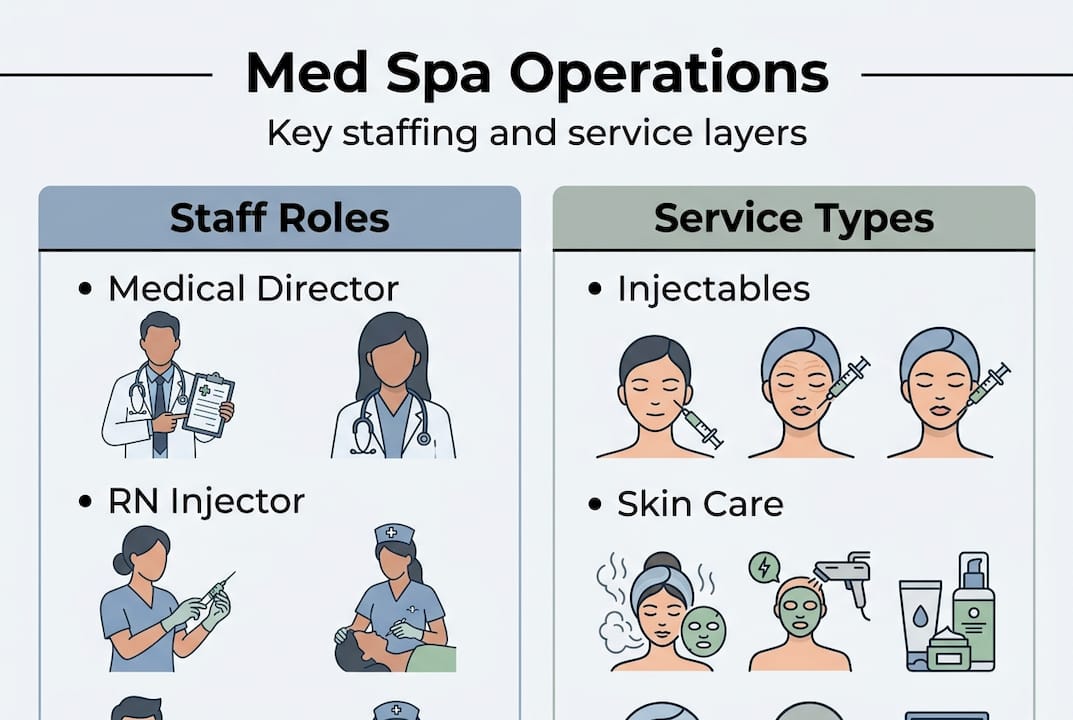
Service mix matters more than most owners realize. Injectables like neurotoxins and dermal fillers tend to be high-margin gateway services that bring clients in and keep them coming back. Energy devices (laser, RF, body contouring) require significant capital investment but command premium pricing. Wellness and skincare services round out the menu and support membership retention.
On the supply chain side, COGS typically run 30 to 40% of revenue, making vendor relationships and product mix critical to profitability. Locking into a single vendor without negotiating volume discounts is a common margin killer.
| Operational metric | Benchmark range |
|---|---|
| Payroll as % of revenue | 30 to 35% |
| Supply chain COGS | 30 to 40% |
| Average revenue per visit (ARPV) | $250 to $500 |
| Membership retention rate | 60 to 80% |
Pro Tip: Never let any single service category exceed 40% of your total revenue mix. Service diversification is not just a growth strategy. It is a risk management tool that protects your business when demand shifts.
Strong client engagement strategies and consistent lead generation ideas are what keep that service mix fully booked.
Profitability benchmarks and marketing strategies
Knowing your numbers is non-negotiable in a business with this cost structure. Average med spa revenue runs $1.2M to $2.5M annually, with net margins of 15 to 25% for top performers. Payroll typically sits at 30 to 35% of revenue, and breakeven is achievable within three months for well-run operations with monthly costs around $64,000.
Marketing is where many owners underinvest or spend without a clear system. Modern med spa marketing is not just social media posts and before-and-after photos. It is a structured funnel that includes digital advertising, local SEO, reputation management, membership conversion, and increasingly, AI-driven analytics to optimize spend and patient acquisition costs.
AI and data analytics tools are reshaping how top med spas identify leads, personalize outreach, and determine the optimal service mix for their market. Owners who adopt these tools early are building a compounding advantage over competitors still relying on word of mouth.
Four essentials to marketing ROI in a med spa:
- Clarity in spend: Know your cost per lead and cost per acquisition before scaling any channel
- Data-driven channels: Prioritize platforms where your target demographic actually books, not just browses
- Ongoing engagement: Memberships and email sequences keep existing clients active between visits
- Reputation management: Reviews and online reputation directly influence conversion rates for new patients
“The med spas that outperform in down cycles are the ones that keep investing in marketing while competitors pull back. Visibility compounds. Silence costs.”
Strong reputation management and a clear plan to boost med spa sales should be formalized in your annual med spa marketing budget, not treated as optional line items.
Compliance and evolving industry trends
Compliance is not a one-time checkbox. State medical and nursing boards govern who can perform what treatments, how delegation must be documented, and what physician oversight looks like in practice. Federal agencies including the FDA, DEA, and OSHA add another layer covering drug handling, device safety, and workplace standards.
Surging demand and rising PE investment are also reshaping the regulatory conversation, with states updating delegation rules and oversight requirements as the industry scales.
Top trends shaping the ecosystem right now:
- MSO model adoption is accelerating as non-physicians seek compliant entry points
- AI and analytics are moving from novelty to operational standard
- Service diversification into wellness and longevity is expanding the client base
- M&A activity and rising valuations are attracting institutional capital
Stay current with board guidance in your state and use martech for med spas to keep your systems compliant and competitive as rules evolve.
Why most med spa owners misunderstand the ecosystem—and how to get ahead
Here is something we see repeatedly: owners who invest heavily in the latest laser technology or a stunning rebrand, but have not reviewed their ownership structure with a healthcare attorney or built a real financial model. They are optimizing the surface while the foundation has cracks.
The businesses that dominate this industry treat their med spa as a medical business first. Marketing is a formal function with a budget, a strategy, and measurable KPIs. Compliance is reviewed quarterly, not reactively. Financial benchmarks are tracked monthly, not discovered during tax season.
Most industry content tells you to focus on your service menu and your Instagram feed. That advice is not wrong, but it is incomplete. Real success comes when you think of your med spa as a medical business first, not just an aesthetic service. The digital branding for med spas conversation only becomes powerful when it sits on top of a legally sound, operationally efficient business.
Step back and map your operation across legal, financial, marketing, and clinical layers. Find the weakest link. That is where your next growth opportunity is hiding.
Take your med spa to the next level with expert support
![cta_image]
Understanding the med spa ecosystem is the first step. Executing across every layer of it is where most owners need a partner. At Aesthetic Brink Lab, we work exclusively with med spas to build marketing systems that generate consistent leads, protect and grow your reputation, and drive local visibility where it counts. From lead generation for med spas to reputation management solutions and med spa local SEO, we bring the full ecosystem approach to your marketing. Let us help you turn what you have learned here into measurable growth.
Frequently asked questions
Who can legally own a med spa in the US?
Ownership rules vary by state, but physician ownership is generally required due to Corporate Practice of Medicine laws. CPOM restricts non-MD ownership, though MSO models allow non-physicians to manage business operations while keeping clinical control with a licensed physician.
What are the core profit drivers for most med spas?
Profit comes primarily from high-margin services like injectables and recurring revenue from memberships, with careful control of payroll and supply costs. Injectables and memberships drive the most consistent revenue, while net margins of 15 to 25% are achievable for well-run operations.
Which regulatory agencies oversee med spas?
Med spas are regulated by state medical and nursing boards and must comply with federal agencies including the FDA, DEA, and OSHA, each covering different aspects of clinical and operational practice.
How soon can a new med spa break even?
Some med spas reach breakeven within three months when operational costs around $64,000 per month are managed efficiently alongside consistent marketing investment from day one.
How does the MSO model work in the med spa industry?
An MSO separates clinical and business operations, allowing non-physicians to own and manage the business side while a licensed physician retains clinical oversight, keeping the structure legally compliant in CPOM states.