
TL;DR:
- CRMs centralize client data and automate follow-up to boost retention and revenue.
- Essential CRM features include scheduling, reminders, personalized marketing, and loyalty tracking.
- Proper implementation and staff training are key to maximizing CRM benefits and avoiding common mistakes.
Most med spas lose clients not because of bad treatments, but because of disorganized follow-up and zero personalization after the first visit. A client who felt great after her Botox session will quietly book with a competitor if nobody reaches out. That gap between service and relationship is exactly where a CRM, short for Customer Relationship Management software, steps in. This guide breaks down what CRMs do, which features matter most for med spas, how they directly improve retention and revenue, and the mistakes you need to avoid before spending a single dollar on software.
Table of Contents
- What is a CRM, and why does it matter for med spas?
- Key CRM features every med spa should prioritize
- How CRMs boost client retention and satisfaction
- Common CRM mistakes med spas make—and how to avoid them
- Our perspective: What most med spas overlook with CRM success
- Ready to level up your med spa with the right CRM?
- Frequently asked questions
Key Takeaways
| Point | Details |
|---|---|
| CRM is a growth engine | Smart CRM use helps med spas keep more clients and increase profits. |
| Prioritize essential features | Focus on appointment scheduling, reminders, and personalized marketing for best results. |
| Avoid common pitfalls | Team training and choosing the right system are critical for CRM success. |
| Personalization drives loyalty | CRMs enable med spas to surprise and delight clients, leading to stronger reputations. |
What is a CRM, and why does it matter for med spas?
A CRM is software that centralizes every interaction you have with a client. Contact details, treatment history, communication preferences, appointment notes, and purchase records all live in one place. Instead of scattered spreadsheets and sticky notes, your team works from a single source of truth.
Med spas operate in a uniquely competitive space. Clients have dozens of options within driving distance, and loyalty is fragile. One missed follow-up or a generic email blast can push someone toward a competitor who feels more attentive. CRM software boosts client retention by an average of 27%, which translates directly into recurring revenue without spending more on ads.
Here is what a CRM actually does for your med spa on a daily basis:
- Centralizes client data so every staff member sees the same complete profile
- Automates follow-up messages after treatments, reducing manual workload
- Segments clients by treatment type, visit frequency, or spending level
- Sends personalized offers based on past behavior, not guesswork
- Tracks appointment history so upsell conversations feel natural, not pushy
- Manages loyalty rewards to keep high-value clients engaged between visits
Generic CRMs built for retail or real estate often miss the nuances of aesthetic medicine. You need fields for treatment protocols, consent tracking, and before/after photo management. Pairing your CRM with strong targeting med spa clients strategies means you are not just capturing leads, you are nurturing them intelligently.
Pro Tip: Before demoing any CRM, write down the top five tasks your front desk handles manually every week. If the CRM cannot automate at least three of them, keep looking.
The right CRM does not just organize data. It turns passive client records into active revenue opportunities. That shift from reactive to proactive is what separates growing med spas from stagnant ones.
Key CRM features every med spa should prioritize
Not all CRMs are built equal, and feature bloat is a real problem. A platform loaded with modules your team will never use creates confusion and slows adoption. Focus on the features that directly affect client experience and operational efficiency.
Essential features to look for:
- Smart scheduling integration that syncs with your booking system and flags gaps or double-bookings
- Automated appointment reminders via text and email, because no-shows drop by up to 38% with automated reminders in place
- Client notes and treatment history accessible at the point of service
- Segmentation tools to group clients by treatment, frequency, or lifetime value
- Personalized marketing automation for birthday messages, seasonal promotions, and recall campaigns
- Loyalty and rewards tracking to incentivize repeat visits
Here is a quick comparison to help you evaluate your options:
| Feature | Generic CRM | Med Spa CRM |
|---|---|---|
| Appointment scheduling | Basic calendar | Integrated booking with service types |
| Client notes | General text fields | Treatment-specific templates |
| Marketing automation | Broad email blasts | Segmented, behavior-based campaigns |
| Loyalty programs | Rarely included | Built-in rewards tracking |
| HIPAA compliance support | Often missing | Typically included |
| Before/after photo storage | Not available | Standard feature |
When you sit down for a CRM demo, treat it like an interview. Ask the vendor to walk through a scenario where a client books a filler treatment, receives a follow-up message three days later, and gets a recall reminder at the six-week mark. If they cannot demo that workflow smoothly, the system probably cannot execute it reliably.
Avoid platforms that require custom development just to send a birthday message or pull a simple report. Complexity is the enemy of adoption. Pairing a capable CRM with strong lead generation for med spas means your pipeline and your retention engine work together instead of pulling in different directions.
How CRMs boost client retention and satisfaction
Knowing what to look for, it is essential to see the real return from CRMs in daily med spa operations. The numbers tell a clear story.
| Metric | Before CRM | After CRM |
|---|---|---|
| No-show rate | 18-22% | 8-12% |
| Client retention at 12 months | 42% | 61% |
| Average upsell per visit | $35 | $78 |
| Recall campaign response rate | 9% | 27% |
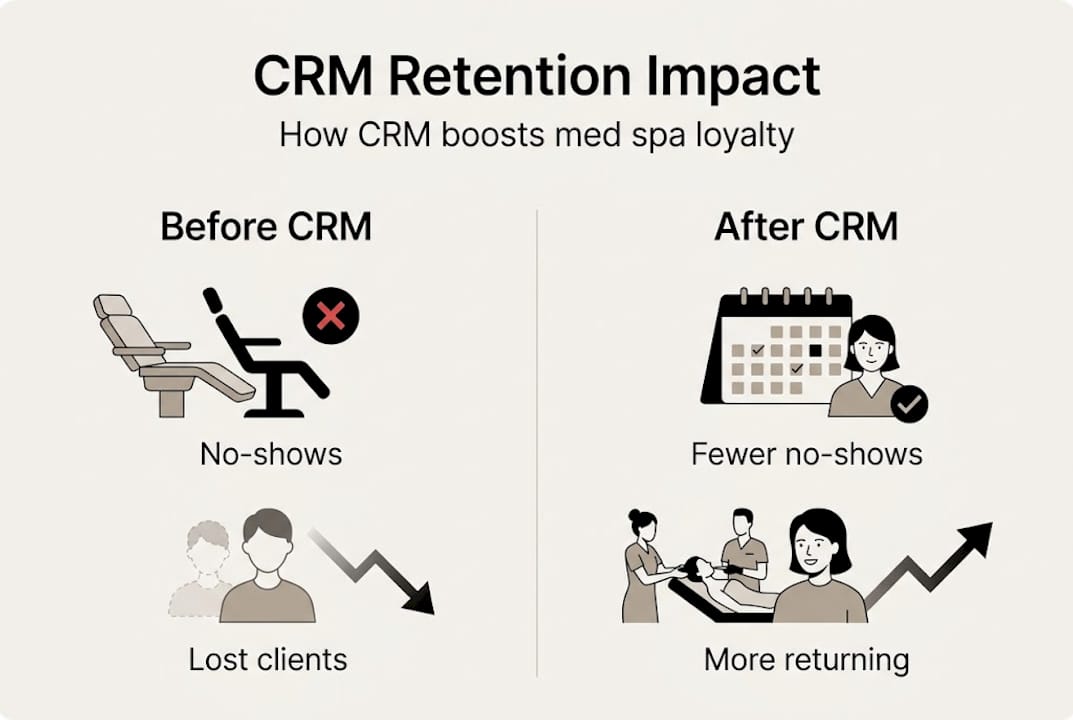
Those numbers are not theoretical. They reflect what happens when your team stops relying on memory and starts relying on systems. CRMs can increase average client lifetime value by up to 25%, which means every retained client is worth significantly more over time.
Here are practical ways to use CRM data for personalized touchpoints:
- Send a check-in message 48 hours after a new treatment to ask how the client is feeling
- Flag clients who have not visited in 90 days for a targeted win-back offer
- Identify your top 10% spenders and create a VIP tier with early access to new services
- Use treatment history to suggest complementary services at the right moment
- Automate review requests after positive post-treatment interactions
“Clients return for service, but stay for connection. CRMs build that connection at scale.”
Consistent CRM-driven engagement also strengthens your reputation. When clients feel remembered and valued, they talk about it. Strong reputation management for med spas starts with the experience inside your practice, and CRMs make that experience repeatable. Combining this with smart client engagement strategies creates a flywheel where happy clients generate reviews, referrals, and repeat bookings.
Common CRM mistakes med spas make—and how to avoid them
While the upside with CRMs is high, there are avoidable traps that med spas should be aware of. The technology is only as good as the team using it.
-
Overcomplicated setup. Choosing a platform with too many features leads to paralysis. Start with core functions: scheduling, reminders, and client notes. Expand from there once the team is comfortable.
-
Lack of staff buy-in. 40% of CRM adoption failures stem from poor staff training. If your front desk does not understand why the system matters, they will work around it instead of with it.
-
Ignoring customization. Using default templates and generic messages defeats the purpose. Spend time customizing communication to reflect your brand voice and your clients’ actual treatment history.
-
Poor data entry habits. A CRM is only as useful as the data inside it. Inconsistent or incomplete records create gaps that break automation and make personalization impossible.
-
Neglecting follow-up workflows. Setting up the CRM and then forgetting to review campaign performance is a common trap. Schedule a monthly review to check open rates, no-show trends, and recall success.
For each of these pitfalls, the fix is simpler than it sounds. Create a short standard operating procedure for each workflow, laminate it, and post it at the front desk. Strong client engagement content paired with a well-run CRM creates a consistent experience that clients notice and remember.
Pro Tip: Allocate at least two hours of onboarding time per staff member, not just a quick walkthrough. Role-play real client scenarios inside the CRM before going live. This single investment prevents months of frustration.
Also, do not assume the most expensive platform is the best fit. A right-sized CRM that your team actually uses beats a feature-rich system collecting digital dust. Explore geotargeting for med spas as a complement to your CRM so your outreach reaches the right people in your local market.
Our perspective: What most med spas overlook with CRM success
After working closely with med spa owners across the country, one pattern stands out clearly. Most practices set up their CRM for automation and call it done. Reminders go out, recall emails fire, and the team feels like the system is working. But they are leaving the most valuable layer untouched.
The real power of a CRM is not in sending more messages. It is in identifying your highest-value clients and treating them differently. Tag your repeat Botox clients. Flag the people who refer friends. Identify who spends above a certain threshold each quarter. Then create a separate communication track for that group, one that feels personal, exclusive, and genuinely appreciative.
We have seen med spa owners use simple CRM tags to turn loyal clients into vocal brand ambassadors. A handwritten note triggered by a CRM milestone, a surprise upgrade on a visit, an early invitation to a new service launch. None of that requires an expensive platform. It requires intention.
Contrary to popular belief, a simpler CRM used consistently outperforms a complex one used poorly. The med spa case studies that show the strongest retention gains are almost never about the fanciest software. They are about teams who treat the CRM as a relational tool, not a task manager.
Ready to level up your med spa with the right CRM?
Choosing and optimizing a CRM is one important pillar of a strong med spa growth strategy, but it works best when supported by the right marketing infrastructure around it. At Aesthetic Rank Lab, we help med spas build systems that attract, convert, and retain clients at every stage. From lead generation strategies that fill your pipeline to reputation management services that protect and grow your brand, our team understands the unique demands of the aesthetic industry. We also help you get found locally through local SEO for med spas so the right clients find you first. Reach out and let us help you build a CRM-powered growth engine that actually works.
Frequently asked questions
How does a CRM help increase med spa profits?
A CRM increases profits by improving client retention, automating marketing, and enabling more upsells through targeted communication. CRM software boosts retention by an average of 27%, which directly grows recurring revenue without increasing ad spend.
What is the biggest CRM mistake for med spas?
The most common mistake is failing to train staff, which leads to poor adoption and wasted investment. 40% of CRM failures trace back to inadequate onboarding rather than software limitations.
Does every med spa need a specialized CRM system?
While not required, CRM systems tailored for med spas often save time and deliver better outcomes versus generic platforms. CRM software in healthcare consistently boosts client satisfaction scores compared to one-size-fits-all tools.
How do I know if my med spa has outgrown its CRM?
If your system cannot personalize messaging, automate reminders, or integrate easily with your booking tools, it is time to upgrade. A CRM that creates more manual work than it saves is no longer an asset.