
TL;DR:
- Local partnerships generate warm referrals at lower costs than paid ads.
- Focus on aligned businesses with strong reputation, professionalism, and mutual value.
- Successful partnerships require giving first, clear proposals, compliance checks, and tracking results.
Running paid ads is expensive, and the returns are shrinking. The average cost per lead for aesthetic services has climbed steadily, pushing many med spa owners to look for smarter, lower-cost ways to fill their books. Local partnerships are one of the most underused growth channels in the industry. When done right, they generate warm referrals from trusted sources, build community credibility, and cost a fraction of what you’d spend on Google or Meta ads. This article gives you a practical framework for evaluating partners, a list of high-impact partnership types, and a step-by-step approach to structuring proposals that actually get a yes.
Table of Contents
- How to evaluate potential med spa partners
- Top local partnership ideas for med spas
- How to structure med spa partnership proposals
- Comparing partnership approaches: Local vs. digital & vendor
- Why most med spa partnerships fail (and how to avoid it)
- Leverage expert support to maximize med spa partnerships
- Frequently asked questions
Key Takeaways
| Point | Details |
|---|---|
| Partnership selection criteria | Choose partners with demographic and brand alignment to maximize referral value without compliance risk. |
| Top local partnership types | Gyms, salons, yoga studios, and nonprofits offer the greatest client-sharing potential for med spas. |
| Proposal structure and tracking | Pitch clear, mutually beneficial arrangements and pair partnerships with tracking systems for measurable results. |
| Compliance essentials | Avoid fee-splitting; work with your medical director to ensure all partnerships meet legal standards. |
| Local vs. digital strategies | Local partnerships build trust quickly, while digital approaches scale faster but cost more. |
How to evaluate potential med spa partners
Not every local business is a good fit for your med spa. The fastest way to waste time and goodwill is to partner with a business whose clients have nothing in common with yours. Before you approach anyone, run through a quick evaluation process.
Here are the key criteria to assess any potential partner:
- Demographic alignment: Does the business serve people who care about appearance, wellness, or self-improvement? A high-end fitness studio is a natural fit. A discount tire shop is not.
- Client experience quality: Your brand is on the line with every referral. Overlapping demographics and environments should be the first filter you apply. If a partner’s clients walk out of a sloppy experience, that reflects on you.
- Professionalism and reputation: Check their reviews. Visit the location. If you wouldn’t send your best client there, don’t partner with them.
- Mutual benefit: A good partnership creates value for both sides. Think about what you bring to the table, not just what you want to gain. Can you cross-promote on social? Co-host an event? Offer exclusive pricing for their clients?
- Compliance awareness: This is non-negotiable. Avoid fee-splitting or revenue-sharing arrangements, and always loop in your medical director to review state-specific rules before formalizing anything.
Compliance deserves extra attention. Many well-meaning partnerships cross legal lines without anyone realizing it. Paying a gym a flat fee per referred client, for example, can be considered illegal fee-splitting in many states. Structure your partnerships around referral exchanges, co-branded events, and educational outreach instead.
You also want to think about how a partnership supports your broader visibility. If you’re building local SEO for med spas, a local partner who mentions you on their website or social channels adds real value beyond just foot traffic.
Understanding who you’re targeting as med spa clients makes it much easier to identify the right partners from the start.
Pro Tip: Start with one new partnership per month. It keeps the process manageable and lets you measure results before scaling.
Top local partnership ideas for med spas
With evaluation criteria in mind, here are partnership ideas med spas can implement for maximum impact. Local partnerships for med spas include fitness centers, salons, cosmetic dentists, juice bars, coffee shops, yoga studios, breweries, boutiques, and nonprofits. Each category brings something different to the table.
- Gyms and fitness centers: These clients already invest in their bodies and appearance. A partnership here gives you access to a highly motivated audience. Offer to host a lunch-and-learn about body contouring or skin treatments for their members.
- Hair salons and cosmetic dentists: The overlap is obvious. Clients sitting in a salon chair for two hours are already thinking about how they look. Leave branded cards, offer a referral discount, or co-host a “glow-up” event.
- Yoga studios: The calm, wellness-focused vibe of a yoga studio aligns closely with the experience most med spas want to create. These clients value mindfulness and self-care, making them ideal prospects.
- Juice bars and coffee shops: These are community hubs. A co-branded wellness event or a simple flyer display at the counter can introduce your brand to hundreds of locals weekly.
- Boutiques: Upscale clothing boutiques serve clients who care about their appearance and have disposable income. A joint event like a “style and glow” night creates buzz for both businesses.
- Nonprofits: Sponsoring or volunteering with a local nonprofit builds goodwill and gets your name in front of engaged community members who trust the organization endorsing you.
The best partnerships feel effortless because both brands are already speaking to the same person. Match your messaging, your visual tone, and your values before you match your calendars.
Pro Tip: Before you pitch a partnership, attend one of their events or visit their location. You’ll have better conversations and spot alignment issues early.
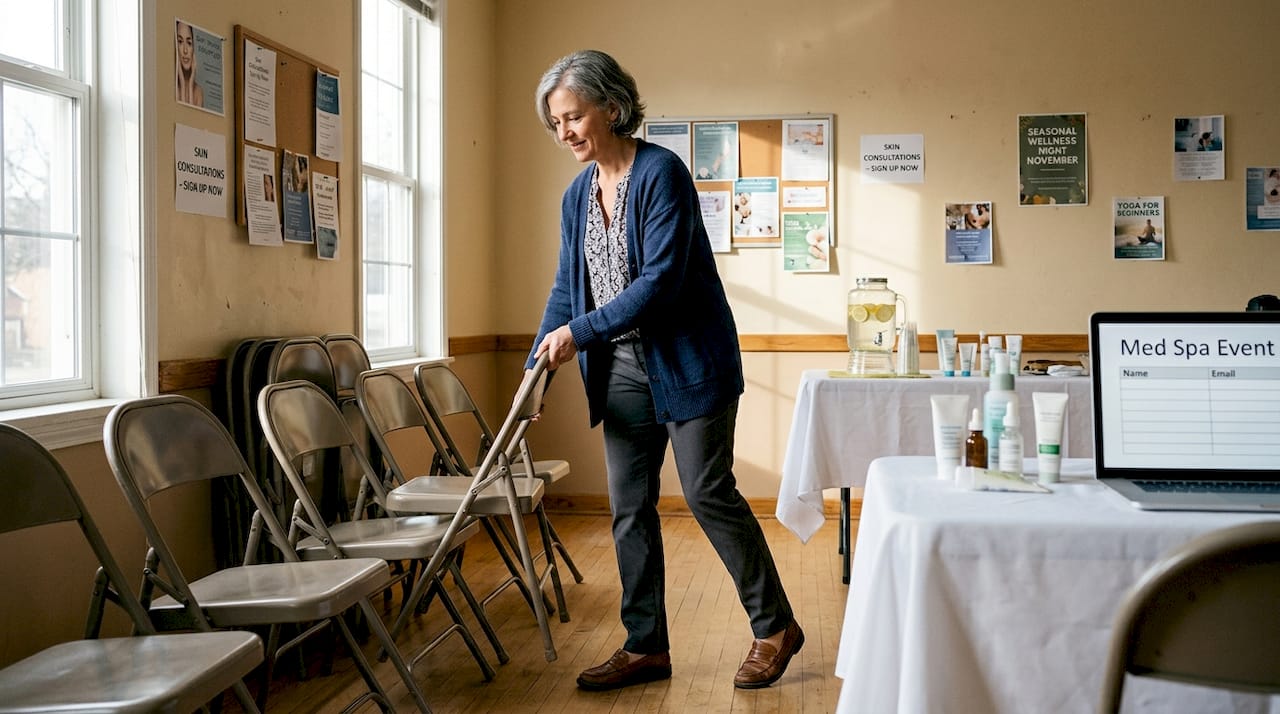
For event ideas for med spas that work well in a co-branded context, think wellness nights, skin consultations, or seasonal treatment showcases. Pair these with local geotargeting tactics to amplify reach before and after the event.
How to structure med spa partnership proposals
Once you select target partners, the next step is crafting a proposal that gets buy-in and keeps you compliant. A vague “let’s work together” message rarely converts. A clear, specific proposal does.
Here’s a practical step-by-step approach:
- Step 1: Make contact personally. A warm introduction beats a cold email every time. Visit in person, attend their events, or get a mutual introduction through your network.
- Step 2: Educate before you pitch. Most local business owners don’t fully understand what a med spa does. Spend five minutes explaining your services, your clients, and what makes your practice different.
- Step 3: Clarify compliance upfront. Be transparent that you can’t pay per referral, but you can create genuine mutual value through events, cross-promotion, and shared content.
- Step 4: Propose a specific first step. Don’t ask for a long-term commitment. Suggest one co-branded event or a 30-day referral card exchange to test the relationship.
Education-based outreach, clear proposals, and referral exchange systems with tracking codes are the mechanics that make partnerships work over time. Use unique booking codes for each partner so you can attribute new clients accurately.
Here’s a sample framework to guide your proposals:
| Partner type | Event format | Compliance focus | Expected outcome |
|---|---|---|---|
| Fitness center | Body contouring workshop | No revenue share | 10-15 new leads |
| Hair salon | Skin care demo night | Referral card only | 5-10 warm referrals |
| Yoga studio | Wellness and glow evening | Educational only | Brand awareness + bookings |
| Boutique | Style and skin event | Co-branded, no kickbacks | Social media reach + leads |
| Nonprofit | Sponsorship or donation | No client payment exchange | Community trust + visibility |
Strong reputation management practices become even more important when you’re co-branding with local partners. And investing in visual content strategies for event recaps and social posts helps you get more mileage from every partnership activation.
Comparing partnership approaches: Local vs. digital & vendor
Having seen how to pitch and structure, let’s examine how local partnerships stack up against other approaches. Not every strategy fits every stage of growth, so it helps to understand the tradeoffs clearly.
Partnerships build trust faster and cheaper than ads but require oversight. Digital strategies offer scalability but at higher costs. Vendor partnerships tend to prioritize profit through consolidation and kickbacks rather than genuine client acquisition.
| Approach | Trust level | Cost | Scalability | Risk |
|---|---|---|---|---|
| Local partnerships | High | Low to medium | Moderate | Compliance risk |
| Digital advertising | Medium | High | High | Ad fatigue, rising CPL |
| Vendor partnerships | Low | Variable | Low | Misaligned incentives |
| Referral programs | High | Low | Moderate | Tracking complexity |
Here’s what each approach does well and where it falls short:
- Local partnerships: Generate warm, high-trust leads at low cost. Require time investment and careful compliance management. Best for community-rooted growth.
- Digital advertising: Reach large audiences quickly. Costs are rising and results can be inconsistent without expert management. Best for scaling fast when budget allows.
- Vendor partnerships: Can provide product discounts or co-marketing support, but the incentives are rarely aligned with your client’s best interest. Approach with caution.
The most effective med spas combine all three, but local partnerships are often the best place to start because they build the kind of trust that no ad budget can buy. Explore lead generation strategies that blend both local and digital approaches, and look at sales boosting methods that turn new referrals into long-term clients.
Why most med spa partnerships fail (and how to avoid it)
Before launching your next partnership, here’s a perspective you won’t find in most guides. Most med spa partnerships fail not because the idea was bad, but because the execution was rushed and the alignment was assumed rather than confirmed.
Owners get excited, shake hands with a gym owner, drop off some flyers, and then wonder why nothing happened. The problem is that a stack of brochures is not a partnership. It’s a one-sided ask.
The real shift happens when you give first to the partner before you expect anything in return. Promote their business to your email list. Feature them on your social channels. Show up to their events. That kind of generosity builds the trust that makes referrals flow naturally.
Compliance is the other silent killer. Skipping the conversation with your medical director because a deal feels informal is how good intentions turn into legal exposure. Every partnership, no matter how small, should be reviewed for fee-splitting risk.
Finally, track everything. Use booking codes. Use referral intake questions. Without data, you can’t tell which partnerships are working and which are just taking up your time. Check out these engagement ideas to keep partner-referred clients coming back after their first visit.
Leverage expert support to maximize med spa partnerships
Ready to put these partnership ideas to work for your med spa? Local partnerships are powerful, but they work best when your digital presence is set up to capture and convert the traffic they generate. At Aesthetic Brink Lab, we help med spas build the systems that turn referrals into booked appointments. From lead generation for med spas to local SEO services that make you easy to find when a partner’s client searches for you, we handle the digital side so you can focus on building relationships. Our social media management team can also help you amplify every partnership event and keep your brand visible between activations.
Frequently asked questions
What types of businesses are best for med spa partnerships?
Fitness centers, salons, cosmetic dentists, juice bars, coffee shops, yoga studios, boutiques, and nonprofits offer the strongest overlap with med spa clientele because they share a wellness and appearance-focused audience.
How do I avoid compliance issues in local partnerships?
Structure partnerships around educational events or referral exchanges, and consult your medical director to prevent fee-splitting risks before formalizing any agreement.
What are the first steps to launching a med spa partnership?
Identify businesses with shared demographics, educate their staff about your services, and create a clear proposal. Education-based outreach and referral systems are the most effective starting points.
How do I track partnership referrals for my med spa?
Use unique booking codes and intake questions for each partner. Tracking with booking codes lets you measure which partnerships are actually driving new clients so you can double down on what works.